Call to Action – LAURA AND THE SHADOW KING – Chapter 1

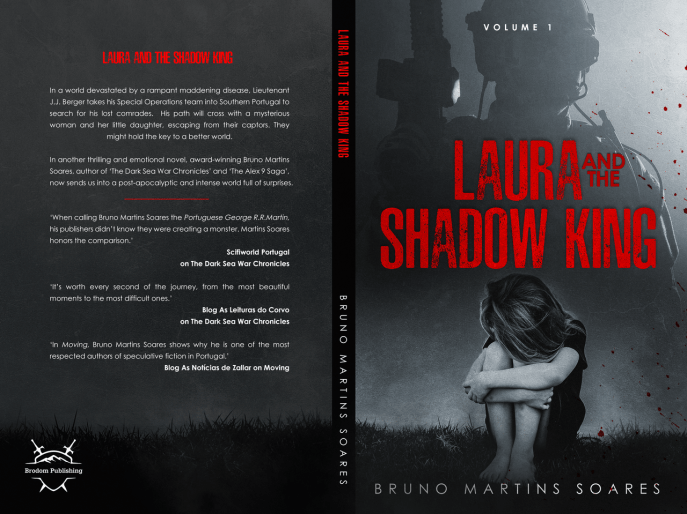
My friends, on February 9, 2019, I will be launching the first volume of my new novel LAURA AND THE SHADOW KING at Amazon. It’s a kind of zombie-apocalypse military action thriller with an emotional side to it, as usual. Here’s the blurb:

In a world devastated by a rampant maddening disease, Lieutenant J.J. Berger takes his Special Operations team into Southern Portugal to search for his lost comrades.  His path will cross with a mysterious woman and her little daughter, escaping from their captors. They might hold the key to a better world.

Today, I start a new phase, that of recruiting my Launch Team. The team is made up of volunteers that will receive the whole book a month in advance and complete tasks like: download it for free when the time comes and post an honest review at the Amazon book page. Anyone willing to do that, please subscribe to the Launch Team list by clicking here:

 LAUNCH TEAM LIST.

For now, let me give you a taste of the book. In three posts I will be showing you the Introduction (Chapter 0), Chapter 1 and Chapter 2. They are all independent – you can read them as you wish. I hope you like it!


LASK1

***

LAURA AND THE SHADOW KING

1.

For a second it felt like paradise. Maybe more than a second. I could feel the sun burning against my skin and the breeze taking away the heat, and the sea chanting nearby. I’d taken a swim in the Atlantic Ocean a few minutes before and felt the salt drying on me. The fresh Coke in my hand took care of the thirst. I looked around. The island was like a mountain in the middle of the sea. It was green and lush. The city crouched against the amphitheater-like geography, culminating on the harbor down where all the vessels rested in safety. The sky was clear and the sea was calm. The island didn’t have many beaches, but the pontoons around the bay allowed us to dive and swim in the open sea.

Madeira Island used to be Portuguese. It surged out of the Atlantic Ocean at about the same latitude as Casablanca, eight hundred miles southwest of Lisbon. Its remoteness had spared her three hundred thousand peaceful inhabitants, but now another two hundred thousand or so not-so-gentle folk were squeezed in with them.

‘LT?’

I looked over my sunglasses at the orderly in fatigues.

‘LT, you’re called to Major Dalton, sir.’

I sighed. I was supposed to have the whole week to myself. It hadn’t lasted two whole days.

‘ASAP, sir,’ continued the young man.

‘Has a nuclear bomb fallen somewhere?’

‘No, sir.’

‘Maybe a carrier sank or something?’

‘Not to my knowledge, sir.’

‘Then don’t ASAP me, Coulter. I was promised absolute R&R for a week. Major Dalton can fucking wait.’

‘Just doing my job, sir.’

‘Okay. Dismissed.’

‘I’m supposed to impress upon you the urgency, sir. Exact quote, sir.’

‘Coulter, seriously, fuck off. I’ll be there in a few minutes.’

‘Yes, sir.’ He saluted and went away.

I sighed and laid down my head on the chair once more. Just for thirty seconds. I looked around, gathering the energy to get up. All around the pool of what used to be, and still felt like, a five-star hotel, the servicemen and women of the Coalition were relaxing as they could, drinking strange cocktails and laughing at each other’s jokes.


I noticed Paige Drexler in a corner. She was showing that perfect body of hers on a lounge chair with her back toward the sun, her bikini lines branding her beautiful skin. She seemed relaxed, but I could tell the rest of the story just by looking at her. Beneath her sunglasses, she was passed out. Probably drunk as well.

I called the waiter, signaling for the check. He came around with the piece of paper and a pen.

‘What room, please?’

‘212.’ I didn’t have to pay the bill, but I picked a couple of notes from my wallet and gave them to him. ‘Listen, see that woman over there?’

‘Miss Drexler, sir?’

‘Yes. She’ll be sick if she stays like that in the sun. Would you please take her to her room?’

The waiter took the currency. ‘Yes, sir. Of course, sir.’

‘Don’t take too long.’

‘Of course, sir.’

‘Thank you.’

‘Anytime, sir.’

I got up and put on my shirt and slippers. As I passed by Paige’s chair, I noticed she had a new tattoo. On her shoulder blade. A Navy SEAL trident inside a heart. Of course . . .

*

I went to my room and put on the uniform before I went to find Dalton.

The hotel had been designed by a legendary architect, the same that designed the capital of Brazil, as it turned out. It rested near the ocean, up the cliff. Next to it, designed by the same architect, was a strange-looking cuneiform building that used to be the casino. Now it was the Coalition’s HQ, filled with offices, desks, desk jockeys and the like. They made a heliport on the top for Little Birds, and another on the gardens for heavier helicopters. Blackhawks and Ospreys were always coming and going from there, as well as black Escalades, brown Humvies and other cars coming and going from the parking lots. Other hotels were bases for all kinds of officials, lab rats and other military personnel, so the activity was constant.

Who would have known a few years prior that the island would look like this now?

*

The first outbreak happened six and a half years before, somewhere in Africa. It had spread fast and been deadly, killing about 38% of the world’s population. It lasted for almost a year before a vaccine was found, and that was enough to collapse the fabric of our civilization. Energy faltered, then water, then everything else. The climate changes going on, including the drought in the south and the rising seas everywhere, didn’t make anything any easier. Still, the disease had been defeated and mostly eradicated.

It wasn’t finished though. A second strain surged out of Asia almost immediately. It wasn’t airborne as the first, so it was less deadly, but it spread through bodily fluids and infected wounds, and didn’t kill the subjects but made them psychotic and extremely aggressive. The real damage had been done by the first strain, and chaos was the norm by then, but this strain made reconstruction basically impossible. Those infected wandered around in the wilderness. They were called zombies at first, but actually they behaved more like apes, violent apes. Still, they wandered around almost everywhere, eating almost anything and competing with other wild animals.

Civilization survived. It fled to the colder places, where the virus didn’t spread well. People survived around Canada, Alaska, Siberia, Scandinavia, Scotland, Greenland, etc. But that’s mostly it. The US collapsed, as well as Europe, Africa, Central and South Asia, Central and South America, Australia . . . Most of the world.

At first, the countries tried to take care of themselves, but soon it became obvious that only an international effort could help the situation. Then the main defense was assured by the UN, but soon NATO had to take over, using its strength and military organization to protect and evacuate huge numbers of people. After that, other countries asked for help and the organization expanded to Australia, Japan, Korea, and India. China and Russia tried to fend for themselves, and we didn’t know much of what happened to them. Most other countries, however, joined what became known as The Coalition.

We hadn’t given up. Several Forward Operating Bases had been set up all over Europe, supported by more than thirty bases in isolated islands on the Atlantic Ocean and the Mediterranean Sea. Little by little we had been cleaning up territory and reclaiming sovereignty. Still, we all knew the score: we were no closer to finding a cure for the disease and, without one, the only real alternative was containment.

*

I identified myself at the entrance and went up to the last floor of HQ, where I had to identify myself again before they let me into Dalton’s office. He was the SOCOM C.O. on the island, and so, my C.O. We had a multitude of teams that went into the wilderness for a multitude of objectives. My team’s specialty was contact with local militias, and I expected this mission to be no different.

After being announced, I knocked on the door.

‘Come in.’

I went in and saluted him. He pointed to the chair and I sat.

‘How are you, JJ?’

‘Pissed.’

‘Sorry I took you off the pool.’

‘Yeah, right.’

‘I need you to go in.’

‘No shit. Where?’

‘Southern Portugal. Your territory.’

‘Algarve?’

‘Further north. We have a team missing.’

I frowned. That was unusual. ‘A whole team?’

‘A whole team.’

‘Who?’

‘Fournier and the Belgians.’

I frowned even more. ‘Those guys are pretty good. How long have they been dark?’

‘Seventy-two hours.’

That was a lot. Communications weren’t as smooth as before. Satellites and satellite communications had failed maintenance for years, so there were a lot of flaws. Still, southern Portugal wasn’t the worst place in the world, and not too far from the ocean. They should have been able to contact somebody.

‘What were they doing out there?’

‘Can’t tell you.’

I raised my eyebrow. What the hell did he mean by that? ‘You can’t tell me?’

‘Something’s going on. You need to report to General Rajani up in N6.’

My eyes widened. Hemal Rajani was a top-notch General, one of the top brass in SOCOM. What was he doing in Lisbon?

‘Rajani?’

‘Yeah. Your team here?’

‘In PS.’

‘Well, get to PS and take the transport to N6 at 1500. You’ll be briefed over there, but you’ll probably be dropped in Alentejo tonight. So, get geared up.’

I nodded. Then I had an idea. ‘I could use an extra hand, if you can spare it.’

He looked at me, annoyed. ‘I’m not sure I have a lot of extra hands. Who did you have in mind?’

‘Paige Drexler.’

He frowned. ‘The English girl? Are you sure?’

‘I’m sure.’

‘What the hell, JJ? Is she even trained?’

‘She worked with Davis, you know that.’

‘Yes. And I never questioned it because I knew they were a pair, and they were doing their own shit and Davis knew what he was doing. But, damn . . .’

‘I know what I’m doing.’

‘But is she well? She lost her whole crew.’

‘She’s upset, but she deserves to get out there as soon as possible. She deserves a chance.’

‘I thought you didn’t even like Davis.’

‘I respected him. He was one of the best. He was one of us.’

‘You sure you want her?’

‘She’s a good operative.’

‘I don’t know who trained her. Do you know who trained her?’

‘No-one knows. Black ops somewhere. But she’s good. I’ve seen her out there. She has the best eyes I’ve ever seen.’

Dalton smirked. ‘You mean, green?’

I smiled a little. The bastard . . .

‘I mean she sees everything. She spots trouble before anyone else. And she’s smart. And she knows languages. I can use her. Morris is not coming back for a while.’

‘Okay, take her. Just don’t be late. 1500 out of PS.’ He picked up the phone and punched the numbers. ‘I’ll get you a Blackhawk. Get a steak or something, get Drexler and get ready. I want you downstairs at 1300. Now, get going.’

‘Yes, sir.’

*

I went to the hotel’s front desk and waved at a receptionist.

‘Hey, Mario. I need your help.’

‘Of course, sir.’

‘I need you to get the master key and unlock a room for me.’

He seemed uncomfortable. ‘A room, sir?’

‘Just do it, Mario. Major Dalton’s orders.’

‘Yes, sir. Which room?’

‘103, I think.’

The man picked up a card and we boarded the elevator. Mario was very uncomfortable.

‘I’m going to leave on a mission today, Mario. One of my team members is drunk and asleep. I need to get her ready.’

‘Yes, sir.’ He seemed satisfied with this.

When we got to the room, we knocked a few times, but, as predicted, no-one answered. So, Mario opened the door.

Paige was on the bed, still in her bikini, sound asleep.

‘Paige. Paige.’ She didn’t react, so I got closer. I sat on the bed and shook her a little bit, and the next thing I know I had a 9 mm pointed at my nose. Jesus, she was fast! But I was faster and I was sober, so I rolled to my knees and up, twisted her wrist, took the gun, and she immediately rolled over, jumped, and was up and ready on the other side of the bed.

‘Hey! It’s me. It’s J.J. Berger.’

She finally recognized me. ‘King? Bloody hell!’ She felt dizzy for a moment and had to grab the wall.

‘Hey. Take it easy,’ I said.

‘What the fuck are you doing here?’

‘I need you to get ready. We have a mission.’

She was surprised. ‘A mission? Me? What the hell do you need me for?’

‘I’m a man short.’

She still didn’t believe it. ‘Why me? I’ve been out of it for weeks.’

‘I don’t know. Major’s orders. Come on, we’re having lunch. Downstairs in twenty.’

‘King, for Heaven’s sake . . .’

‘Wheels up at 1300, so hurry up.’

‘Fuck. What time is it?’

‘1215. Let’s go.’

‘Fuck, King, give a girl a break, will you? Let me powder my nose and shit. I’ll be down in twenty.’

‘Don’t be late.’

‘Go to hell.’

*

Twenty minutes was enough for me to have a long hot shower (my last hot shower for a while, I figured), put on my fatigues, get packed and go downstairs to the restaurant—a large hall with huge glass windows with a great view over the ocean where officers of several original armies were starting to have lunch.

Paige showed up two minutes late, just as I was starting to get annoyed. She looked clean and ready, dressed in Portuguese army fatigues, a bit greener than mine, with her sleeves rolled up above the elbows. She used to have shoulder length red hair, but after Davis’ death she cut it short. She also wore a black US Navy cap and black cut-off combat gloves. She saluted me American style, probably something the SEALs taught her.

‘Sit down,’ I said. ‘You want a steak?’

She took her cap off and sat. ‘Sure.’

Madeira Island had limited agriculture because it was so tiny and rocky. Still, the Azores had been isolated as well, and even though much of its beef went to the Canadian colonies, we had a regular provision of meat, milk and cheese here on the island. Madeira even had a brewery that produced some light beer and soda. So, I ordered a couple of steaks and two orange-flavored sodas that had barely any orange in them.

I looked at Paige. She looked okay, if not for the black around the eyes.

She leaned back and looked at me, too. ‘You used to be an NCO before you were an officer?’ she asked me.

‘Yes.’

‘Combat promotion?’

‘Field promotion, yes. About a year ago.’

‘Good for you. So, whose idea was it to get me an assignment?’

‘Dalton’s, far as I know.’

‘I bet. Does he even know my name?’

‘He has a file on you.’

She smirked. ‘He does not.’

‘You worked with Davis, you think he wouldn’t have a file? He probably feels you should start earning your keep again.’

‘And he puts me in Shadow team? I think not.’

The waiters brought the steaks with fake mashed potatoes and the sodas. The mashed potatoes had probably expired, but the meat was enough for me, and they’d found onions God-knows-where, which was brilliant. We started eating.

Bon appétit,’ she said.

After taking a few bites of some really good beef, I turned to her again. ‘Look, what I need to know is that your mind is in this thing. Is it?’

She looked at me. ‘Yes. It is.’

‘How about the rest of you?’

She almost laughed. ‘You tell me. You took a good look.’

I clenched my teeth, irritated.

She stopped smiling. ‘I can handle it. I’ve been working out. A bit too much, actually.’

‘Target practicing?’

She hadn’t, I could tell.

‘I’ll be alright.’

I stopped eating and looked deep into her eyes. ‘I need you to have my back, Drexler. Can you handle it?’

She stopped eating too and looked back deep into my eyes. ‘I’ll have your back, .’ And she was serious. ‘Thank you,’ she added.

That was good enough for me. I wiped my mouth and prepared to leave. ‘Good,’ I said, getting up. ‘Let’s grab some bananas, we need to go.’

She looked at her steak, half-eaten on the plate, and hesitated. Finally, she picked it up with her fingers, put the beef in her mouth like a dog, and got up, ready to go.

I laughed and turned away.

*

A few minutes later we flew along the eastern coast of the island on a Blackhawk toward PS. I looked at Paige sitting across from me and could see she was nervous. She had her suppressed German-made G36 rifle on her lap, the mag off, and was pulling the bolt from time to time. She had her cap pulled to her ears and her expression was troubled. When I saw her look outside and pull the bolt a few more times, I looked behind my shoulder and saw we were going past the Funchal International Airport, a scary one-runway-airport surrounded by sea on three sides and a mountain on the other. We called it FUX, for short. That’s where most of the planes coming in would land. Mostly people coming to help in our efforts or survivors collected from the mainland. We even had a regular flight to and from Canada. It was also heavily defended and scrutinized. No-one with signs of infection would pass those gates or the guards with the .50s on the checkpoints.

It had also been where, a few weeks before, an unsuspicious passenger coming in from somewhere in southern Spain had detonated a powerful bomb and killed Paige’s whole team, including Matt Davis, her fiancé, along with twenty-three others. She had been there but at a distance, and she had been thrown and dislocated a shoulder, but remained untouched otherwise. Physically, I mean.

No-one could understand what that bomb was about. There was no claim from anyone, and no-one knew of any terrorist groups capable or willing to do something like that. It disturbed us all.

 

nmD_tUZc

Call to Action – LAURA AND THE SHADOW KING – Intro

My friends, on February 9, 2019, I will be launching the first volume of my new novel LAURA AND THE SHADOW KING at Amazon. It’s a kind of zombie-apocalypse military action thriller with an emotional side to it, as usual. Here’s the blurb:

In a world devastated by a rampant maddening disease, Lieutenant J.J. Berger takes his Special Operations team into Southern Portugal to search for his lost comrades.  His path will cross with a mysterious woman and her little daughter, escaping from their captors. They might hold the key to a better world.

Today, I start a new phase, that of recruiting my Launch Team. The team is made up of volunteers that will receive the whole book a month in advance and complete tasks like: download it for free when the time comes and post an honest review at the Amazon book page. Anyone willing to do that, please subscribe to the Launch Team list by clicking here:

 LAUNCH TEAM LIST.

For now, let me give you a taste of the book. In three posts I will be showing you the Introduction (Chapter 0), Chapter 1 and Chapter 2. They are all independent – you can read them as you wish. I hope you like it!


LASK1

***

LAURA AND THE SHADOW KING

0.

There had been a world before this one. In that world, Pablo had a house. A home. He had a family, a wife, two daughters. Now he was here, somewhere he had never been before, in a crowd of people he didn’t know. And how? And why?

The song in his ears. He had earphones in. He didn’t remember putting them there. Someone had given them to him. Someone had asked him to hear it. Over and over. The same song. Someone he didn’t like. Yesterday. Maybe before that. He didn’t really remember. Pablo was a confused man.

The crowd moved forward a bit, and Pablo moved with it. They were all waiting. Waiting to move through the door. For them to let them move through the door.

Pablo didn’t remember much. He remembered the girl and her mother. He remembered them. He liked them. He liked them a lot. They reminded him of before, when he had a house, a home, and a wife and two daughters. Pilar and Marina. He remembered their names. He was pleased with himself. He finally remembered their names. And his wife? His wife’s name was what? He could almost reach it. Almost.

There was a loud noise. Behind him. There was a loud noise. Pablo looked. He turned around and looked. It was a plane. A small loud jet plane taking off. “Breathe, keep breathing,” a voice told him. The song in his ears.

Someone shouted an order, and the crowd moved forward again. Pablo had never been here before, but he remembered similar crowds. Once . . . back in the past, he had taken his daughters, Pilar and Marina, taken them to . . . somewhere. Somewhere they had been happy. Somewhere like this. A place where people came out of an airplane and gathered in a crowd and were corralled through glass gates.

But that had been in the past. A past he could hardly remember. He was confused. He had something to do. He had a task. He remembered the little girl. The little girl and the woman. He liked them. They were nice. But now he had a task. There was something he had to do.

There was a strange hollow gate up there. A gate the crowd was put through. Just an empty frame in the middle of nowhere. And there were guards. Policemen, but not exactly policemen. Policemen, but with military uniforms. And a few others with rifles. People with rifles. There was something he had to do. A task. Something to do with those people with rifles. Something to do with this crowd.

When he had traveled with his family, the guards used to have police uniforms. It was different then. Before. He had lost them. He had lost them.

The crowd moved forward. Pablo moved forward.

He put a hand inside his jacket pocket. There was a task. He put his hand inside his pocket and felt the plastic thing. It felt wrong, but he had to do it. He was supposed to do it. He didn’t really know why, but he had to. When? What? Why did he have to do it?

Something was wrong. Something was very wrong. There was someone looking at him. A man with a rifle. A big man, broad shoulders, brown hair, sunglasses. He was looking at Pablo. He was talking to someone else—not directly—on a radio. That was a radio. Pablo knew it. The man was talking on a radio and warning somebody. Warning them about him. About Pablo. And other guards looked at him.

Before. Before all this . . . Pablo was happy. He had been happy. He had a house, a home, a wife, Lucia, two daughters, Pilar and Marina. They traveled. They had gone through crowds together, laughing, singing, joking. They loved each other. But that was before. It was before.

The guards gave orders to the crowd. They shouted at them. Shouted things Pablo couldn’t understand. His hand closed inside his pocket. Closed around the plastic thing inside his pocket. And he listened to the song. Always the song. We hope that you choke. That you choke? Why?

Then men pointed their guns at him. Rifles and pistols. Pointed at him. And the crowd left him alone. The crowd parted and abandoned Pablo in the middle of the hall, with his earphones in his ears, and his hand in his pocket. And they were shouting at him. Things he couldn’t understand. Things he couldn’t hear.

And the man with broad shoulders was getting closer, pointing a rifle at him. Why? But there was a task. A task. And the song in his ears. And the man shouting.

‘SHOW ME YOUR HANDS! SHOW ME YOUR HANDS!’

Pablo was listening to the song. And then it stopped. It stopped. And now he could hear the shouts. And see the men with the guns and feel the plastic thing in his pocket. There was a button on that thing. And the song had stopped. And he had a task. He used to be happy. He knew that. He used to be happy. Before . . .

‘NOW!’

Now . . . Pablo thought. Now he had nothing.

His last thought was to the little girl. The little girl whose name he didn’t remember. And the woman. The nice, good-looking woman. He didn’t know why, but he thought of them.

And then he pushed the button.


nmD_tUZc

‘The Grey’ and The Writer’s Voice: Into the Fray

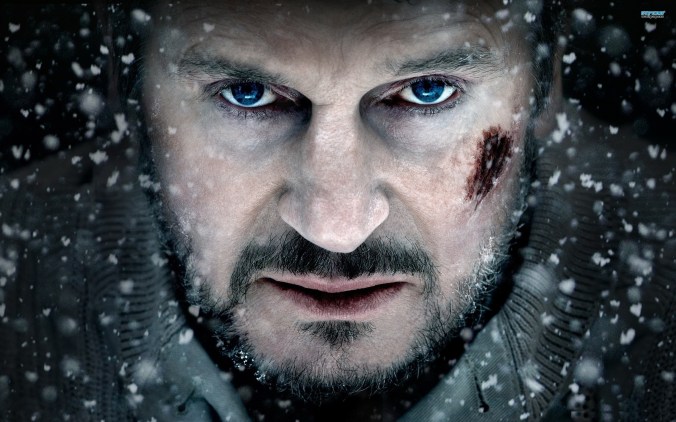
As you might know by now I usually write while listening to music, in particular Original Soundtracks for all kinds of movies. Lately, I’ve been listening a lot to the OST for Joe Carnahan’s THE GREY. It’s a lovely inspiring tune – you should look it up. Yet, the first time I watched the movie was last night. It’s not brilliant but it’s a very interesting film, and Liam Neeson is so good in it – always containing a load of emotion and subtly letting it come out to the screen at the right times. It was really good to watch it. I have also wanted to speak about the Writer’s Voice and how it impacts your writing. When I watched the movie last night I felt like the two things were well connected and it was maybe the time to speak of both.

the-grey

Every single text you write or read has a Message. Something that is at the core of what the author wants to communicate. It can be something simple like: ‘Good guys win and bad guys lose’, or ‘Love conquers all’, or ‘we Humans are amazing beings’. Or, as in the case of THE MATRIX something more complex (see here).

Even when the author has no idea of what is his/her message, it is there, branding the story in one way or another. When we try to smother it we ruin our writing. Our writing becomes bland, plain, unconvincing, weak. For years I didn’t know this. But at one point people didn’t seem to enjoy my writing. I knew I wrote well enough – I had won one of the most prestigious awards in the country and my short stories were being read and well reviewed. People just didn’t like my new stuff. Finally, I understood it: I wasn’t connecting. I wasn’t saying anything that was interesting to people – it wasn’t the way I wrote, it was what I wrote that was the problem. I needed to convey a Message that made sense to people, that made it worthwhile. But what? What did I have to say? And that’s when I understood: that’s what writers call The Voice! The Voice is having something to say! It’s having a Message.

So what did I have to say? How could I find My Voice? Oh, that was trickier. It was trickier and it took me years. For some time I thought I didn’t have anything interesting to convey to people. More than that. The stories I wanted to tell seemed not to have any Message. But then I started to discover it. The first thing I noticed was the themes. Stories also have Themes. For instance, I was writing THE ALEX 9 SAGA, a story about a commando from the 22nd century that finds herself in a world where civilization is still in the Middle Ages. I was certain I didn’t have any Message hidden in this story. But soon I found the theme: it was a story about Purpose. Alex 9 spends almost every chapter trying to find out what her secret mission is, a mission that her handlers failed to communicate to her. So she ends up finding a Purpose for herself and that purpose is what in the end leads her to the happiness and the fulfillment she always thought was not meant for her. And that’s when I found the Message of the story. It was: you can only find what you are looking for when you decide for yourself what your goal is. And something more about diverse families and how a family can come to be in unusual ways – but that’s a secondary Message.

In the end, it seems I did have something to say. And more: I found that if I was conscious of what my stories wanted to say, of my Themes and Messages, I could control much better the whole meaning and satisfaction of the story. It actually helped me plot more consistently, enrich the backgrounds and create subtle connections in the text. And so my next novel, THE DARK SEA WAR CHRONICLES was about Sacrifice, and how you must keep going in spite of everything. And my current WIP, LAURA AND THE SHADOW KING is about Hope and how it can achieve the incredible and lead you to where you never thought was possible.

THEGREY_DD_VFX_08

And now, back to THE GREY. This is a movie about Survival. A man called Ottway has to go through the unthinkable, standing up after a plane crash in Alaska and leading a small group of survivors who are relentlessly chased by a deadly pack of wolves. I’m not particularly drawn towards tales of survival in the woods, although I’m also not drawn away from them. In some ways they remind me of the Path of the Writer – always struggling in a world of uncertainty, never knowing when his/her efforts are going to succeed, never knowing if he/she will ever be able to be read nor by how many. All kinds of obstacles seem to show up from the darkness to stop them in their tracks, but the Writers must go on, accept the challenge, keep at it. And that seems to be the Message of the movie. Not to give up, not to let go. It’s not a question of Hope, it’s a question of accepting the Path. Accepting this Challenge we call life. ‘Once more into the Fray’ says Ottway’s father’s poem, the one he grabs on until the end. ‘Live and die another day. Live and die another day.’

364967

So once more into the fray, my fellow warriors. Go deep into yourselves and learn what you’re all about. The Message, that one thing you want to say, what you want people to hear, Your Voice, is right there, in front of you, in the deep lake of your soul. Your characters will say it for you. They will live it. They will shout it. You just have to live and die another day … and another… and another.

William Goldman, ‘All the President’s Men’ and Character Developing Dialogue

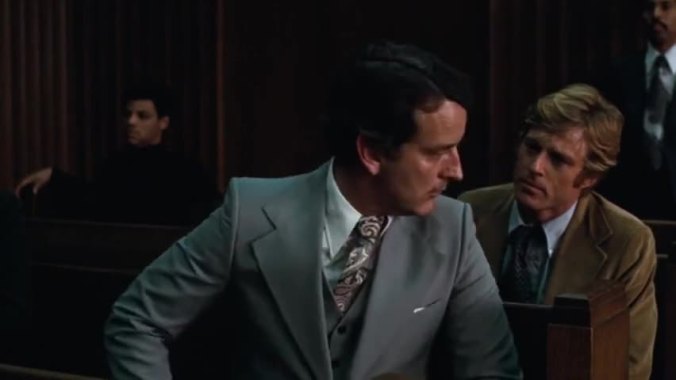
So… Stan Lee and William Goldman went in one breath of wind… What can I say about that? Today I’ll focus on Goldman. The Oscar-winner screenwriter died this week from colon cancer and pneumonia and other complications. May he rest in peace. He left us a long legacy: some brilliant scripts and a particular way of doing things.  One of my favorite movies is Alan J. Pakula’s ALL THE PRESIDENT’S MEN. I mentioned it here. It is, of course, a very timely movie, even though it has been here since 1976.  It was written by Goldman based on the novel by The Washington Post journalists who helped to crack the Watergate scandal which caused the downfall of Richard Nixon: Carl Bernstein and Bob Woodward. In the movie, Bernstein is portrayed by Dustin Hoffman and Woodward by Robert Redford. Two flawless performances under the brilliant Pakula direction. I want to talk a bit about this movie and I was set to make two very distinct points on two very different issues: on character development through dialogues and on the importance of the media for democracy. However, as I spoke already on the second point here, and will definitely speak about it again, let me for today focus on the first point.

all-the-presidents-men-slice-600x200

I’ve been recently asked how to make characters three-dimensional. It’s an interesting and profound question and not necessarily easy to answer. Of course, you can design character arcs and write the backgrounds and develop all kinds of personal traits. I tend not to do that. They might distract me from the really important stuff like… you know… the story. No, I’m kidding – let’s not treat this issue lightly. What I think is that some scenes demand a specific trait from a character and unless it’s absolutely necessary, I develop the characters when I’m plotting and when I’m writing the scenes themselves. If I can, I will not write backstories – unless they are really necessary. So how do you develop a character in a scene? Most of the time, I learned, there is only one thing needed: intelligence. You make them intelligent characters. Thinking characters. There’s a sequence in the first few minutes of ALL THE PRESIDENT’S MEN that I particularly like and which shows what I mean. Be advised: I did not read Woodward and Berstein’s book and don’t know what was their creative input and what was Goldman’s. Still, I believe this dialogue sequence to be absolutely brilliant.

d8c896ae-66d6-404c-87fd-2a3aa10b6c41_screenshot

This dialogue goes on between Woodward and a lawyer named Markham, which in the first draft of the script was referred to as Caddy. So here is some of the sequence as written in the script (these are print-screen images, so forgive me for the quality):

Imagem7

Imagem1

Imagem6

Imagem3

Imagem4

I think this simple sequence of dialogues is stunning and utterly revealing for both characters. It’s the first time we see Woodward in action, so it’s his de facto introduction, and even though we never see Caddy/Markham again, it’s a perfectly believable and somewhat developed character – you get the feeling you actually ‘know’ that man from somewhere. The way Goldman did this was by making both characters intelligent (well… one a bit more than the other). So let’s look at the subtext: Woodward is a nosy tenacious reporter and Caddy/Markham is a lawyer trying to avoid the journalist’s questions. He is always trying not to say anything at all, but in fact, because Woodward is intelligent and tenacious, every time he tries to avoid the questions he actually gives more and more away. In the end, with so little said and done, so little of the movie passed, we actually learned a lot about the characters: Caddy/Markham is a somewhat important lawyer with no apparent reason to be there; he is a liar; he was called at the middle of the night; he apparently called the other attorneys himself – he is arrogant, defiant and mysterious, obviously representing some organization or some big shot who wants to be left unnamed. On the other hand, Woodward is a young, ‘hungry’, intelligent reporter who doesn’t quit. It takes about a couple of minutes of the movie for us to learn all this from the characters –without any exposition whatsoever. This is skill. This is Craftsmanship.

You can see this throughout the movie and in several other Goldman’s scripts like BUTCH CASSIDY AND SUNDANCE KID – the way the characters are developed through the intelligence in the dialogue. How can we forget Mandy Patinkin in THE PRINCESS BRIDE saying over and over again: ‘My name is Inigo Montoya, you killed my father, prepare to die!’ Isn’t that the core of that character? Of course, in movie scripts, you have to develop the characters through dialogue – but that can also be done in books, so you ‘show, don’t tell’. It’s still an art form, though, and Goldman was a master at it.

1329284585-1328807772_

And so William Goldman goes on to a better place. Good for him. He left us better than we were before, which is the vain ambition of many of us. See you around the next campfire.


5 Composers and 5 OST’s

So I’m in this rush to edit and proofread two novels coming out at the beginning of the year. The Portuguese version of THE DARK SEA WAR CHRONICLES will come out in April (hopefully) and the first volume of LAURA AND THE SHADOW KING will be published in February. So now is the moment the editors are coming down on me like a ton of bricks and sometimes it really feels too much. I also have a comic book script to deliver and don’t seem to have the time to even look at it, which is making me crazy. And I’m slowly advancing in the writing of LAURA AND THE SHADOW KING’s second volume, which I absolutely don’t want to let slide – my personal deadline is Spring 19. But I am happy and seeing good things happening so I can’t complain. Through all this hard work, I have a constant companion which is my music. I learned some music in my youth but I definitely don’t have a knack for it, so nowadays I just listen to it and enjoy it while I work. As I feel very connected to the movies, Original Soundtracks are one of my passions. It’s like I’m watching the movie again even though I’m just listening to the music. I truly think that some of today’s film composers will be the Mozart’s and Beethoven’s of the future generations. They will look back and hear the masters at work and be astounded. But I can’t be the judge of that. I just don’t know enough. What I know is that I enjoy them. So here are 5 film composers and 5 Soundtracks that I really love and which I suggest to you all. Maybe not the best, or the most famous, but the ones I admire and been listening through the years. No particular order, as usual.

  1. VANGELIS – BLADE RUNNER OST

Blade-Runner-2-em-julho

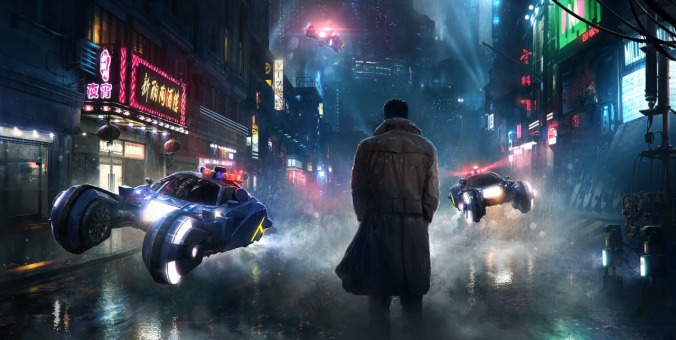
The Greek Vangelis has been a particular composer for years and one that I admire and love since the COSMOS series in the 80’s.  It’s like his music propels you to the stars. And I’ve heard several of his OST’s, including for the failed Ridley Scott’s 1492 movie with Gérard Depardieu as Colombus, and the brilliant score for Koreyoshi Kurahara’s ANTARCTICA. But it’s the score for Scott’s BLADE RUNNER that has inspired me for years. I love the dark, moving, intense themes that end in that climbing fanfare. Every time I listen to it I recall the character’s lines: ‘Moments lost in time like tears in the rain’; or ‘We don’t know how much time we have together, but then again… who does?’

  1. ENNIO MORRICONE – ONCE UPON A TIME IN THE WEST

mspfilm-Once_Upon_a-Time_In_The_West-still-1-copy

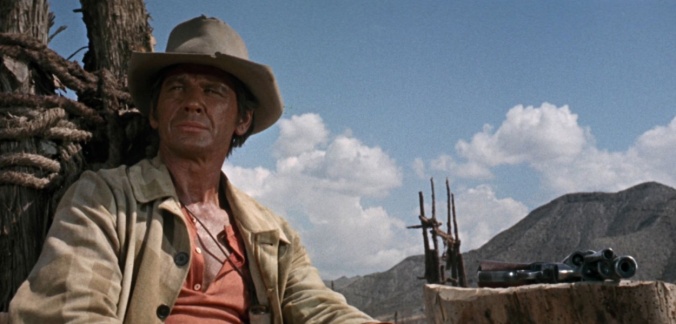
I usually enjoy Sergio Leone’s westerns, including the ones that were inspired in Akira Kurusawa’s masterpieces. Clint Eastwood is fantastic as the blond ‘pistolero’ with the poncho, and Lee Van Cleef as the everlasting veteran and Eli Wallach brilliant in his portrayal of the lost criminal. But in Sergio Leone’s movies, we can also always expect those lovely scores by Ennio Morricone. Morricone is an uncontested master, now. We heard his music in Joffé’s THE MISSION or in some of the latest Tarantino films. But the score that keeps coming back to me is the OST of Sergio Leone’s best movie: ONCE UPON A TIME IN THE WEST. Each main character has a powerful theme, from Charles Bronson’s harmonica to Henry Fonda’s brass to Claudia Cardinale’s violins. One of the best westerns of all time with an equally strong soundtrack.

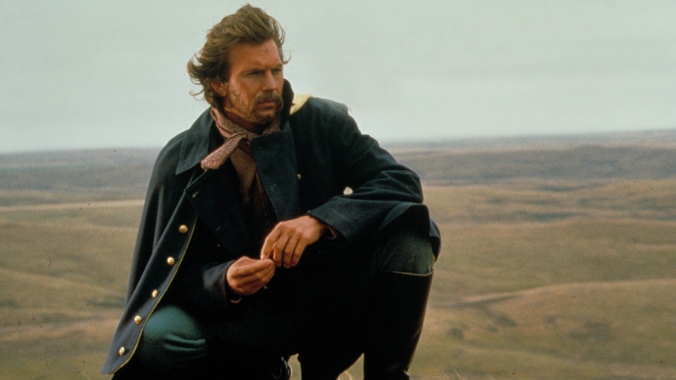
  1. JOHN BARRY – DANCES WITH WOLVES

dances-with-wolves

John Barry is one of the best movie composers ever. What we love about James Bond’s movie music is all because of John Barry who scored at least six of them, if I recall. He composed some timeless movie music, like the score for Schlesinger’s MIDNIGHT COWBOY and won several Oscars including for James Hill’s BORN FREE and the marvelous OUT OF AFRICA. Who can forget Robert Redford and Meryl Streep’s airplane ride over the rich plains of Africa to the sound of John Barry’s strings? Still, the OST that I listen to over and over is another of his Oscar winners: the score for Costner’s DANCES WITH WOLVES. Every time I listen to it I’m struck by the sophistication of Barry’s orchestrations and his sheer talent. It’s absolutely brilliant!

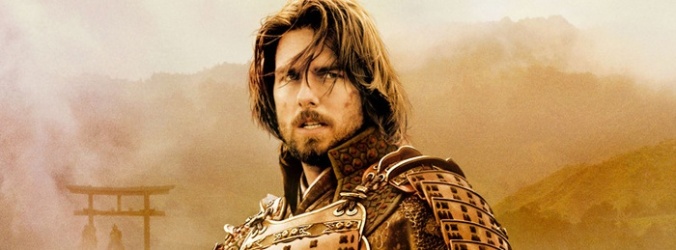
  1. HANS ZIMMER – THE LAST SAMURAI

daea32adcae6abcb548134fa98f139f9_700x259

Hans Zimmer is synonymous with film music in our days. If there is one household name in our days that spells movie music, it’s his. Here is a fraction of the scores I love from this man: THE DAVINCI CODE, DARK KNIGHT, DARK KNIGHT RETURNS, INCEPTION, GLADIATOR, THE CROWN, MADAGASCAR, etc. You cannot watch a handful of movies without stumbling upon one of this guy’s pieces. But the one I seem to listen to over and over is the OST for Zwick’s THE LAST SAMURAI. It is so emotional, so delicate and so powerful at the same time – even though I like the movie, and I believe Edward Zwick to be an underrated director, I think the music score is much better than the whole film. It is a masterpiece.

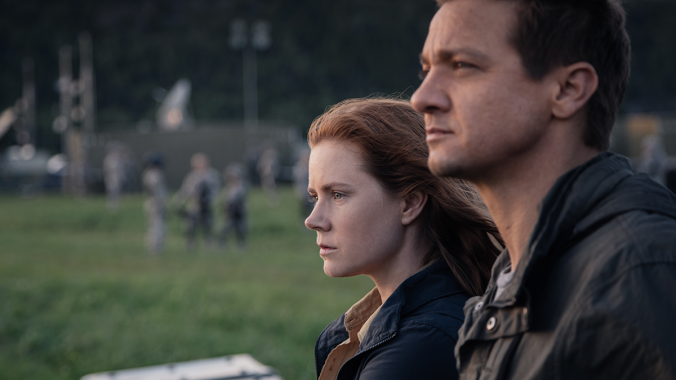
  1. MAX RICHTER – ARRIVAL

achegada-capa

I think Max Richter is a star in the making. Or maybe just a star already. His finely composed themes are a treat to the ears. In the tradition of minimalists as the brilliant Philip Glass or Michael Nyman, Richter seems to bring something more to the table. The main theme for Villeneuve’s ARRIVAL is incredibly powerful and gives a whole new meaning to the movie – getting us inside the soul of Amy Adams’ character. I also love his deeply emotional score for THE LEFTOVERS.

And so these are some of the composers and OST’s that have been my support in moments of labor. What do you think about them? Do you have any suggestions I might have overlooked? Tell me.

PS – Just got a note from a friend of mine that the ARRIVAL soundtrack is credited to Jóhann Jóhannsson. That is true. Still, the main theme is ON THE NATURE OF DAYLIGHT attributed to Max Richter for the Shutter Island OST. In the post above I was mainly referring to this theme. I do like Jóhannsson very much, but I believe Richter is a better composer. 

The Glorification of War or Why I Write War Stories

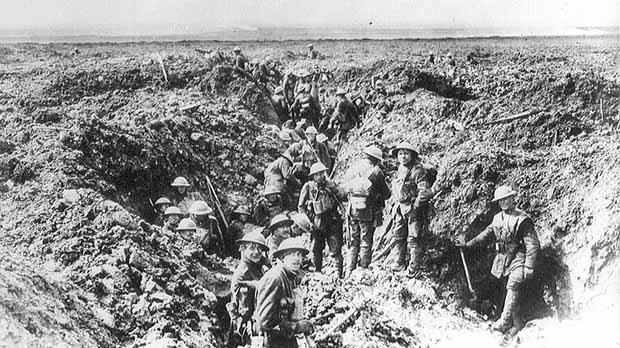
This morning, beyond the solid grey cloudy sky I heard F16 fighters flying by over and over again. They were celebrating 100 years of the Armistice de Versailles that ended the First World War back in 1918.  Wikipedia says that over 9 million combatants and 7 million civilians perished in that conflict – numbers unheard of in the entire History of Mankind but soon to be toppled by the events of the 1940’s. Man seems to have a cunning ability to top his records for the best and the worst. War is a terrible thing and Mankind is now able to destroy and wound with a force unimaginable in the past. My country, Portugal, gladly, has been at peace for over 40 years and hasn’t been invaded since the devastating Napoleonic Wars 200 years ago. But it has suffered a brutal Colonial War in the 60s and early 70s and was present in the bloodthirsty trenches of the Great War. Memories of that are not good, as you might imagine.

Trenches_hero-hero

As it turns out, just yesterday I finished reading one more of the excellent books by Alexander Kent (Douglas Reeman) about the life of Royal Navy Captain Richard Bolitho, who inspired me to create my hero Byllard Iddo of THE DARK SEA WAR CHRONICLES. The book I finished was WITH ALL DESPATCH and goes on in 1792, as France declares war on Britain. Even though this book has a plot that’s a little more confusing than most of Kent’s books, the last sea battle is absolutely thrilling and superbly written. It is brutal, nerve-wracking and bloody. As a battle should be.

Why does this fascinate us so? Why are we drawn to war stories, both real and made up? In all my Scifi/Fantasy novels – THE ALEX 9 SAGA, THE DARK SEA WAR CHRONICLES and the upcoming LAURA AND THE SHADOW KING, I write about war and describe cruel battles and agonizing deaths. Is it me? Do I have a morbid streak? Of course not. These and many other works are read by millions. Scifi/Fantasy, including all kinds of war fiction, seems to be, in fact, the most read genre of all.

Freud spoke of two Pulsions that move Human Beings: Eros, the Pulsion of Life; and Tanatos, the Pulsion of Death. Psychologists no longer accept the pure concepts of Pulsions, but the ideas are nevertheless interesting and explain much of the fascination we have for certain themes. In one way or another the whole Path of Life, the whole Human Drama is one about Life and Death. We’re always pining between the two. The Pulsion of Life also stands for Love, Sex, Creation and Creativity, Production, Music, Light, Joy, Heat, Future, and many other things we could imagine. The Pulsion of Death stands for Hate, Sterility, Destruction, Silence, Darkness, Cold, Past and many other things. So in one way or another, it’s as if we’re fighting between Life and Death every single day of our lives.  Between Love and Hate, between Creation and Destruction, between Light and Darkness. Every single time we cross a street or argue with our spouses or bosses we are in this fight – standing against the inevitable Big Silence at the end.  And war, in a way, is the summit of this struggle. It is the dreaded event that puts everything in the balance. And as I read the description of a Royal Navy lieutenant that stands by the helm of his ship inspiring his men as he is mortally wounded, there is something beautiful and fascinating in the gesture. Something deeply Human, noble and inspiring to me as well.

300px-Evstafiev-sarajevo-building-burnsIn 1998 I was in Sarajevo for a couple of weeks. It had passed three years since the Siege and the horrible civil war (and a few days later Bill Clinton would bomb Belgrade over Kosovo). The city had been torn apart by the war, as you may know. There is a river going through Sarajevo, the Miljacka river, crossed by several bridges. During the war, every single person who crossed those bridges would most likely be a target for snipers and the likes. And children could only play in the streets when there was a mist. By the time I got there, every single wall was still scarred by bullet holes, and some buildings still had UN plastic standing in for the broken windows. When I asked my fellow Bosnian writers about the war they advised me to read Paul Auster’s IN THE COUNTRY OF LAST THINGS. They said that was how it was like in Bosnia during the war. I read the book when I returned and it was a terrifying and devastating experience.
It seems that war, real war, has nothing noble about it. The glorification we see systematically in war stories and fiction all around is nothing but an ignorant flare trying to imagine the best in people, the heroism that we seek to bring back into our ordinary lives in the guise of petty decisions that worry us so much more than they actually should. Or maybe there’s something more. There is some kind of morality at the end of this rainbow. Some kind of nobility that might escape us at first sight.

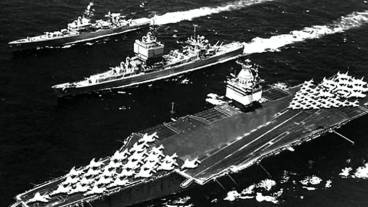
cuban-missile-crisisHistorian Donald Kagan studied war for years. In his book ON THE ORIGINS OF WAR AND THE PRESERVATION OF PEACE, he writes about Thucydides’ take on the origins of war: people go to war, it seems, for three reasons only – fear, honor and interest. One goes to war for fear of losing his life, his country, his way of life, etc. One goes to war for interest, to get land, or resources, or power, etc. And one goes to war to defend one’s honor.  Honor? Why would people go to war for something so ethereal and so vague as honor? Actually, it turns out that honor is not such a vague concept. It stands for the ability of a person or a nation to be respected, to be believed and trusted. If one stands for honor, one is actually standing for some core principles – some of which may be important enough to risk everything, including your life and that of your loved ones. One example given by Kagan is the Cuban-Missile Crisis. In blockading Cuba and sending its Navy to stop the Soviet ships, the USA drew a line in the water. In theory, the US Navy could have let the Soviet ships pass if they tried to cross. Nothing immediate would have come of it. But if they had done that the US would have lost face, lost honor. And they would not be respected again. Abuse would have spawned for certain from foes all around the world. Honor means something. It means something because Respect means something and our Rights mean something.

8f910a72f695e6b436682509315b1f10My favorite scene in CASABLANCA is the Marseillaise scene. In this scene, some German officers are singing a triumphant song about their country at Rick’s Caffé. The whole room of refugees and French nationals seem submissive and oppressed by the strong German voices, reflecting the almost invincible Nazi armies that were marching through Europe. Looking at this, the Resistance leader Viktor Lazlo turned to the orchestra and, with Rick’s consent, asked them to play the «Marseillaise», the French national anthem. As he started singing with the orchestra, the whole room seemed to come alive – soon, every living soul in that room was singing the anthem as loud as they could, with tears in their eyes, crushing the sound of the German tune. This scene is the symbol of the Resistance. The symbol of honor and respect. And it inspired millions around the world in the 1940s as they faced the Nazis and the vicious dictatorships of Italy and Japan. Even in Portugal, a country ruled by a dictator that didn’t take part in the war, this scene in the movie inspired several rebellious events.

There is nobility and gallantry and honor in war – it stands for principles that are paramount to our core beliefs and the integrity of our souls. In war as in everyday life, it is our decisions in moments of truth that mark our existence – moments like the time to vote or the time to stand against injustice. The dramatic stories of war can teach us that. And that is why I read them. And that’s why I write them. Until next time, fellow warriors.

A Story of Marketing

MexicanFishermanLarge-e1487542083472-750x244Let me tell you a story. Be advised: any similarity with reality is pure coincidence. Once upon a time, a long time ago, there was this fisherman. Every day this fisherman caught a few fish. Maybe two, maybe three, he always caught enough to feed his family. One day, though, he invented a new net and started catching a lot more fish. He felt he was rich, but most of the fish he caught would go to waste, so he decided to go to a farmer and ask him to give him some p’tatoes in exchange for some fish – he thought the farmer would be pleased. So he walked about half a day to get to the farm and proposed to the farmer the exchange. But the farmer declined. He said he didn’t like fish. But he would love some shoes. So the fisherman ran a few more hours until he found the shoemaker. He successfully exchanged his extra fish for a pair of shoes, he ran back to the farm and exchanged the shoes for some p’tatoes, and then ran a few more hours… that day he was able to get back in time for dinner with the heavy p’tatoes on his back but he wondered: could he do this every day? And when would he have time to fish? And how would he keep his extra fish before they got spoiled?
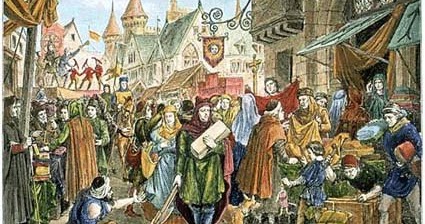

Thankfully there was someone who had a brilliant idea and invented what nowadays they call: money. This money-thing allowed the fisherman to keep the value of his fish in his pocket.  He could sell his fish to the shoemaker when he wished and then buy p’tatoes and carrots from the farmer whenever he wished. But he still had to walk a few dozen miles anyway. Which was very tiresome. Then somebody else had another idea: ‘What if we all met and traded on holidays and parties and maybe on certain Sundays? We could call those gatherings ‘fairs’ or something.’ And so they did. They started trading in certain days when everybody was gathering. And that’s when advertising was born, I guess. Somebody would shout: ‘Here are the cheapest shoes!!’ And others would shout: ‘Here is the best ham!!’ or ‘The best ale!! It kicks like a horse!!’

medieval fair

But soon people were not living in villages but in cities and it became bothersome to meet only on a few days. People needed to be served every day. But if you had to go to town looking for shoes and you did it on foot, it wasn’t too easy to look around the whole city. So cities started to become organized by trade. In old cities like Lisbon or London, you can find a street that would be called something like: the Shoemaker Street, or the Blacksmith Road, or the Silver Street, or Baker Street. Then if you wanted to find shoes you knew where you were supposed to find them: all the shoemakers would also be positioned to watch their competition and plot against it.

But then something happened. An event stranger than anyone would have imagined. They called it the Industrial Revolution. Suddenly, the shoemaker that could make a few dozen pairs of shoes a month (I guess), now was able to make (I’m guessing) 100 pairs a day? This is incredible, but it’s also a problem. This shoemaker simply does not know 100 people who will want his shoes. He will have to go look for other ways to sell them. Sears invented the catalogue for that reason, I would think. A cowboy in Tombstone would look at it and order some blue jeans or something and it would be made in Chicago or something and sent there. And adverts became the norm: you would print ads in magazines and newspapers and things like that and send them everywhere!! And that’s when salesmen got such a bad reputation: their job was to get some product no-one wanted or never knew existed and push it around until people bought it. That later became known as Product Based Marketing.

189446-004-34B7E234And then a clever guy called Henry Ford had a few more ideas. It was called Production Based Marketing (even though he didn’t know that at the time). His production methods were so efficient that he was able to drastically cut the price of his products. He would make cars is such a way anybody could buy them: ‘In any colour as long as it’s black.’ In this way, you could market a product based essentially on price.

But these guys selling products and underpricing the competition were so good that soon everybody was getting everything even before they knew it! Soon, it was clear that factories were producing a lot more than the people were able to buy them. So what did factories do? What every reasonable factory would do: they cut production rates and started producing less and less. How did they do that? They fired workers. But fired workers start having less money in their pockets and so they stop buying stuff. So soon enough the factories discovered they were overproducing again and they fired more people and this lead to less buying and so on. This had a huge impact on the Economy and was called the Great Depression.

Coming out of that Great Depression someone said: ‘Well, let’s not do that again, shall we? Let’s not just produce products not knowing if people want them.’ ‘How would we do that?’ Somebody else asked.’ ‘Well…’ Said the know-it-all, ‘Why don’t we ask people first what they want and then produce it for them?’ That actually seemed a great idea and ‘Market Research’ was born then and there – leading to what we call Consumer Based Marketing.

Importance-of-Consumer-Behavior-in-MarketingOnce people started to research why people bought things, they started stumbling on certain patterns. There were different needs and different wants, but in the end, the main drives were pretty much the same.  With the help of some wackos with strange Austrian names, they found what was inside the thoughts of Humans. And in the last decades of the last century, they focused on improving stuff for people. Products became better and better and better. Until they became very similar. To some, marketing became a war where consumers were ammunition that helped slay the enemies/competitors. If the enemy/competitor got an advantage, it was best to imitate the bastard to become ever so similar and strong in the market.

With all this blood and guts going through the floors, the people-that-bought became less responsive to the products themselves and more and more attentive to the way these products were presented. Suddenly, what made the difference was Service: from the niceness and empathy of a waiter to the payment and delivery accommodations of a company. Products no longer made an impact: Service was all that mattered. Until Service was also the same. All companies delivered on time, all waiters said nice things. In the end, Service had to become something else: to be different, Service had to become a Relationship. A Relationship means something special: it means a connection between people. For a time, that was overlooked and Relationship Marketing seemed to be all about information and numbers in computers. But that didn’t last long. Soon it was all getting back to basics: Marketing was about People meeting People.

What-is-Relationship-Marketing-and-How-to-Use-it-to-Connect-With-Your-Customers

And that is how, today, when people ask me if I write to a specific audience I mostly reply (or I wish I had the presence of mind to reply): ‘I write from the deepest ends of my soul, I write about what I need to and want to write. I believe that there are people out there that need to read and want to read something like that. My purpose is to be able to connect with those people. So I write the best I can to satisfy myself and in turn satisfy others. Then I go and try to find these people to the best of my ability. Marketing, for all its complexity, is all about that: finding the people who want to connect with you. Sales are just a bi-product of that relationship.’

And that’s all I have to say today, my fellow knights. Hope this wasn’t too crazy a story and didn’t turn you away with a patronizing sigh. Maybe next time I will have a better story. It’s all about you, my friends. Or you and me… together. See you around the next campfire.


Science Fact and Science Fiction: Truths That Should Be Self-Evident

5afd808f1ae66234008b466b-750-563So what is a fact? We used to know that. It was a given. There were always conspiracy theories and wild paranoiac plots going on in untrusting minds all over the world, but now we’re in a different Era. It seems even the most basic facts are put into question: is the Earth flat? Do vaccines work? Did man really go to the Moon? Is climate change real? All of these questions should have evident answers, but no longer. We used to trust basic Science before, but no longer. How can we? Science is changing every day. What used to be true to science yesterday is no longer the norm, and studies seem to contradict themselves every day. More than that! Many pranksters have shown that «serious» science magazines will publish anything. How can we trust them?

Scientists themselves seem to disprove their own in wild ways. Thomas Khun established that science depends on scientists’ creativity. Karl Popper argued something to the point that absolute proof is impossible, as it requires infinite observations. Facts, in that absolute sense that we were used to, are no more. We live in a ‘post-fact’ world. And I’ve written somewhere else and here, about how some Science Fiction nowadays, what I call Narratives of Conscience, actually question our own take of what Reality is, of what the Facts are. See, for instance, my posts about the MATRIX here.

Plant ResearchBut let’s look at Science for what it really is. I argue here that Science is a language to understand Reality. I’ll go a little bit further in the discussion. Science is an Ethical Standard. It’s a set of values. A set of values that allow everyone to question Reality and what we all assume are facts. Within these values we are directed to prove truth, or to prove hypotheses until they are accepted (even temporarily) as facts. Science demands that we experiment, and replicate experiments and argue with logic and certainty to prove our points. Science is the Ethical Standard of only accepting as facts what has gone through the thorough extenuating process. Many scientists have lost their reputations and their livelihood by not being able to get their ideas proven by the process. And many have come to glory by being able to prove ideas that before seemed impossible. So Scientific fact is not absolute fact, but it is as close to Reality as we can usually get.
On the other hand, Religion is not an Ethical Standard; it is an Aesthetical Standard, as I argue here. There is no way possible to prove the existence of God or its inexistence. Atheism is as arbitrary as every Theism out there. Religion is about belief: it’s about how the Universe makes sense to each and every one of us. Is the Universe more beautiful if there is a Creator behind its Creation? Or does it make sense and is it beautiful if it blossomed spontaneously? Religion is about what we feel, not what we reason. Religion is about opinion.

That is set in many constitutions around the world, including the most important one, the one that started it all, the American Constitution. In its First Amendment, it states: ‘Congress shall make no law respecting an establishment of religion, or prohibiting the free exercise thereof; or abridging the freedom of speech, or of the press.’ There is a reason for this: the Constitution is acknowledging that there is no absolute truth or fact about Religion: it is a matter of opinion. And as it is a self-evident truth that all men are created equal, we are not to impose one’s Religion over another.

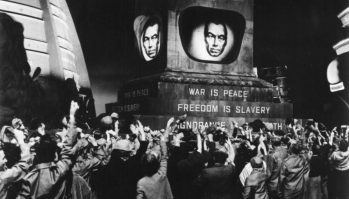
I write this post as it is becoming evident that another big country, Brazil, will fall to the Forces of National-Traditionalism, that worldwide movement trying to destroy the Liberal Agenda that was set by the American Constitution and which we fought for for over two centuries. This movement is not of extreme-right or extreme-left, it is something completely different. It is against globalization, against the idea of an international world order, against the UN, against NATO, against the idea of a Human conscience or a Human culture. It is isolationist, nationalist, anti-modernist, and it believes in a radical return to the isolationist cultures that stimulated imperialisms and the tragedies of the late 19th century and both world wars of the 20th century. They follow the ideas of the likes of Alexander Gudin and Steve Bannon, and books like the Science Fiction novel LES CHAMPS DES SAINTS by French novelist Jean Rafail. Among the world leaders and forces abiding by these ideals are Vladimir Putin, Donald Trump, Marine Le Pen, Recep Tayyip Erdoğan, Bibi Netanyahu, Iran’s Ali Khamenei and, if you think about it, also ISIS and Al Quaeda. And now, unfortunately, Brazil’s Bolsonaro.

1984_1956-1024x585

These National-Traditionalists sow many scary and threatening concepts, but one of them I can describe like this: they believe that Science is an Aesthetical Standard and that Religion is an Ethical Standard. If you think like that then Science becomes a matter of opinion and Religion a matter of fact. And if you think like that then Freedom of Religion becomes worthless.  Another idea at the centre of the Liberal Agenda, that allows us to believe what we want to believe, to make the Universe beautiful ourselves, will turn to dust.

This is one point where the Agendas are radical opposites: Liberals believe in an Aesthetical Standard of Religion, believe in the ideal that anyone can imagine and practice their own version of metaphysical philosophy and their own version of religious thinking. Also, Liberals should believe that Science is an Ethical Standard which demands the highest efforts of proof and analysis to establish something as a scientific fact. It should be clear for liberals that climate change is real, that the Earth is round, that the American flag is on the Moon, that vaccines work. Because, to the best possible standards, these are facts.

0827e6c6-7b30-4a3f-9a06-fa7d9ec14d21Traditionalists, however, will fight for the opposite. Here are the words of Alexander Dugin himself: ‘The notions of tradition, religion, and pre-modernity already offer us an undoubtedly broader spectrum of alternatives. If we reject the laws of modernity such as progress, development, equality, justice, freedom, nationalism, and all of this legacy of the three centuries of philosophy and political history, then there is a choice.’

I don’t know about you, but for me the choice is clear. These Trads scare the daylights out of me!

FF18: Writers go to Events

So this weekend I went to another edition of the Fórum Fantástico, one of Portugal’s most important events on SciFi and Fantasy. I’m not sure exactly how to talk about this in a way that is interesting to many around the world, all I can say is that most writers that I know and know of made sure they went to promotional events and they are an integral part of becoming a successful writer. So let me speak a little bit about that.

Forum PNG

I was never a particular fan of events. I don’t really like crowds or crowded places and get bored in many of the so-called fun activities. I started going to a few local ones not because I was having fun or to show myself to the market but for a very simple reason: I was learning stuff. I was meeting good writers, exchanging ideas and listening to many speak about problems that I also was having or I never thought about and yet I should. Also, many nowadays famous writers seemed to have begun by going to local and not-so-local events before becoming famous. And I was starting to understand why Tom Clancy would bother to go to autograph sessions where only five or six people were coming, for instance – he was starting and six people is better than none.

So I don’t go to many events, but I choose a few I try never to miss. First among these is Fórum Fantástico. This year I was invited to animate a couple of workshops with my friend and publisher Pedro Cipriano. We did ‘How to Kill Your Characters’ once more (you can read about it here), and another one we called: ‘From Idea to Structure’ (about things you find here). At one of them, we had only one single student. A few years ago that would have broken my heart, but these days it didn’t surprise me nor discourage me – I had a blast speaking with this Brazilian national coming from France that just read about the workshop on a magazine and decided to show up.

43348604_2210493032357453_4971170670818885632_n

I was also able to meet the talented writer Chris Wooding, and his smart editor Gillian Redfearn, and attended their workshop on Character Development that made me open my eyes to a couple of new things. Chris spoke about his use of ‘Theme&Thesis’ Character Development scheme he picked up from Dara Marks and which I became very interested in.

44043513_10156828548377146_4405986806122676224_n

Another thing I really enjoyed: I was part of the jury of a national contest for Fantasy novels. I had to go through 27 novels by writers from all over the country. It seems daunting, doesn’t it? It was. I sighed in relief when we were done. But also: I was really surprised by the quality of the writing out there, appearing from nowhere. I believe we will have a new generation of very talented Fantasy writers coming from Portugal in the next few years and that’s incredibly exciting. At the FF18, we presented the award to the winner: a young writer called Pedro Lucas Martins no-one really had ever heard of. He’s really good. Let’s hope he keeps writing!

FF is not the biggest event of the kind in Portugal but it’s the one the ‘people-in-the-know’ like to go. You must have similar events in your part of the world and my advice is: go to them. Mingle. Get to know people. Learn some stuff. It will seem little at first, but then you’ll find it will serve you more and more. Until next year Fórum Fantástico. I’ll be there in a year.

‘Venom’ and IOF Writer’s Block: How to Tame Our Monsters

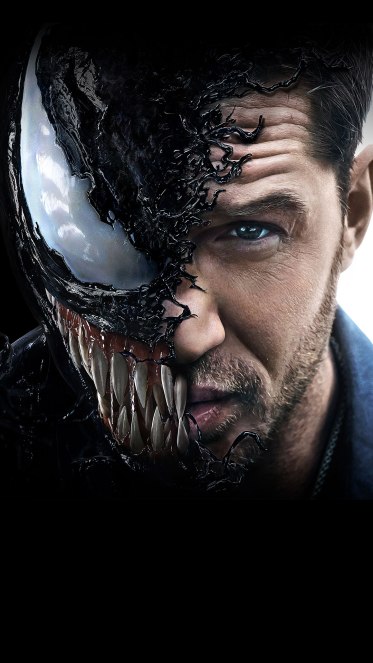
A couple of days ago I watched Ruben Fleischer’s VENOM with the powerful Tom Hardy as Eddie Brock, the MC, a man who shares his body with a horrifying invading alien from Outer Space. First of all, loved the movie. It has a certain amount of ugliness that makes it different from the average super-hero movie. Everyone is somewhat ugly, with the probable exception of the female MC, Brock’s girlfriend, played by Michelle Williams. Secondly, it is again a story about a schizoid mind, the likes of which I’ve been writing about in the last few weeks, from NARUTO’s Nine-tail Fox (here) to Neo’s MATRIX. VENOM is a film about the struggle with our inner monsters, and the way they dominate us and many times ruin our lives with their destructive powers. Let me speak a little bit about that and how that translates to Writer’s Block – particularly the Inside-Out Fear I already spoke about here.

bg_mobile

There’s this brilliant psychologist called Melanie Klein who created the school of Object Relations within the psychoanalytical school of thought. Let me put forth a few of her concepts in a very basic way. Klein would say that we feel that inside us there are Good Objects and Bad Objects (our Monsters?) and we have a hard time dealing with the interactions between them. We are many times scared that our Bad Objects will hurt us or hurt others around us, and so we act out to expel those monsters from us, or we fight against their release by locking them in and hurting ourselves in the process. As I said when speaking about THE MATRIX here to here, though, it is the fight itself that binds us in danger – if we understand our monsters and stop fighting them, we gain some peace and control. As The Oracle would show to Neo: it’s when we understand our choices that we are able to be free to make them.

Let’s translate that into the field of writing. Before, I spoke about one particular type of Writer’s Block: the Inside-Out Fear, which happens when our inner demons are stopping us from writing a particular scene we know we need to write. It happened to me, for instance, when I wrote a rape scene for one of my novels: THE ALEX 9 SAGA. It was to be so gore and cruel that I postponed it for weeks, as it made me uncomfortable. It could also happen in a simpler more subtle way: imagine you have a character that unconsciously reminds you of your grandfather and that your plot needs for you to kill it. If you don’t understand why it is making you wary it could block your writing for a long long time. Once your fear becomes conscious, though, it will almost seem stupid how easy it is to overcome it.

How about when our monsters intervene? Love and hate often come together, but it is sometimes hard to come to grips with that. Imagine, if you will, that you have a teenage son that got drunk and wrecked your car – a car you cannot afford to fix. A part of you hates him, even though it is possible you will not be able to accept that yourself. But you could have the villain of your story beat or torture a boy in a ruthless way. Your mind will react to that: either blocking your writing or being cathartic and relieving your inner emotional pressure. Your monster will either be attacking you or fantasizing about attacking your son – and the safest place to get it to do that is in the page of your text, no doubt about it. Understand that, accept the fate of that fantasy boy, consciously making that choice, and you’ll see good results popping up on the pages. And your anger towards your son will most likely subside (fingers crossed).

Becoming conscious of your monsters can then become a very useful resource for your writing. Your writing can become richer, rawer and more emotional if you can harness the energy of your monsters instead of fighting them.

venom-4-700x350

Just like NARUTO or THE MATRIX, VENOM’s is the story of a man burdened with his monsters that is able to turn his life around by getting along with the demons. The story is slick and fun, and at the same time it is Human – Hardy’s character is not your usual hero in any way. His failings lead him to demolish everything around him and ironically it is the monster that comes to destroy him that ends up saving him.

I didn’t like a couple of things in the movie, actually. The way that Venom, the monster, suddenly becomes an ally did not convince me fully. I would bet with you there is somewhere a background scene written for the monster, where we could see how he feels like a loser among his kind (the manifest motivation he states in the movie), but the scene was discarded at some point and left to rot – it’s what makes sense to me.

venom-clip

In the end, both Human and Monster become a better ‘person’ together than they ever were apart. It’s a classic story. We all have our monsters. We all fear and despise a part of us: our ability to hurt others or to disappoint or to do the wrong thing or to be violent. We all believe there is a part of us that is unlikeable and shouldn’t come out into the open. Part of the Human Drama, that fundamental field of research for every writer, is that conflict between the Good part of us and the Bad part of us.  Just look at HAMLET, for one. But it’s not a fight we can outright win – the only way to win is to gain some harmony, to accept one’s demons as a part of us and find a way to live with them.

Becoming a writer could be a solid path to integrate and deal with our monsters. A writer can channel the monster’s energy into the pages and give the demons a space to strive without doing much harm – quite the opposite, they boost creativity. Always remember one thing: what happens in your life is real; what happens on the pages is not. So for you, fellow knights, I leave you with the following: you can try and fight your dragons, put them down with your spears, incarcerate them in the deep dungeons of your inner being and mock them while praying in fear that they don’t find a way to escape; or you can learn how to ride them and fly. I strongly suggest you do the latter.