So this weekend, after years of work, my new novel LAURA AND THE SHADOW KING was finally released to the public. It’s still in its infancy, of course, and there’s a long way to go, but it’s always exciting and little scary to see our baby crawl into the wild. The novel is fast-paced and filled with action sequences, and because of the tension they bring and that feeling of danger we get when characters we like go through those sequences it’s easy to get the impression that these are the things that grab the readers and lock them into the story. But what I have found time and again (tell me if you feel differently), is that what really moves the story, what actually grabs the readers, are the feelings of love. Let me speak about that, as I believe this is a complex matter that deserves attention and study.

When I talk about love I’m not speaking necessarily of romance. We all know that romance sells. More even than sex, or violence. But other types of love also make you bleed. In LAURA AND THE SHADOW KING, I have romance, but what I have found is that the relationship between mother and daughter in the book is actually much stronger and sexier. It’s an indestructible bond – and all the sacrifice they endure for each other moves the story like little else.
This is not the first time I focus on the relationship between mother and child. In both THE ALEX 9 SAGA and THE DARK SEA WAR CHRONICLES, mothers play a crucial role in the plot (more in the first work than the latter). And fathers as well, of course. The seminal works of Sigmund Freud I like so much tell us, if nothing else, how important fathers and mothers really are to their children through their whole lives and a large percentage of flashbacks and B-stories in fiction look for the causal effect between a child’s struggle and the mistaken/enlightened choices in the characters’ paths.
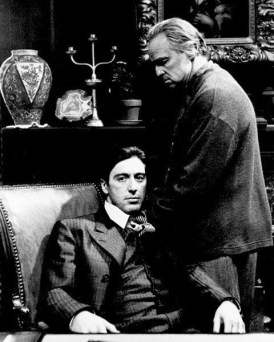
Often, they are the whole core of the plot, as I’ve confirmed after watching the marvelous GODFATHER yet again this afternoon – it’s a Father-Son movie all the way, of course. Just as LORD OF THE RINGS is essentially a bromance.
Maybe (here comes my romantic streak) love is the whole point of everything. Maybe the love we share with our family, and friends and partners, is the point of all existence. And maybe all we look for in fiction is actually a reflection of that. Take my exaggerations as you will… The thing is, also, that love is not an easy or simple thing. It is an ocean of complexity.
For many years there was this behavioral theory of attachment that said (grosso modo) the main bond between a baby and his mother, or caretaker, was there because of a survival need: babies need food and water and security, and so they developed an attachment for people who provided them with those things. Psychologist John Bowlby brought the idea of attachment to another level: it seems we have a natural tendency to attach ourselves to people around us, much beyond our physiological and survival needs. It’s something much stronger and deeply rooted in all kinds of feelings. But love, it seems, is still more than that. We notice it, as we write, at least in romantic entanglements: people (or characters) have the possibility to choose who they attach themselves to – but who they come to love is a step further away.
Imagine, if you will, that we live with a big dark hole in our souls. It’s this feeling that we lack something, that we are only whole when we fill that gap. That something is wrong with how we relate to reality and with how reality relates to us. That we don’t belong to anywhere or anyone. So we go searching for something to fill in that hole. It could be all kinds of stuff, like work or dreams or things or feelings. But often we look for other people to fill that hole. And maybe, as we fall in love, we nourish the illusion that another human being is the one piece that is needed to make us whole. This, however, is not love. Because love is not about us. It’s about the relationship with another. It’s about what’s shared. When this illusion of completeness dies out we are ready to love – we are ready to see the other person as a different entity. And then we can choose to be with that person, to continue the journey to fill in the gap in our soul, but this time not alone – this time, together.
That’s why I am generally, as a writer, much more interested in the difficulties and complexities of love within a relationship and not the gameplay that happens before the establishment of the relationship – because love is something that develops and blossoms slowly.
 This said I am very interested in one manifestation of love that always blows my mind and which is extremely powerful in fiction: sacrifice. All studies tell us that loneliness is toxic. Loneliness brings despair (and many other foul things), as love brings hope. But in the rift between despair and hope lives sacrifice. The ability to forfeit what’s ours, even our own selves, so that others may profit. I think this is obvious in my stories: when the odds are overwhelming, it’s the sacrifice for the sake of love that will save the day. Maybe that’s my whole Message all along.
Either way, I truly believe that love is sexy. That if our stories are about love, and its complexities, they are much closer to the readers than when we just use violence or sex or gore, or any other device. And so my new book is out there and it’s about a mother and a child. Go take a look. It will be free to download for a couple of days. See you around, fellow knights.




 Brian De Palma is not one of my favorite directors. He directed a few good movies but there is always a thing or two that will bother me in them. In particular, I think he tries hard to do the same things that Hitchcock did and the old master was way better than he ever will be. Still, THE UNTOUCHABLES is a movie I already watched many times and it does not turn me away. Kevin Costner is good in it, and both Sean Connery and Robert DeNiro are superb. And it has a good script. Tonight I saw it again and it made me want to write about a particular scene. They say a good movie always has a Watercooler Moment, that moment you will be talking about the next day with your co-workers by the watercooler on the coffee break. In THE UNTOUCHABLES it is definitely the 9-minute-long Train Station Shootout Scene. You can watch it
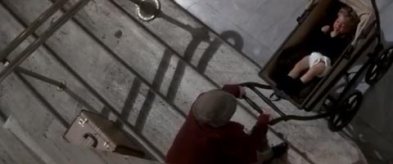 Then Ness takes notice of a well-dressed man stopping by a pillar. By Ness’s reaction, he must be a gangster. Is he? Slowly, the lady turns the cart around and starts pulling it up the stairs. She puts one suitcase on a step behind her, and then the other, and then she pulls the cart one step. Then she begins again: one case, then another, then pulling the cart one more step. Ness is becoming more and more nervous. More people come in, the clock keeps moving, the main doors open, the speaker warns. A woman comes downstairs and kisses the man by the pillar and they go away. He wasn’t a gangster after all. Finally, a plot-point: Ness decides he must do something about the woman and the child and he abandons his position to help them. As he starts pulling the cart up, the first gangsters arrive. And the Second Act begins. The whole First Act served the essential purpose: it raised the tension.
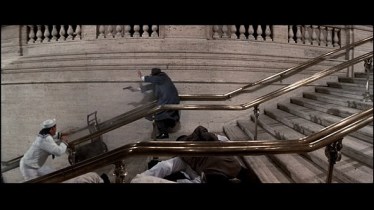 And suddenly Ness has two conflicting purposes: he must shoot the bad guys to survive and he must get hold of the baby cart before it crashes on the bottom of the stairs. De Palma shoots all this in slow-motion or the whole thing wouldn’t work, there are too many moving parts. But it works: bad guys and bystanders die, and at the last moment Stone comes running from the other end of the station and is able to catch the baby cart before it crashes. Break into the Third Act.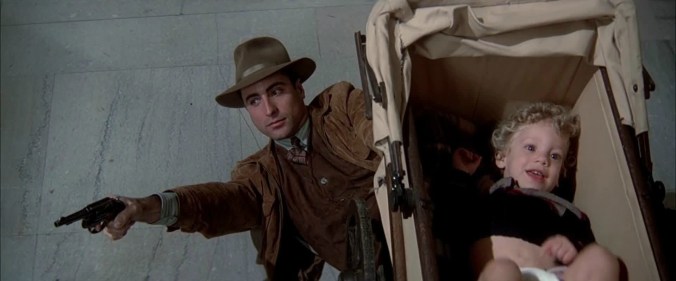

 So, in the beginning, we are taught conformity. Even though as babies and children we feel we are the center of the world, we are taught since the get-go that we need to conform to norms and other people. And it’s important that we learn the lesson, otherwise we will be unable to relate with other people and even ourselves, as we face the frustration of reality. Conformity to norms enables us to live with others and thrive. Remember, it seems the Neanderthals had a bigger brain and were stronger than Homo Sapiens, but our species knew how to work together and face the challenges of the elements by socializing. However, if conformity goes unchecked, we become submissive slaves, unable to make our own minds about what surrounds us, maybe hiding our more honest opinions deep inside ourselves so not to offend the Other or from fear of retaliation. Still, submissive slaves are de pillars of what Arendt calls: ‘the banality of Evil’. People who will do anything the System will ask of them without much question allow the most catastrophic wrong-doing to happen. They even support this wrong-doing, as we have seen in Nazi Germany.
 To overcome the entrapment of conformity, we can rebel and break the rules, even becoming radicals. Well, I do believe that this rebellion is very much necessary and enables us to innovate and become better as individuals and as a society. But breaking the rules and rebelling is nothing more than allowing the ‘wild’ to return within ourselves. It’s releasing our inner Neanderthal. But a sustainable System, needing balance, is usually able to counter this rebellion: madhouses and prisons and medications are made for that. I also do not believe that our most wild ‘self’ is our ‘real’ self, as some would argue. Breaking the rules for the sake of breaking the rules brings us nothing but violence and extreme behavior. It’s just another way of conformity, another way of being a slave. Just think of some of the things we are ‘supposed’ to do: in Universities, we are supposed to ‘experiment’, we are supposed to ‘try drugs’, we are supposed to ‘get drunk in parties’ ‘get wild at Spring Break’, etc. Are really all those things ‘breaking the rules’ or just another form of conformity? And how about cops and lawyers that aren’t supposed to ‘snitch’ on each other? Or CEO’s that should be allowed ‘to bend the laws’ to save the bottom line? Or flat-earthers? Or ‘jihadists’? Aren’t all these people another kind of ‘slaves’ to the System, in some kind of illusion of liberty for being ‘radicals’ and ‘rebels’?
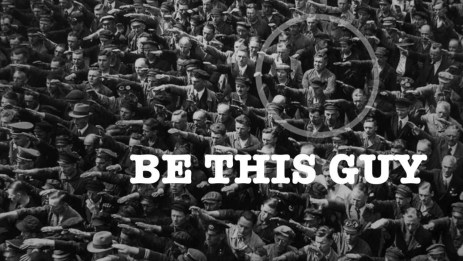 How can we counter this? We can counter this by becoming Thinking People. People who can make complex and intelligent choices. And then, we must become engaged people. We must count in a political world. We must be heard. And it will become uncomfortable for us, and it will become unpleasant. But if we are engaged we can change things, and we can prevent something horrible or disastrous to happen – just by being engaged along with many others we engage and inspire. Our opinions matter.
 I remember when I was 15 or 16 I went to watch ROCKY IV with my brother at a theater and that moment in the end when Rocky finally was able to punch the seemingly invincible Drago and draw blood the whole theater went wild and jumped in their seats. Also, every time I watch Zwick’s GLORY I cry at the end when the whole Regiment is slaughtered. This is Catharsis – this emotional jolt you get from stories. And that’s the treasure we promised our audience. To get it we have to invest and carefully build-up our characters so people care about the final situation. But it’s the final Act that will deliver the blow.

 There are a few things about writing that are a mystery to pretty much everyone who never tried it. There are a few phenomena, in my experience, that happen to many or even most fiction writers that seem wild and almost crazy for someone on the outside. Something like Writer’s Block is commonly known and widely discussed. But there are other things that happen that not even writers understand, many figuring it is something that only happens to each of them. Over the years I have been meeting more and more writers and talked with many about their writing and confirmed that these kinds of phenomena are not a figment of the imagination. So today I’d like to talk about three of these things – see if they make sense to you.
 You know that Disney short movie in FANTASIA where Mickey Mouse plays the Sorcerer’s Apprentice who tries to wield his insipient magic to complete his domestic tasks by enchanting brooms and scrubs, making them wash dishes and clean the kitchen, and then they get out of hand and the apprentice loses control and soon the whole place is flooding and plates are breaking and everything becoming chaos? Well, sometimes that happens with our writing. I’m speaking in particular about the characters and how they sometimes refuse to do what we ask them to do. Maybe the Sorcerer’s Apprentice is not the right metaphor, as in the movie this happens because of the incompetence of Mickey Mouse, and in writing it happens, I believe, in spite of or because of a high level of competence of the writer.
 Say your story is developing very well. All the plot points were at the right places and happened just as you planned, and your characters have become bigger and fuller and richer and stronger. But then you have to kill one of them. It’s imperative. Your story demands it. But as you start to write the scene where the painful departure is going to happen, you feel anguish and sorrow. As you write it, your eyes swell and you start to cry. You are still writing and it’s incredible that you can even do it as tears flow down your face. You have to stop for a few minutes to dry them until you are able to resume your writing. As you finally finish and your beloved character is dead, you feel an overwhelming sense of loss. It’s as if that character was a real person. A person that really died in your life. But how silly is that? It came from your imagination, right? It was your puppet. Why is it affecting you so much? Is this normal?
 Here’s a strange one. So you’ve been writing for a while, maybe years, on that book you really wanted to write. You are coming to its end and you have been satisfied with all that’s been done until then. But suddenly, as the end approaches, the doubts start to appear. Is it good enough? Have I made the right choices? Will anyone like the story or the characters? And the act of writing itself becomes more and more difficult. Maybe you get blocked and can’t sit down to write any word at all. Maybe you procrastinate and find any excuse not to write. Because every time you sit in front of the computer it seems the weight of the world is on your shoulders. And as you get closer and closer to the end, it all becomes harder and harder.




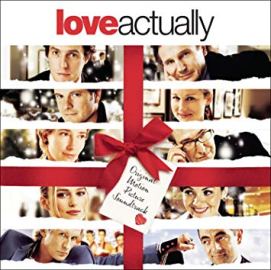 I’m always baffled that this Richard Curtis ensemble movie became such a success. I find it deeply flawed. It’s always difficult to make an ensemble-short-story-pastiche work and this movie seems to work for far too many people, in my view. It actually annoys me that it became a sorta-classic-Xmas-movie. Most of the too-many stories in the movie are very poor, in my view, but I have to say there are a few that I still enjoy taking a peek at. The central PM-Hugh Grant and the help-Martine McCutcheon plot actually seems funny and solid. It has nothing to it, but it’s well… nice. And it works. However, the better parts of the movie are, in my view, three other tender and clever plots. First, the delicious sorta-love-story between the rock star played by the brilliant Bill Nighy and his agent played by Gregor Fisher – it’s a story both surprising and improbable. Then, the short Martin Freeman and Joanna Page plot about two body-doubles that fall in love as they interact pretending to have sex in movies. And then, for me the most entertaining and intelligent story, the one where Liam Neeson runs to support his teenage son’s first love. That one I really like – with the background of the death of the characters’ wife and mother, it becomes such a good story about the bonding of father and son. It’s too bad I have to suffer through the whole lot to watch these bits. But that’s Christmas…