Cameron’s ‘Aliens’ and the Importance of the Midpoint

James Cameron’s ALIENS has more than 40 aka’s around the world, I’ve just found out. In Argentina it’s ALIENS – EL REGRESO (or ALIENS – THE RETURN), in Italy it’s ALIENS – SCONTRO FINALE (or ALIENS – THE FINAL ENCOUNTER). In Portugal it’s ALIENS – O RECONTRO FINAL (also ALIENS THE FINAL ENCOUNTER).
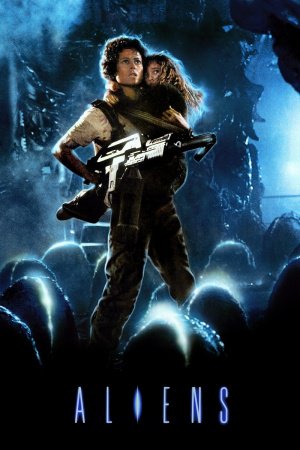
nORMXEkYEbzkU5WkMWMgRDJwjSZOf course at that point (1986) there was no way of knowing there would be at least 7 or 8 more movies on the infamous alien (if I’m counting the Prometheus and the AxP storylines correctly), so it wasn’t the final encounter by any measure. I actually watched the Cameron movie in the theatre, before I watched the Ridley Scott groundbreaking first installment, and even though I’ve watched both several times since then, I still like the Cameron movie better. But that’s just me: I love military action and I think ALIENS is one of the best Scifi military action movies ever made. And as I watched it last night one more time I concluded three things: 1)Cameron is a really talented director; 2) Cameron, Giler and Hill’s screenplay is really-really good, and; 3) the Midpoint in this movie is very powerful.

Let me go through these conclusions one by one, with special emphasis on the last one.

James Cameron is a household name. Just in Scifi, you can’t avoid icons like THE ABYSS, TERMINATOR or AVATAR, whatever you think of the movies themselves (thumbs up for those who think AVATAR is a downgraded, hyper-marketed, silly version of DANCES WITH WOLVES). But you can also speak of the very solid TITANIC phenomenon and, of course, it is doubtful the ALIEN would have become a franchise if the second movie of the series, Cameron’s ALIENS, wasn’t such a great film. But as I watched it again last night I couldn’t help but notice the little things that make it so. Cameron’s use of sound is brilliant. There’s not a lot of music and a lot of the movie is very silent and quiet… until it isn’t. The feeling throughout a large part of the movie is of eeriness and discomfort. And then there are some scenes I absolutely love. Several of them. As the moment Newt is fearful with water to her waist, grabbing her doll’s head in her hands, while waiting for Ripley and Hicks to cut the metal grid above her to bring her to safety… but too late. It’s a stunningly tense and beautiful scene and Cameron’s choice of camera work and actor’s directing is very strong. Or the moment of the first confrontation with the aliens, where confusion is so intense that only yesterday did I understand that about half the casualties of the Marines were self-inflicted or acid induced (pun intended).e5fe38f162ed88757ed5582fdecd69c7--newt-aliens-aliens-

The script is also very well written. You can see it in the richness of the supporting characters, like Bill Paxton’s Hudson. But mostly, the first half hour or so is brilliantly paced. It’s a constant build-up with little action, but you feel the tension rising relentlessly. The way the script keeps hiding the final act is perfect. Only in the final act do we see the Alien Queen and real danger Ripley is facing. We know ‘it must be something we haven’t seen yet’(as Bishop puts it) but we don’t really know what it is. And the way Ripley goes from ‘fifth wheel’ to a leader is also very interesting.

But this script also features an impressive Midpoint. I always have trouble explaining the Midpoint beat of a movie. Why is it there? What does it do? What do we do with it? Blake Snyder used to say: “If you can crack the Midpoint, you can crack the story.” And in most stories I write, I find he was right. The Midpoint changes the movie. It divides it in two. Before the Midpoint we were watching a movie, or reading a story, after the Midpoint we’re looking at something else entirely. Like in MATRIX. At the Midpoint Neo meets the Oracle. Until that moment we thought ‘he must be the One’, or ‘it’s Neo against the Machine’. After that point he’s just there to save Morpheus – and he becomes the One in the process. After the Midpoint we’re just watching Oracle’s prophecy unfolding. Or in GRAVITY: until the Midpoint we had Bullock’s Ryan and Clooney’s Kowalski trying to get to the Space Station, but after the Midpoint we see Kowalski dying and Ryan is alone trying to save herself. The best Midpoint I’ve seen in recent years, though, was in MANCHESTER BY THE SEA. The event at the Midpoint completely changes our perspective and we don’t watch a completely different movie after that but we notice we’ve actually been watching a different movie than we thought we were all along.

The Midpoint is very important but it’s difficult to explain both what it is and why it’s so important. It’s like we had a period of maturation of our relationship with the characters until then and at this point we’re ready for the final challenge, to face the real danger, to go for the moon.
aliens1

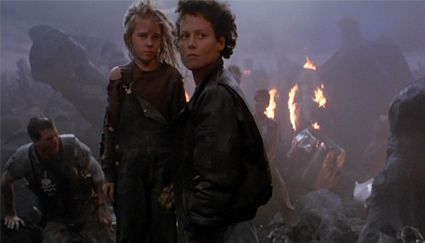
ALIENS Midpoint makes it great. Until the Midpoint we were watching a gung-ho military action thriller. After the Midpoint we are faced with a strong, unpretentious, feminist plot. What happens at the ALIENS Midpoint? This happens: after the first disastrous battle against the aliens, a group of survivors manage to escape to an Operations room where they settle and plan their way to safety. After they have prepared, Ripley goes kiss little girl Newt good night. Newt says she doesn’t want to go to sleep because she dreams with monsters. Ripley tries to calm her down saying she will be in the next room and that she will never abandon her. Newt asks her: «Promise?» and Ripley replies: «Promise.» And that’s it. Until then, the movie was about Ripley confronting her fears and facing the monster in her past. It was her against the Alien. From the Midpoint on the movie is something else: it’s a fight between two strong females protecting their young. The Alien Queen and the Human Leader will face each other to the death. That’s the Final Encounter. Not a ‘Return’ as they would say in Argentina. Ripley is not there to face the Alien anymore. It’s an Encounter, as the Italian title affirms. It’s the face-off between two bad-ass females.  After the Midpoint, Ripley is there to do only one thing: to protect Newt and bring her to safety. Period. Whatever it takes. Even when she has escaped already, she will go back to the lion’s den to retrieve the lost little girl.

This Midpoint actually makes this movie, in my view, both more powerful and relatable but also in a class of its own. It’s a feminist movie. It’s bold and discrete at the same time. ALIENS is one of those action thrillers that might be commonly undervalued and rejected as a shallow narrative. As Cameron himself, I’d bet. But that ignores the power that it conveys. It’s for sure one of my favorite Scifi movies. Maybe not in the Top 5, but somewhere close. How about you? What do you think of it?

Greengrass’s ‘Bourne’, Action Scenes, Cuts and Threads

I was in my late teens when I read the first Bourne novels by Robert Ludlum.  I remember the first book, THE BOURNE IDENTITY fairly well, but I don’t recall most of the other two I’ve read: THE BOURNE SUPREMACY and THE BOURNE ULTIMATUM.

1__0Hz4nykC4rC_Cm1_aXeWg

I remember THE BOURNE IDENTITY movie/TV-series(2 episodes actually made a movie, I think) made from it in the 80’s with Richard Chaimberlain and Jaclyn Smith. The movie was fairly decent by the standard of the time and I loved the books. But nothing prepared me for Doug Liman’s version in 2002. What a great movie! It didn’t just depict most of what I loved about the book, it went one better: it changed spy movies forever. If you thought James Bond was the paradigm of action spies, that changed in 2002. From then on, the paradigm was Matt Damon’s Bourne. And then Paul Greengrass picked up the helm and made THE BOURNE SUPREMACY and THE BOURNE ULTIMATUM. Those brilliant movies made Bourne an absolute icon and changed the face of action movies.

The book by Ludlum depicts a CIA operative who gets amnesia and is set to find out who he is. In the book, Bourne’s on an operation to find the terrorist Carlos by impersonating an assassin himself, so his identity is always equivocal. In the latest movies, Bourne is a real assassin, CIA black ops, who is fighting against the CIA itself. «They should have left him alone» says the poster for the second movie. I don’t think SUPREMACY and ULTIMATUM’s movies have any resemblance to the actual books, but I can’t recall, so don’t take my word for it. A few years back, I read another book by Eric Van Lustbader (another good writer I read in my youth) , who picked up the series. The book was called THE BOURNE IMPERATIVE and I was struck by how far behind the novels had gotten. This novel was far far below the level Paul Greengrass’s movies and Tony Gilroy’s screenwriting had taken Bourne. Greengrass and Gilroy’s Bourne is tormented, vulnerable, and yet relentless, sharp, ruthless, cold, skilful and formidable. But what makes the difference, in my view, is the unstoppable rhythm of the movies. The breathtaking speed of the action is amazing. The novels’ plots and action scenes cannot keep up.

The-Bourne-Supremacy-The-Truthedited-msmv9se52e75bem1i2ox9k7ihwur87rpc6owsseolcI must also tell you that in my view, THE BOURNE SUPREMACY is in a class of its own. It is by far the best of the Bourne movies, with a brilliant plot that focuses on a wounded warrior looking for closure for the death of his lover. The last scene in Moscow, where he confronts the daughter of a Russian diplomat he killed is a tremendous scene that credits both Damon and Greengrass and which shows the depths of the character in such a powerful action movie. It ends with the wounded Bourne walking to the sunset projected in the windows of the buildings, a shot I always love to watch.

But what makes Bourne’s action sequences revolutionary? The first thing, in my view, is the writing. Every move is clever. Every challenge, every twist of the plot is filled with little details that make Jason Bourne first of all a thinking machine. «They don’t do random» says Nicky (Julia Stiles) in SUPREMACY. Bourne doesn’t do random. Everything is fast but clever. Every move is thought through. Even the way Bourne looks at the train schedule while he’s running from the German police, or how he picks up the map of the building when he’s evading the American Embassy in Switzerland. Superb writing.

Second, it’s the directing. I watched this video few days ago and was blown away. There’s this measure called the Average Shot Length (ASL) which shows how many cuts a movie has. So, in Liman’s IDENTITY, the ASL is 4.2 seconds. On average, there’s a cut to another shot every 4.2 seconds. But if this is fast, Greengrass goes one better: in SUPREMACY, the ASL is 2.4 seconds! And in ULTIMATUM it is 2 seconds flat! So much of the speed we see in the movies is made by tricks of the camera, directing and editing.

bourne-identity-film-2-smallWhat I’ve learned about Greengrass’s directing is that it does not live on cutting alone, quite the opposite: it lives on the thread. With all the crazy fast cutting he «doesn’t do random». Every cut is perfected to the maximum so that we never lose the thread. We always can follow where the blow goes, where the next weapon is, where the movement happens. So the thread is the crucial part, not the cuts.


I try to do the same thing when I write action sequences: I strive to follow a single thread, guiding the reader’s attention like I was in a movie, so that the reader is never more confused than absolutely necessary. The more controlled the gaps are, the better the sequence. I’ll write more about this at a later date, I promise.

All this made me wonder about the evolution of society around speed and number of inputs. Some time ago I frequently observed and argued that the speed of inputs in our society was getting higher and higher. Lightning speed commercials followed breathtaking videogames and movies and television and the stress in everyday life and 24-hour news and ever more frequent sports events, etc. What I was arguing was that we were educating our kids to a probably dangerous kind of thinking: instant gratification, multitasking, high-speed decisions, crisis mentality. This was good to deal with a crisis, but it left behind other important skills like: strategic and abstract thinking, planning, long-term resilience. Today, I can see millennials comply with my predictions. Millennials seem fickle, capricious, easily bored or discouraged, without aim.

hero_EB20070802REVIEWS70710008AR

That figures: in the 1920’s a Russian economist called Kondratieff said that economic trends came in 60-year cycles. We just had a big K-curve crisis in 2008. As he predicted, these ones take about 6 years to clear out. In the end of the cycle, when crisis is about to strike, people seem to have a particular type of thinking: short-term (as the long-term is uncertain), indebted (because of the economic imbalances), insecure (because of cost-cutting and firing), multitasking (because there are less workers for the same work), anxious. So it figures millennials would fit right in. However, we’re turning the page to the long Spring and Summer of the K-curve, with long-term prosperity, which means strategic long-term thinking will be important. Should we worry about the younger generations? Maybe not. Maybe millennials are also just trying to find the thread. Or maybe even seeing a larger thread.

I’ve always wondered why fickle millennials would be able to follow slow narratives as THE GAME OF THRONES (or read George R.R. Martin’s books), or WESTWORLD, or THE HANDMAID’S TALE. Or even read those lengthy HARRY POTTER books. Or why they like sequels. This is not compatible with easily bored types, I think. But maybe millennials are not bored because they have no patience but because they sometimes lose the thread. Because the random cuts disconnect them from what they value and they are connected to something else. I’m actually not sure about this and I usually write about stuff when I am a bit more certain about them. But all this made me think. How can we connect to one another? What’s our thread? What makes us whole?

The divisions we see in society, that mimic so closely the 1940’s, show us to be disconnected and at odds with each other in the most incredible basic notions. Truth seems to have lost its way. But what if we are simply missing the thread? What if this confusion hides a deeper truth in itself? A thread we cannot see yet? Well… I’ll keep at it. Tell me what you think.


How much is a human worth?

This will be the first invitational post for Hyperjumping. My friend Nuno Reis is a computer scientist with a thing for cinema and science fiction who is now exploring marketing to manipulate the minds of others (yes, he turned evil).  He usually writes about the fantastic in SciFiWorld.pt, and about Technology in blog.nunoreis.pt. I asked him to write whatever was going through his mind at the moment and this is what he sent me: 

large_XlXnH7D1dLLW2PutTNbCYsIt3PNupzfQHX-pinw9MHU

We hear all the time that a human life is priceless, but no one speaks about the value of humanity. Everyone is talking about the robots and Artificial Intelligences that will take our jobs, but no one is considering the jobs that will remain human forever. Let’s look to our society.

The pessimistic vision

The first step leading dehumanization of work was mass production. Each man was a specialist in a single task and had to do it ad infinitum until a tendinitis or mental breakdown sent him home or out of a window.

Then war came and men were disposable objects against automated machine guns. People used to kill people, but in the 20th century weapons started to kill people without help. Women step into factories to keep production and consumption high.

And then the doubled workforce was too high to keep. Without the scarcity of human resources, companies became more demanding, paying worse and terrible conditions. Unions faced the threat and gave better conditions, like 35-40 hours weeks, health insurances, vacations periods, leaves, retirement plans, trying to make the faceless corporations to see people as people.

Things were going great until machines started to take the place of people in the work lines. First were the manufacturing jobs. A robots is better at doing repetitive tasks than people. No tendinitis, a 24/7 work week every week and never complain about anything. The precision of robots allowed industry to go to a nanoscale no one ever dreamed about. That led to better machines and better computers.

robotComputers are thinking machines. They started to take the jobs from mathematicians. Database quickly replaced libraries and digitalized every possible archive to make it smaller to store and faster to search. It was called progress and everyone enjoyed having a personal computer at home and to do shopping online. In a few years computers were in our pockets, in our cars, in our watches, in our clothes, in our tvs and in our fridges. Computers everywhere, telling us what we should wear, what we must watch and what we must buy.

And then computers started to think for us. First it was fun to say a computer defeated a person in chess. It is just a brute force algorithm. Then a computer defeated a human in Go, a game where brute force is not possible and some strategy is required. Suddenly we realized it was too late. The A.I. handled payments in parking places, in highway tolls and in grocery stores replacing low pay jobs. They even flip burgers in fast food restaurants. But they are not only in production, administration, logistics and sales. They are working is cinema, in healthcare, in marketing, one is even running to a mayor office in Japan. Old jobs will disappear faster than new ones can be created. Unless we can prepare a new generation is less than a decade to be more than computer savvy and take the jobs of the future, we will have a huge gap between the I.T. people and the others. The ones with high paying jobs and the ones without a job.

This is where we stand. Some countries are preparing a social system were everyone gets a basic wage and can do stuff to become more profitable. Hobbies turned into passions. But unless you are truly an artist and your work is enjoyed, how do you plan to sell? Computers can think of anything and print anything faster than you. They will create what people want to buy. You’ll will have to learn from YouTube, sell in Amazon, advertise in Instagram… you’ll need to ask Siri for help with all that.  Or just join the dark side and let the computer to all the work for you. It is so much easier to just let it be.

The light at the end of the tunnel

There is a goal in Computer Science called the “Turing test” where a computer has to pose successfully for a person in an online talk. A jury chats with several people and bots, and if a bot is taken for human, the computers win. They are scarily close from it. Some have already won, but they cheated like Deep Blue.

Because the jury is biased, it is hard for humans to get a 100% score. A secondary goal is to be the most human among humans. Can we apply that logic to jobs? Where is the humanity irreplaceable?

McRobot-810x553

The sad conclusion is that the only thing robots can’t do to mimic people is to be family. Maybe they can trick us in most of our adult life – having a meaningful chat, serve us a home meal, having sex – but for a child there is still a big line. I don’t mean school. Kids would rather learn from their tablets than going to a place with other children. But before that. The early stages of cognitive development where not only colours and sounds matter, but the human touch (sensorimotor stage) and the wonderful moments of building a language (preoperational). Even if the machine learning of harvesting blabbering data from millions of children makes a computer knowledgeable of the subtleties of those little creatures, nothing replaces a person. We are doing it with our senior citizens, but no one would dare to give an innocent child to a machine!

17626448_10211872369341619_894251349077120470_nWe all know what the oldest job in the world is. I dare to say that the last job will be a close match between Parent and Foster Care. Yes. I demand that parenting becomes a job with proper training and evaluation. With all that free time, there are no excuses. The single mention of an exam will reduce birth so much that the planet is safe. And Foster Care is because even the best A.I. teachers can’t be sure if parents will be good, and A.I. doctors can’t keep early death away. There will always be a human missing for someone. The one that is priceless.
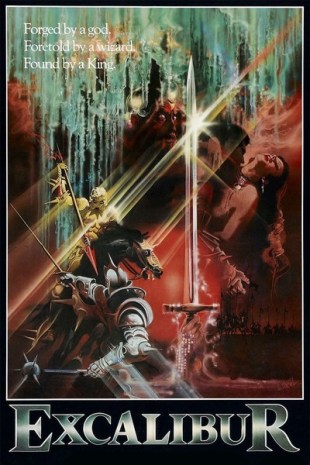
Boorman’s ‘Excalibur’ and the Mastery of Plot – 2

This post is the continuation of the previous one. Those of you who haven’t read the previous post, please start there. If you keep reading this post, let me warn you it contains SPOILERS to the movie EXCALIBUR, even though I don’t believe these will ruin it for you. You must watch it! Seriously!

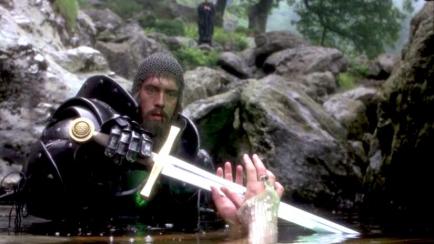
So, as I was saying in the previous post, a few minutes into the movie young Arthur becomes King Arthur. He hasn’t yet united England, but his loyal subjects around him will help him do that. One day, as he travels to war, his army is stopped at a narrow bridge by a shiny knight from a distant land, who challenges and defeats knight after knight. Frustrated and irritated, Arthur finally decides to confront him himself. The knight presents himself as being Lancelot du Lac (Lancelot of the Lake… coincidence? I think not);  he’s a knight from a foreign land on a quest to find a true king he may pledge allegiance to. Arthur fights him and soon he is in trouble. This perfect knight is better than him. Everything Arthur tries to win the fight is perfectly countered by Lancelot, until, at the end, knowing he will lose, Arthur calls on the power of Excalibur and strikes a blow. The blow defeats Lancelot, but it also breaks Excalibur. «You’ve broken what could not be broken!» Despairs Merlin. «Hope is broken!» Casting his broken sword on the lake, Arthur feels the guilt: Excalibur should have been used for serving the people, for uniting the land, not for the pride of one single man. He is unworthy. But as he understands this he becomes worthy again – the Lady of the Lake shows up and gives him a renewed Excalibur.

john-boorman-excaliburArthur takes it as Lancelot wakes up  – he is happy, he finally found a king who could beat him and, so, a king he could serve. This is incredible plotting technique as intentions and motivations and action twist and turn around themselves. Lancelot is so perfect, a figure of myth himself, a figure of the Lake, that only supernatural power can overcome him. It is Excalibur, not Arthur, who defeats him. But in using Excalibur for himself, Arthur is committing the sin his own father had committed – and so Excalibur is lost. So Arthur must recognize his own fault and his mistake. However, only by that mistake does he win Lancelot’s loyalty. When he gets Excalibur back, Arthur becomes the king Lancelot could follow. If he hadn’t committed that sin, he would never have won Lancelot. Clever, no? One single event has opposite effect on two storylines: to win Lancelot, Arthur must lose Excalibur. And yet he needs both.
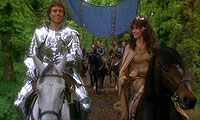
That sin and that win over Lancelot will come back to haunt Arthur in the opposite directions. He will lose both Excalibur and Lancelot before he is able to get both back. And it happens because he learned his lesson well: because he puts his crown above his manhood. But I’m jumping ahead.

As the war ends and England is united, the Age of Chaos also ends and the Age of Camelot begins. A Round Table is put under the perfect castle of Camelot. Armors become shiny as only Lancelot’s was before and the knights become the myth. With this, Arthur decides to marry Guenevere and asks Lancelot to escort her from her father’s house. excalibur3As they travel, Guenevere asks Lancelot if he loves any woman. As he is a perfect knight, Lancelot replies that he serves his king and, as such, he can only love one woman forever: his queen. This is very perverse and is masterful plotting: it’s Lancelot’s perfection itself, his virtue, that will bring everything tumbling down. To avoid the traps of this love, Lancelot starts travelling, becoming absent. This is the pretest evil Morgana can use to arouse suspicion on the minds of the court. On one of his travels, Lancelot comes across Perceval, who becomes his squire. Perceval will be the symbol of the common man and a very important character as the History progresses. At the same time, Lancelot is betrayed by his dreams of lust/love for the queen. Awaking from one of this dreams he accidently stabs himself with his own sword (a phallic symbol of desire turning on the man). Meanwhile, Morgana is able to convince Sir Gawain of Lancelot’s betrayal, encouraging the knight to accuse the champion and the queen. Arthur must make a choice: either he defends Guenevere as his husband and his man, or he remains her king and her judge. Of course, he won’t commit the same sin as his father, he won’t fall into the temptation of being a man first and a king later. He decides to remain the king and leave Lancelot to defend the queen. The wheels keep turning. At the day of the trial, Lancelot is not there to fight Gawain and defend the queen as he is still fighting the wound opened by his desire. Arthur then asks if no-one would defend the queen. The only one willing is the small, humble, common, brave Perceval. Arthur hurries to make him a knight, even though the man has no chance against Gawain.  At the last moment, Lancelot shows up. He defeats Gawain because in truth, he and the queen have not betrayed Arthur. Still, his wound opens up and he almost dies, because in truth Lancelot and Guenevere are in love. Lancelot is the man Arthur cannot be. He is the perfect man instead of the perfect king. That night, Guenevere goes to him and he cannot reject her. That is the night of doom. In one night, Lancelot and Guenevere betray Arthur, and Arthur sticks Excalibur on the ground between them. When he does this, Excalibur injures the Dragon and Merlin dies. Arthur is then deceived by Morgana and makes love to her, making her pregnant. He also falls into the trap of lust and sin. In one night, everything that was built is destroyed.
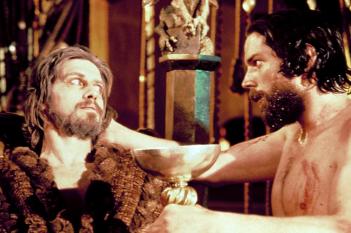
What is interesting is that it all seems inevitable: all characters seem to be doing what is destined to be, what they were meant to do. This inevitability of decisions that make and break characters and stories is a very difficult thing to achieve in such a powerful way. In EXCALIBUR, it’s not just one character that is pushed into doing what he or she does: it’s four, five characters doing what seems inevitable to them. This is very good writing.

After this night of doom we enter the Age of Christ. Excalibur, Guenevere, Lancelot, Morgana and Merlin disappear. Showing up before the cross of Christ, Arthur is struck by lightning in his heart and becomes severely ill. There’s only one thing that can save him, and that’s the Holy Grail, the blood of Christ. As the knights of the Round Table go on a quest to find the Grail, they see the land and the people also very ill – as in the plagued Middle Ages. Now the movie turns to the story of Perceval and his quest.

MSDEXCA EC013He travels far and hard, watching his fellow knights fall one by one. When he is caught by his enemies and hanged and he is about to die, he finally sees the Grail, then a voice is heard: «What is the secret of the Grail? Who does it serve?» Perceval is saved at the last minute, losing the Grail. But he must try again. On one of his travels, he finds Lancelot, gone mad, preaching the apocalypse with a cross on his neck. As Perceval tries to approach him, Lancelot pushes him into a river. Perceval is pulled down by his armor. He is going to drown. He takes off his armor piece by piece. He becomes a common man again, fragile and alone, about to die, resembling Christ himself. And then he sees the Grail again, and again the voice asks: «What is the secret of the Grail? Who does it serve?» But now Perceval knows the answer: «You and the land are one.» «Who am I?» «You are Arthur my king.» There: that’s everything! That’s what the movie has been telling us since the beginning: the land, the people and the king are one. That’s the secret of power. All connected. Perfect!
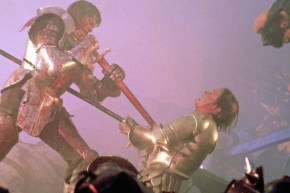
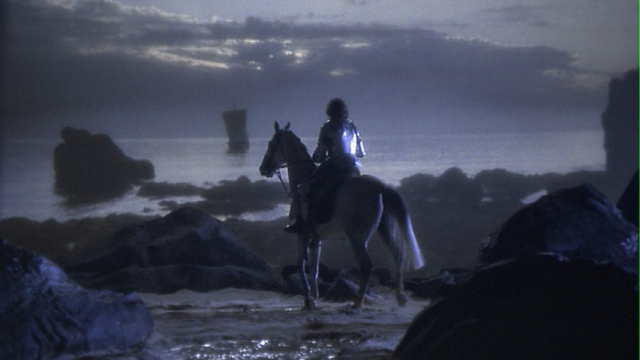
As Perceval answers the questions, he is able to get the Grail and gives it to Arthur, who recovers. But the king and the land and the people still have a mortal enemy: Morgana, the bearer of revenge, and Mordred, her son, born of incest with Arthur. They fight Camelot and all it represents. Arthur gathers his knights to battle. He finds Guenevere at a convent (where else in an Age of Christ?), where she expiates her sins while guarding the Sword of Power: Excalibur. He forgives her, of course. With renewed strength, Arthur goes to battle wilding Excalibur and is helped by two other allies: the ghost of Merlin and the returned Lancelot that saves his life when all seems lost. The perfect knight will fall, bleeding out from his old wound. Finally, Arthur faces Mordred alone: they kill each other. Good and Evil cancelling one another.Morte

In the end, only Perceval, the common man, survives. When a dying Arthur asks him to cast Excalibur into a lake, Perceval hesitates. Excalibur is the dream, it’s Camelot, it’s Paradise. Without the perfect king, there will not be a perfect kingdom. Perceval tries to deceive Arthur, but the king tells him: «One day, a king will come, and the sword will rise again from the waters.» The dream is not dead. The common man will always try to go back to Paradise. One day he will be able to. Excalibur is cast into the lake and Arthur dies, leaving in a funeral barge.

As I said earlier, this is one of the best scripts I have ever seen. The writing is superb. Most of all, the plot is almost perfect. No other depiction of Arthur’s story I know is so sophisticated, coherent, profound, intelligent. Any screenwriter, or every fantasy writer, or any writer, should see this movie and analyze its plot. See how the techniques are used, how it is all connected. How the characters are multilayered and each layer has an impact in the story. And at the same time they are all coherent and symbolic. It has an anthropological perspective, showing us the struggle of Mankind itself and the difficulties of being human as a whole. And it has multiple amazing plot-points with scenes that propel the story in several directions, equally essential, which is something that is so difficult to do it’s incredible it happens so many times in one movie.

End

I once wrote a scene in THE ALEX 9 SAGA where two friends are chasing their enemies through a tunnel and a wooden door shuts between them. On one side the first character is threatened by flames and smoke; on the other side the other character is in the dark with a silent assassin. The first character finally is able to turn the fire to the wooden door and make an escape. As he does this, the flames light up the silent assassin, allowing for the second character to defend himself. I was proud of this scene, even though many may not have noticed its sophistication: there was one single difficult solution for two different problems – a small storyline crossed another small storyline. This is difficult to do because both storylines must cross at exactly the right moment, whatever may be happening on one side or the other. And it must seem easy and coherent. I was inspired to do this little thing by EXCALIBUR. The movie does it over and over again in a much larger scale. So go watch it. Watch it with different eyes. I promise you will learn from it.

Boorman’s ‘Excalibur’ and the Mastery of Plot – 1

When I was a boy, I watched John Boorman’s EXCALIBUR for the first time and was amazed.  I’ve watched it many times after that and I am still amazed. It’s not just a ‘sword fighting’ movie as many would see it, it is a lesson in writing. A lesson in plotting. I have learnt a lot from it and after being urged by a comment on Facebook I finally decided to give you a glimpse of what I see in this brilliant piece of work, which is still today one of my favorite movies. Actually, these will be two long posts – read them at your will.

poster

John Boorman is a solid director that gave us movies like DELIVERANCE or ZARDOZ, et al., but for me, 1981’s EXCALIBUR is by far his best work. It features very young actors that would become legends, as Liam Neeson, Gabriel Byrne or Helen Mirren as Morgana LeFey; and also a brilliant Nicol Williamson as Merlin. The costumes are not adequate to the time it portraits (the plated armors are more indicative of the 14th century than of the 8th or 7th, but this is mostly irrelevant) and the light and photography and effects are not as sophisticated as we’d see today. However the writing remains superb and is for me, by a long shot, the best rendition of King Arthur’s story I ever watched or read. I never read Thomas Malory’s LE MORTE D’ARTHUR on which the film is based, so I don’t know how much of the writing is in fact Malory’s and how much is Boorman and Pallenberg’s screewriting – however it’s so full of intelligent use of extremely sophisticated and difficult techniques it’s mind blowing for a writer. These include: important scenes and events that move the plot in several different directions, perfect harmony between plot and symbolism, profound insights into Human Nature and Human History, characters that always seem to do the inevitable and other plotting techniques used so easily that audiences don’t even know they are there – but kids, please don’t try this at home, this kind of writing is like Paganini to violinists or Rachmaninoff to pianists, it’s just virtuoso plotting, it’s the equivalent to plotting as Aaron Sorkin’s writing is to dialogue. And plotting, believe me, is much more difficult to master than dialogue.

So I’m going to write this post in a different way, today. I haven’t watched EXCALIBUR in years, but I’m going to try to describe the main plot point by point, at least the main points I want to talk about. This will mean SPOILERS. Even though I know from experience that knowing what’s going to happen won’t ruin this movie and King Arthur’s tale is one of the best known stories of all, I still have to warn you. The movie goes through three different mythical/anthropological ages as it tries to describe the History of England and even the History of Mankind. First, the Age of Chaos; then the Age of Camelot; then the Age of Christ. With each age, rules, thinking and feel very much change even as the story remains one. This is remarkable by itself. Let me tell you how it plays out.

UtherIt all starts with Uther Pendragon, a warlord of early feudal England. The land is divided and lords fight among each other to find a king that’s worthy of the throne. Uther has an ally, the wizard Merlin. Merlin draws his powers from The Dragon, which is Nature itself, it seems. Merlin would describe it as: «It is everything! It is everywhere! It is all around us!» Merlin takes Uther to a lake where the Lady of the Lake gives him Excalibur, the Sword of Power, made from the scales of the Dragon itself. Showing the sword to the other lords, Uther achieves peace and allegiance. However, he’s not a complete man and so he falls in love/lust with his rival’s wife. War breaks out again. In the mist of battle, Uther asks Merlin to use the Dragon’s power to give him a night with the woman. Merlin, seeing Uther is not the man to unite the land, accepts but demands a mystery favor in return. Uther gets his night of love with Igrayne.
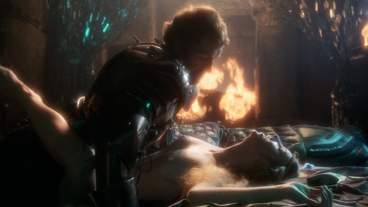
IgrayneThe image of a full armored man making love to an eluded naked woman was very erotic in the 80’s, and it is the perfect image to show us the Age of Chaos, an age where myths, mystical magical powers, passions, violence and war were the way of the land. Uther crushes his rival Cornwall and marries the widow Igrayne, who gives birth to Arthur. When Arthur is born, Merlin returns and demands the baby as payment for his service. See how the plot swirls around? Merlin gives his power to Uther, lends him the power of the Dragon, but as Uther is an imperfect man, a man of his age, it is exactly because he wins everything he wants that he will lose in the end. A perfect king must know that the use of power is not about him. Is not about being powerful, it’s about more than that. Still, Arthur is the union of the Pendragons with the blood of their adversaries, which makes him the embodiment of the Union. He has a half-sister, daughter of Igrayne and Cornwall: Morgana LeFey, which will be the remnant of the Age of Chaos and embodies the revenge of Uther’s rival – so Uther’s human faults, the ‘mistake’ he makes in the beginning of the movie, will be the downfall of the Pendragons in the end.  A perfect circle.

Mad with Igrayne’s cries for the loss of baby Arthur, Uther charges into the woods after Merlin. But he is betrayed by other knights that loathe him and knowing that he is lost, Uther does the unthinkable: as he is dying he decides to destroy Excalibur against a stone saying: «No-one will have Excalibur but me.» It’s the ultimate selfish act: to destroy the Sword of Power if he cannot have it. Excalibur, however, instead of being destroyed, gets stuck in the stone and becomes stuff of legend. For the people, the one who takes is out of the stone is destined to be king. But that’s not Uther’s curse; he said: «No-one but me.» Which means: only his own blood can take the Sword. This is a fantastic technique difficult to use: have part of the characters believe in something, but give it a small twist, so the plot-point has two different effects on the plot: only Arthur will be able to draw the Sword because he is Uther’s blood. But every knight is fighting to prove himself worthy and become king because the myth is: he who has that sword will be king. But Arthur is already king, because he was born from one. Maybe this is the source of that tradition: that the crown passes from king to his son?

excaliburpedraAnyway, Arthur has grown into a young man, raised by Lord Ector incognito and becoming the squire to his would-be brother Kay. Kay is to fight in a tournament to earn the right to pull Excalibur from the stone. As Kay’s sword is robbed, Arthur decides to take Excalibur from the stone and does it easily. He becomes the king, but several of the lords will not accept a mere boy as king so they rebel against him. Merlin shows up to help Arthur and is impressed by the boy’s leadership skills. As Arthur goes to help his main ally besieged by Lord Uryens, the movie gets to one of its best scenes. I’ve shown this scene at some Leadership Seminars and it always moves me. It is, for me, the portrait of true leadership. This is what happens:
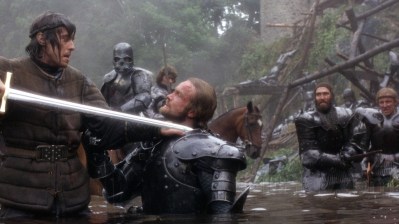
At the top of the battle, Arthur is able to jump on his lead-enemy Lord Uryens and overcome him. He puts the blade of Excalibur against Uryens’ throat and asks his surrender. Everyone stops fighting and looks at that confrontation. Everything is in the balance. Surrender, demands Arthur. But Uryens replies: «Me, a knight?! Becoming a subject to a simple squire?? Never!!» And Uryens’ men echo: «Never!!» Arthur thinks about it. He looks around. And he decides Uryens is right. Uryens is just fighting for what is just. For what the people believes in. For knighthood and honor. He says: «You’re right. I’m not yet a knight. You, Uryens, take Excalibur and make me a knight.» He gives Excalibur to Uryens and kneels before him. Uryens is baffled. Someone shouts «Kill him Uryens! Take the sword!» But after a moment of confusion, Uryens puts Excalibur on the shoulder of Arthur and makes him a knight. He then kneels and surrenders, swearing allegiance. He becomes a loyal subject. Arthur is a true king.

Uryens2What a brilliant scene!! I still get goose-bumps from it. A king is not the one who wields the power, he’s the one who is true in his heart. The one who serves his people, not himself. Arthur understands what Uther never did. And so he becomes what his father never could. This scene not only is brilliant in the writing but completely serves the story. We not only recognize a leader in Arthur here, but we find that the reason he becomes a leader is the whole point of the whole story. This is plotting, my friends!!
All this will be confirmed again in another beautiful scene: the time Arthur meets Lancelot. I’ll describe it in the next post.

Systems, States, Soldiers, Spies: What Does TV Tell Us?

In the last few weeks I’ve been following several TV spy-shows. I love spy-stories and if you ever read any of my novels you must know that by now. There are several very good shows of that genre on TV at the moment. I want to speak to you about what they tell me of the world. Let me present them first. I’ve been watching: COUNTERPART, HOMELAND, DEEP STATE and THE LOOMING TOWER. About COUNTERPART I already spoken here and my opinion has only been enhanced by watching several other episodes of the series. Here’s what I find of the other three.

13-homeland-710.w710.h473

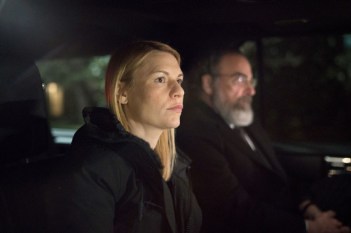
HOMELAND is already in its seventh season. It had its ups and downs but it remains an impressive show. Claire Danes and Mandy Patinkin are still outstanding in their roles even though we miss Damien Lewis. The seventh season deals with an internal American plot to destroy the Presidency of the United States, including Russian meddling. More than usual it deals with the divisions in American society and the idea that the fight between the system of government and disruptive forces around it is becoming more and more dangerous.

DEEP STATE is a classical spy-thriller with the always strong Mark Strong (oops, I punned) as the MC. Strong plays a former British Intelligence officer betrayed by his agency and individuals within the State, who are trying to kill his son and kidnap his family. We still don’t know where this plot is going, but once again the show’s bad guys are the officials within the Governments.

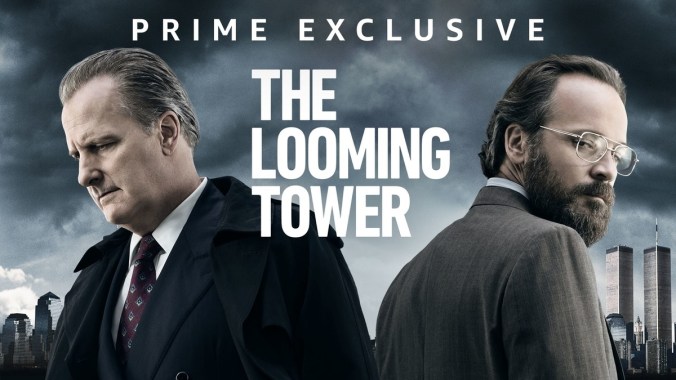
Finally, THE LOOMING TOWER with the amazing Jeff Daniels (nowadays on top of his form) exposes how the inner conflicts between the FBI and the CIA in the late 1990’s led to a massive failure in preventing the 9/11 attacks.

the-looming-tower

Spy-shows always dealt with People vs. System question, where internal divisions and inner conflicts, ‘moles’ and corruption were addressed. But in the last decades, and especially in the last two or three years, in particular the Trump years, this theme has been ever more present. I remember in the 1980’s reading THE BOURNE IDENTITY by Robert Ludlum about a CIA operative who loses his memory. There was even a movie with Richard Chamberlain and Jaclyn Smith, if I recall. But in the 2002’s reboot by Doug Liman (superb, by the way), suddenly Bourne became a covert clandestine assassin and the CIA ‘Deep State’ operations were the enemy.

‘Deep State’, of course, is the expression Donald Trump and his followers use to describe rogue functionaries and bureaucracies within the States that undermine the will of the people and the democratically elected. On the other side, some people say that ‘The System works’ as the bureaucracies limit the abuse of democratically elected officials.

Democracy is a clever enlightened and enlightening ideal. Before democracy people in power could abuse with little check and the only true way to change who was in power was by violence. So violence was regular and always lurking in the dark. Bureaucracies still represent that: power that remains unchanged and apparently unmovable. Democracy is a way to check these powers, but what we seem to feel in recent years is that even democratic powers have become bureaucracies themselves. In most countries, the parties in power do not change for decades. And in many constitutions (including the Portuguese Republic’s) you can’t even legally be elected without forming a party. And parties are bureaucracies. That’s why most men and women in power have to climb ‘through’ the parties and adhere to written and unwritten rules, many of them corrupted. I believe that the emergence of such controversial figures as Donald Trump and Emmanuel Macron came to be because democratic parties, who should be checks on bureaucracies, have become bureaucracies themselves, in such a way that the peoples don’t feel represented anymore and are eager for alternatives. This is very dangerous on the whole.

DEEP-STATE-902953

On the other hand, we know that majorities aren’t always right and democratic powers can also be corrupt, corrupted and corruptive. The theory of bureaucracies was pioneered by Max Webber, one of the founders of sociology, many years ago. Bureaucracies, he would say, are focused on efficiency; they are about the way how things are done. They are not just cold structures, they are people employing rules and regulations to assert the principles of (in our case) democracy.  They assure, in other words, what we call the Rule of Law. And we know what happens when the Rule of Law does not apply because we see it in many dictatorships around the world and in the aptly named Failed-States (States that have in effect ceased to exist as bureaucracies).

This could be seen in World War II. Even though the fall of Nazi Germany was achieved through violent sacrifice of many on the battlefields, through the years of occupation the Holocaust was fought by the bureaucracies. There were attempts of revolt and violent resistance, of course, but the most effective combat against the evacuation of the Jewish population to concentration camps was achieved by bureaucracies. In places like Denmark, Belgium and even Italy, the systems themselves may have saved hundreds of thousands of lives. In Italy, for instance, which should have been a loyal ally of Germany, Jews were hard to find. When they were found, there were many legal exceptions that prevented their arrest. When they were arrested, they were hard to transport. When they were transported, they might get lost. One Portuguese diplomat in France, for instance, called Aristides de Sousa Mendes, issued hundreds of unauthorized passports to Jews and saved thousands of lives. Because beyond the Rule of Law, bureaucracies are also made of people and these people can also prevent abuses and be a check on the powers that be. And the Law, as I believe was argued in Nuremberg, is more than the written word, it is also an ethical standard about what it is to be Human.

C5kO-WWUwAIIZ2p

So, this People vs. System theme is now more important than ever. Democracies and the world in a whole are in turmoil the likes of which we probably haven’t seen since the 1940’s. And let’s all hope that both Democracy and the Rule of Law survive, because one cannot live without the other. One of the best sitcoms I ever watched, years ago, was a show called YES, MINISTER about a fresh inexperienced Minister in the British Government being advised by a clever skilled experienced bureaucrat. Episode after episode we could witness the dynamic between the two and rejoice as one and then the other would get their way in the governing of the United Kingdom. That dynamic is, in my view, absolutely necessary for our future. Let’s hope we are able to keep it.

SHARK-KILLER: Prizes, Prejudice and The Dark Sea War Chronicles

This weekend marks the release of the third and final installment of my Scifi trilogy – THE DARK SEA WAR CHRONICLES. It’s a space-opera/space-fleet adventure about a young man who enlists in the Space Navy after a violent trauma and as war breaks out he becomes a decorated hero in a faraway Solar System. The main concept is: a kind of WWII’s Battle of the Atlantic in Space. SHARK-KILLER is the last volume of this saga and is the culmination of years of work. My aim in this week’s post is to write a little bit about my own adventure in writing and publishing the trilogy.

Bruno_Martins_Soares_K (2)

I started writing when I was 12 years old. My first unfinished fictional text, as it turns out, was a Scifi story about my brother and me going back in time and fighting bandits in 19th century’s American frontier. It was horrible, but it was fun. I never stopped writing from then on. At 13 I started my first novel, a spy-action story, but I quickly got disappointed as I found it was harder to write than I thought: my style was evolving so quickly and I was learning so much that by the third chapter I was writing in a completely different way than the first and the text was very incoherent. That’s when I started writing short-stories: so I could develop my style. It worked. Soon I wanted to develop characters and started writing novellas. It worked as well. After 10 years of training, I was finally ready to write novels… Or so I thought. Little did I know that I’d have to write four bad novels that would end up in the trash before I was satisfied with an end result.

Still, my short-story writing was getting better and in my 20’s I was able to earn a couple of prizes, having the honor to represent my country abroad and being published in Italy. Btw, that prize-winning short-story, MINDSWEEPER is about to get published again by a division of Penguin Random House, in a celebratory anthology, as it happens. More news soon.

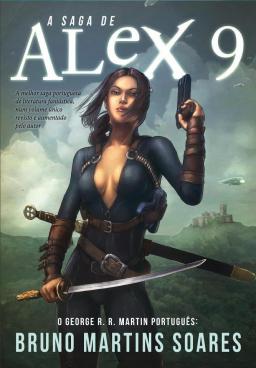
Anyhow… By this time I was writing mostly realistic fiction. I like writing realistic fiction, but I realize now that I was being prejudiced against one of my favorite genres: Scifi/Fantasy. In Portugal in particular, Scifi/F is considered a minor genre and is not accepted as something as prestigious as realistic fiction. And so it took me a while to understand that my prejudice was keeping me from writing what I really wanted to write. And this actually blocked me for years. Finally, around 2007, I started writing a novel I had in my head since the early 90’s. A Saga de Alex 9That was THE ALEX 9 SAGA – a trilogy about a Special Forces operative from the 22nd century who gets lost in Space and finds a new planet very similar to Earth, but where they are still living in the Middle Ages. She soon finds out that she’s not there by accident and the intrigue spans through several light-years and centuries of time. This saga was eventually published in Portugal in three books by the Portuguese publisher Saída de Emergência, within the series that also featured George R.R. Martin’s SONG OF ICE AND FIRE, a.k.a. THE GAME OF THRONES, and other incredible works from authors like Bernard Cornwell. Imagine my joy!

After that (by now it was 2012) my attention was drawn to other stuff, like screenwriting (produced a movie!!) and more short-stories. Around 2014 I decided to face a new challenge. I wanted to go beyond Portugal and find more public. I had written several screenplays in English and found I could handle myself well enough in that language, so I bit my tongue and started writing a new Scifi novel in English. I’d been reading Napoleonic Era Navy novels by the likes of Alexander Kent and C.S.Forster, and loved the atmosphere they showed. I always liked good teams at work and Navy novels show you that. At the same time, I was hooked on a PC game called NAPOLEON TOTAL WAR, where battles last for hours and you could fight with powerful fleets of sail ships. I wanted to write something that felt like that. THE ALEX 9 SAGA had already been inspired by the TOTAL WAR series; and Scifi/F gave me the chance to invent great battles and geopolitical conflicts without sounding absurd. Then this idea came to me: what if I wrote about a war resembling WWII, but in a distant Solar System, where planets were as the countries on Earth? That was it! That was cool! So I started writing THE DARK SEA WAR CHRONICLES.

Bruno_Martins_Soares_K (1)

It took me a few years of writing and re-writing before I was ready to try my luck. I sent the book to some agents around the world, but became increasingly disenchanted. At the same time, I was reading and studying more and more about self-publishing. I decided I had to try it and late last year I finally published the first volume of TDSWC – FIGHTING THE SILENT on Amazon. I loved it. The whole process was enjoyable and soon I was getting results, people from all around the world buying and reading my book! I marketed it within the Scifi circles in Portugal and started getting reviews from people who knew my work, like this:

The book starts early on by setting the stage and the tone of a retro-sci-fi world building that is absolutely stunning, and only gets better. Am eagerly awaiting the next ones! Carry on!

 It’s always good reading something like this. But then you start getting stuff from people in other countries that you never knew existed:

Loved it. Can’t wait for the next book. I loved the notion of submarine warfare in outer space and how humans would cope with it. Also really enjoyed the romance between the two main characters.

 Or:

Book 1 of a series. Great story. Great writing. Lots of good character development. Interesting from beginning to end.

 That’s when you get hooked! You start going to the Amazon page everyday to look for reviews. A fool’s errand, of course, as many others you have in this business. Another special date is when you get the first paperback copy in the mail. It looks so good on the shelf!

Bruno_Martins_Soares_KVol2

Then I published the second volume – MISSION IN THE DARK. The downloads kept coming. And I started earning some money in yen and rupees. That’s so cool! Here’s another review from some unknown person from around the world:

Superb, read it from cover to cover in one sitting as I simply couldn’t put it down. I can’t wait for the next book.

People are unanimous: the second volume is better than the first. And now comes the last one. As I usually do, I’ve sent it to some bloggers here in Portugal. The first review already came in and it’s stellar. I can’t resist translating a few lines for you, from Carla Ribeiro’s AS LEITURAS DO CORVO:

One of the most impressive aspects in this trilogy – and oh it does have some impressive aspects – is the way the author fits everything together in such a short volume. In one hundred and fifty pages you have large memorable battles, life and death decisions, revelations and inner demons, humor, strokes of emotion and a global context so vast it’s almost unending. And the best of it all is that nothing seems rushed, nothing is too narrow, nothing crucial is left behind.

It’s really good to get reviews like this. They tell you things about your work you hadn’t even noticed! They fill your soul. There are several things that really make me happy in writing, but three great moments come to mind: the moment I finish a large work as a novel; the moment I have the book in my hands, especially if I see it in a book store, and I know people are buying and reading my work; and finally, when I get great feedback. I love all of this. Tomorrow, the final version of my latest trilogy will be available for download – and soon after as paperback. Some will like it and some will not. That’s the way it is. I’m already working on the next one. If you want, you can download the first volume of THE DARK SEA WAR CHRONICLES for free at Amazon, Barnes & Noble, Kobo, etc. If you do, please get back to me on it. Tell me what you liked and what you didn’t like. Just comment below or review it at Amazon or Goodreads. Feedback is always welcome. And enjoy! That’s what books are for!! I sure love writing them!


‘Annihilation’, Conscience and Perspective

I finally watched Garland’s ANNIHILATION and loved it. Let me talk about it, but let me go about it in a twisted long way, alright? Then tell me if it was worth it.

MV5BNDJlNWU5MGQtZGZhNC00ZjAyLTlkYzUtNDM2NzczY2EyNWI5XkEyXkFqcGdeQXBrZWVzZXk@._V1_

When I was about 16 years old I had my first deeper bouts with Philosophy. For a while I was fascinated with Descartes. Not his preposterous proofs of the existence of God, rather I was enthralled by the concept of the Doubt, his methodical doubt. What if we doubted reality? What if it was all a dream? What if it was an illusion? Like many other illusions we have.

Does a stone think? We actually don’t know. We know that it does not have a brain, but what if it has another way to think? Some way we are unable to access? There’s a lot we don’t know. So much, in fact, that if we stopped to think about it, we wouldn’t be able to do anything else. So we assume. We assume reality is unified, that we sleep, eat, make love, get drunk, laugh and cry. We assume that the Past we have in our memories was real (even though our memories are fallible) and that the Future we plan for will happen more or less how we expect (even though it never does). We pretend there are more moments than the absolute Present. We assume that even if we don’t see or touch the Egyptian Pyramids, they are actually really there. Or that even when we don’t experience the sea, it exists somewhere. There is no certainty of this, but we assume it because it supports our balanced lives and there would be no escape from doubt without a slimmer of belief. I’ve written a little bit about this in here, when I was speaking of ARRIVAL – check it out.

Well, after Descartes and some others came Freud and Lacan. Unlike Freud, Jacques Lacan wrote about the psychotic mind. Freud taught about neurosis, which manifests in the difficulty of managing relationships. A psychotic mind, however, has a true difficulty to perceive and manage reality as a unified concept. The reality gets ‘split’ in the mind and that assumption mentioned above about assuming reality in a pragmatic way becomes impossible. I love that sentence I think Freud said: ‘mental health is the ability to deal with ambiguity.’ In other words, being sane is the ability to live in uncertainty. Of relinquishing some control. Psychotics have some difficulty in doing this because the Doubt scares them to death. They rather believe in exotic certainties and conspiracy theories than deal with the doubt of existence.

annihilation-what-is-the-shimmer-1086305

So, for Lacan, reality is a construction of our mind, and there are three orders of thought: the Real is that which we can’t deny. If we drop an orange on the floor it will always fall down – not up, not to the side. Even if we doubt that it will fall down the next time, we drop it again and it falls – and it’s very difficult to keep doubting – that’s typical of the Real. Then there is the Imaginary, which is the part of us that, basically, if I recall correctly, is what we cannot share, what remains within us no matter what. It’s an area of ideas, images, impressions. Finally, there is the Symbolic, that culminates in Language and is the realm of the shared reality. This idea that Reality is a construction that can be somewhat illusory and revolves around these orders is very interesting and is the basis of what I call Narratives of Conscience (it’s just what I call them, there may be other names by other authors), which is a kind of narrative that has been very common in Scifi for some time. In Narratives of Conscience we are never very certain of reality. It could all be an illusion. We see it in films like THE MATRIX, INCEPTION, TOTAL RECAL, etc. In these movies, the protagonist is haunted by an elusive conscience of reality that may or not be real. The Doubt dominates the narrative. We can see it most in the stories by Phillip K. Dick, who, some say, was himself mentally ill.

But I have been recently spotting another trend in Scifi narratives. I don’t know what to call it except maybe: Narratives of Perspective. These do no center in the fabric of reality itself, as Narratives of Conscience, they don’t doubt the construct of reality, but they add to it. They impose on us a different, almost unreal perspective. As if we are obligated to think of reality in a different way. With an added perspective.

evolution-trailer-aex-garlands-annihilation-696x464

This is the case of ARRIVAL, by Villeneuve – even though it plays with our conscience of the facts, time and space, we never doubt as we watch it that we are watching a single unified reality. We can’t say that in the MATRIX, for instance, or in THE MAN IN THE HIGH CASTLE, where there are multiple possible realities – who knows if true or illusory?

As in ARRIVAL, Garland’s ANNIHILATION plays with our sense of perspective more than our sense of conscience. To understand the alien invasion we need to perceive what it really is doing and not assert what is illusory or not. That is interesting, stimulating and thought provoking. I, myself, loved the movie. It’s no-doubt one of the best Scifi movies of the last few years and I absolutely recommend it.

This (new?) Narratives of Perspective seem appropriate for our times. Added Perspective assumes that we agree on some sort of plateau of reality. That we understand there is illusion sometimes, but that we are secure enough to communicate with each other in a balanced plain, and understand each other enough that we can actually act on what surrounds us. That seems to be what is lacking in the world today, with new virtual realities, cries of ‘Fake News’ and so many divisions in the way we all see reality itself. It almost looks like the world itself is schizophrenic. Maybe everything is an illusion. Some of us really don’t know. But that’s why it’s so urgent to find a Language, a Symbolic order, we can use to understand each other and balance the plain. Even if what surrounds us seems surreal, let’s add to our perspective, try to understand new views, instead of acting blind.

The Cartesian Doubt is all around us. It is, or it should be, inevitable. Certainties are very frail. But being sane means being flexible. Being intelligent means being determined to communicate: to listen, to accept, to be balanced. I like these Narratives of Perspective. I’m eager for more. Will you write the next one?

Writing Subtly: Talent, Sophistication, Subtext and Pragmatics

When I was very young I was enlisted in Music School, trying my best (and mostly failing) to learn how to play the piano and the sax. One day, my mother pointed to me a young man carrying a cello that was said to be the best cellist in town. She said to me: ‘That young man’s first teacher told him he had no talent whatsoever for playing the cello. But he changed teachers and kept working and look at him now. He’s better than his teachers.’ This is not an uncommon story. You know that saying: ‘Hard work trumps talent every time’? I believe in it. I’ve seen time and again very talented artists and writers never achieving anything while others less talented but hard working being able to do impressive stuff. I saw it again a few weeks ago when I was teaching Screenwriting to a young class of would-be film directors. Curiously enough (or maybe not) there was a gender gap: the girls in the class worked their asses off, while the boys were too sure of their talents. You could see the potential in some of the boys, but the effort wasn’t there, and if you don’t develop work habits when you are young, you’ll have a hard time later. Guess who’s got the best grades? As for me: I was lazy studying piano playing, but not when it came to writing. I was persistent and steady in my writing over the years and it has been paying off, I guess.

images

But this is not a post about talent and hard work. It’s about something else. It’s about seeming effortless in writing. It’s about being subtle. Fluid writing seems a matter of talent but, to be sure, it’s more a matter of hard work. People often confuse sophistication with intellectual thinking. I’ve seen many writers and filmmakers pursue the dead end of intellectual thinking flabbergasted by the idea of showing intelligence or fascinated by the work of some fringe artist, while undervaluing the effort of execution and of learning how to be fluid, deep and sophisticated.

Let me go back to Hemingway. Here’s a piece of dialogue from ‘A FAREWELL TO ARMS’:

transferir

(The leading couple is in bed. The protagonist is trying to convince his girl to marry him – she refuses.)

(…) ‘I am married. I’m married to you. Don’t I make a good wife?’

‘You’re a lovely wife.’

‘You see, darling, I had one experience of waiting to be married.’

‘I don’t want to hear about it.’

‘You know I don’t love anyone but you. You shouldn’t mind because someone else loved me.’

‘I do.’

‘You shouldn’t be jealous of some one who’s dead when you have everything.’

‘No, but I don’t want to hear about it.’

‘Poor darling. And I know you’ve been with all kinds of girls and it doesn’t matter to me.’

‘Couldn’t we be married privately some way?’


Hemingway goes through pages and pages of dialogue without any description. Everything in between, he trusts the reader to build on his/her own. So let me fill in the blanks – let me try to add some description to this dialogue (sorry Ernest):


‘I am married.’ She said, looking at me in the eye intensely, surprising me. ‘I’m married to you. Don’t I make a good wife?’ She kept trying to convince me that she was committed to me.

‘You’re a lovely wife’ I said, trying to calm her down.

‘You see, darling, I had one experience of waiting to be married.’ She explained as she remembered her lost love.

‘I don’t want to hear about it.’ I said, jealous of her memory.

‘You know I don’t love anyone but you. You shouldn’t mind because someone else loved me.’ She said, a little embarrassed.

‘I do.’ I knew she loved me even though I was jealous. But it was stronger than me. She tried to appease me.

‘You shouldn’t be jealous of some one who’s dead when you have everything.’ In reason, she was right. The man was dead, for Christ’s sake. But it still bothered me.

‘No, but I don’t want to hear about it.’

‘Poor darling.’ She said, with a condescending smile. ‘And I know you’ve been with all kinds of girls and it doesn’t matter to me.’

I just wanted to change the subject, come back to the matter at hand:

‘Couldn’t we be married privately some way?’


See how I messed it up? It’s not a bad text because I added description, it just stopped being a sophisticated text. It stopped being clever Hemingway, who respects and values his readers. This is where the adage ‘Show, don’t Tell’ comes to fruition. Subtlety is in rarefying the information to give the essential to the reader. Focus on the feeling, and not on what exactly is said. Focus on the subtext and not on the actual text. Robert Mckee will tell you as much. Dialogues in movies should focus on subtext. And I would add: and everything we write in fiction is the same – subtext is the key. What is subtext? It’s what’s said between the lines. It’s the core of the relationship. Not only the relationship between the characters but also of the relationship between writer and reader. (A core aspect of this is what I call ‘investment’ which I spoke about in here )

There’s this school of Psychology in Palo Alto, California, founded by Paul Watzlawick and others, that studies the pragmatics of Human communication.AVT_Paul-Watzlawick_8465

They say that there are two kinds of communication. In digital communication, everything is black and white, 0’s or 1’s. It’s all about information. But then there’s analogue communication, with all kinds of grey areas where not everything should be taken at face value. Most Human communication is this second kind, where the relationship is the core, not the information. So if I ask you if a cake you’ve eaten was good and you say ‘Yes’, but shrug your shoulders, I’ll feel you actually did NOT like the cake. The information coming from your words is not correct as you contradicted it with the shrug. This is the essence of subtext. The words in Hemingway’s dialogue are digital information, but the subtext between the lines is what actually defines the relationship. The subtlety comes from the knowledge that the readers will perceive the subtext more impressively than the actual text.

And there are rules to this communication. The Palo Alto school will tell you that ‘It’s impossible not-to communicate’; or ‘every communication is a commitment’; or ‘repeated communication defines the pattern in the relationship’. And other things we’ll talk about another time.

My point is: intelligent sophisticated writing is about going deep and working hard in the execution. Learn to be subtle by showing, not telling. When we read Hemingway’s dialogues we can guess the action, we can imagine the reactions. The essential is in the words being said. Being exchanged. And they’re more important because of the subtext they carry rather than the words themselves. Sophisticated writing is not about good ideas and intellectual thinking. It’s about learning about communication and working between the lines.

I must disagree with other people: you do not become a writer just because you write. That’s digital thinking. You become a writer when you are being read. It’s all about communication. And for this, you need to learn a whole lot of things. You need to learn your craft and you need to learn about people and much more. But it could be a truly wonderful journey. If you’re on your way – good luck.


Why I Celebrate Easter

And so, it’s Easter. This is a particular holiday. I was raised a Catholic as most Portuguese, but I haven’t considered myself a Christian for some time. Yes, I was baptized. But no, I don’t believe Jesus Christ was a son of God, nor that he died for our sins, nor that he was reborn. Actually, Easter stories are the ones I used to make most fun of. So Judas was really identified as a traitor at the Last Supper and none of the apostles tried to stop him? Or was it a lucky draw where Judas got the short straw and was instructed to stage the betrayal so Jesus could die a martyr? That’s why he killed himself, right? The narrative of Easter is full of logical holes and I would make fun of it now and then.

But now I celebrate it. Why? Because being with my family and friends and having a meal in peace and happiness is much more important to me than discussing the absurdities of organized religion. I cherish the occasion, not the symbolism.

cropped-maxresdefault.jpg

A long time ago, I had an enlightening conversation with a friend of mine, an Italian philosopher about Faith and Meaning as we walked and drank on the streets and bars of Sarajevo. I’m not sure anymore about what he told me exactly but it’s still very clear in my head what his words meant to me. What I took from that conversation was this: the way we see the Universe and Existence is mostly a question of Aesthetics. Does God exist? Is it a big hoax? Does Nature evolved by itself? Is atheism the answer? There really is no way to prove a thing or another. The Universe is still too immense for us to understand it. So the way to cope with our ignorance is: believing in something. What makes sense to us? Is the Universe more beautiful with a God in it? Or without it?

We try again and again to have intelligent logical conversations about it, but they are, in truth, void conversations. They don’t mean anything. The purest truth is: we don’t know. So being an obstinate atheist is as incongruent as being a religious zealot – at least in logical terms. But let us have another type of conversation. Let’s discuss how we find the Universe beautiful. Accept our ignorance and accept that to someone it makes sense to believe in God and to some others it doesn’t make sense to believe in God. And, as in any conversation on aesthetics, let’s respect the taste of one another. Believing in God or not is, in the end, a matter of taste. Think about it… It can take some time to get to this conclusion. But let’s face it… Do you have a better one?

Okay, I have some misgivings about organized religion, but that’s a whole other conversation I’ll have with you another day.

Today, I’m celebrating Easter. I don’t celebrate it because of Jesus Christ, I celebrate it because my family is together, we are feasting on fresh fish, puddings and sweets, and that’s beautiful enough for me. I celebrate it because I enjoy it. I hope you do to.

Happy Easter, everybody!