This will be the first invitational post for Hyperjumping. My friend Nuno Reis is a computer scientist with a thing for cinema and science fiction who is now exploring marketing to manipulate the minds of others (yes, he turned evil). He usually writes about the fantastic in SciFiWorld.pt, and about Technology in blog.nunoreis.pt. I asked him to write whatever was going through his mind at the moment and this is what he sent me:
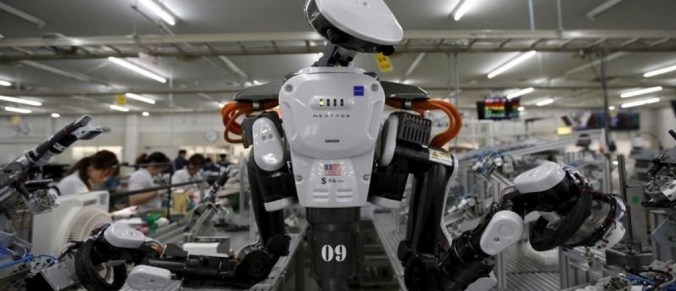
We hear all the time that a human life is priceless, but no one speaks about the value of humanity. Everyone is talking about the robots and Artificial Intelligences that will take our jobs, but no one is considering the jobs that will remain human forever. Let’s look to our society.
The pessimistic vision
The first step leading dehumanization of work was mass production. Each man was a specialist in a single task and had to do it ad infinitum until a tendinitis or mental breakdown sent him home or out of a window.
Then war came and men were disposable objects against automated machine guns. People used to kill people, but in the 20th century weapons started to kill people without help. Women step into factories to keep production and consumption high.
And then the doubled workforce was too high to keep. Without the scarcity of human resources, companies became more demanding, paying worse and terrible conditions. Unions faced the threat and gave better conditions, like 35-40 hours weeks, health insurances, vacations periods, leaves, retirement plans, trying to make the faceless corporations to see people as people.
Things were going great until machines started to take the place of people in the work lines. First were the manufacturing jobs. A robots is better at doing repetitive tasks than people. No tendinitis, a 24/7 work week every week and never complain about anything. The precision of robots allowed industry to go to a nanoscale no one ever dreamed about. That led to better machines and better computers.
 Computers are thinking machines. They started to take the jobs from mathematicians. Database quickly replaced libraries and digitalized every possible archive to make it smaller to store and faster to search. It was called progress and everyone enjoyed having a personal computer at home and to do shopping online. In a few years computers were in our pockets, in our cars, in our watches, in our clothes, in our tvs and in our fridges. Computers everywhere, telling us what we should wear, what we must watch and what we must buy.
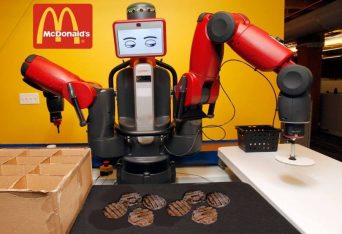
And then computers started to think for us. First it was fun to say a computer defeated a person in chess. It is just a brute force algorithm. Then a computer defeated a human in Go, a game where brute force is not possible and some strategy is required. Suddenly we realized it was too late. The A.I. handled payments in parking places, in highway tolls and in grocery stores replacing low pay jobs. They even flip burgers in fast food restaurants. But they are not only in production, administration, logistics and sales. They are working is cinema, in healthcare, in marketing, one is even running to a mayor office in Japan. Old jobs will disappear faster than new ones can be created. Unless we can prepare a new generation is less than a decade to be more than computer savvy and take the jobs of the future, we will have a huge gap between the I.T. people and the others. The ones with high paying jobs and the ones without a job.
This is where we stand. Some countries are preparing a social system were everyone gets a basic wage and can do stuff to become more profitable. Hobbies turned into passions. But unless you are truly an artist and your work is enjoyed, how do you plan to sell? Computers can think of anything and print anything faster than you. They will create what people want to buy. You’ll will have to learn from YouTube, sell in Amazon, advertise in Instagram… you’ll need to ask Siri for help with all that. Or just join the dark side and let the computer to all the work for you. It is so much easier to just let it be.
The light at the end of the tunnel
There is a goal in Computer Science called the “Turing test” where a computer has to pose successfully for a person in an online talk. A jury chats with several people and bots, and if a bot is taken for human, the computers win. They are scarily close from it. Some have already won, but they cheated like Deep Blue.
Because the jury is biased, it is hard for humans to get a 100% score. A secondary goal is to be the most human among humans. Can we apply that logic to jobs? Where is the humanity irreplaceable?
The sad conclusion is that the only thing robots can’t do to mimic people is to be family. Maybe they can trick us in most of our adult life – having a meaningful chat, serve us a home meal, having sex – but for a child there is still a big line. I don’t mean school. Kids would rather learn from their tablets than going to a place with other children. But before that. The early stages of cognitive development where not only colours and sounds matter, but the human touch (sensorimotor stage) and the wonderful moments of building a language (preoperational). Even if the machine learning of harvesting blabbering data from millions of children makes a computer knowledgeable of the subtleties of those little creatures, nothing replaces a person. We are doing it with our senior citizens, but no one would dare to give an innocent child to a machine!
 We all know what the oldest job in the world is. I dare to say that the last job will be a close match between Parent and Foster Care. Yes. I demand that parenting becomes a job with proper training and evaluation. With all that free time, there are no excuses. The single mention of an exam will reduce birth so much that the planet is safe. And Foster Care is because even the best A.I. teachers can’t be sure if parents will be good, and A.I. doctors can’t keep early death away. There will always be a human missing for someone. The one that is priceless.
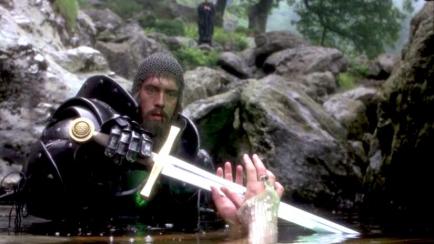 Arthur takes it as Lancelot wakes up – he is happy, he finally found a king who could beat him and, so, a king he could serve. This is incredible plotting technique as intentions and motivations and action twist and turn around themselves. Lancelot is so perfect, a figure of myth himself, a figure of the Lake, that only supernatural power can overcome him. It is Excalibur, not Arthur, who defeats him. But in using Excalibur for himself, Arthur is committing the sin his own father had committed – and so Excalibur is lost. So Arthur must recognize his own fault and his mistake. However, only by that mistake does he win Lancelot’s loyalty. When he gets Excalibur back, Arthur becomes the king Lancelot could follow. If he hadn’t committed that sin, he would never have won Lancelot. Clever, no? One single event has opposite effect on two storylines: to win Lancelot, Arthur must lose Excalibur. And yet he needs both.
 As they travel, Guenevere asks Lancelot if he loves any woman. As he is a perfect knight, Lancelot replies that he serves his king and, as such, he can only love one woman forever: his queen. This is very perverse and is masterful plotting: it’s Lancelot’s perfection itself, his virtue, that will bring everything tumbling down. To avoid the traps of this love, Lancelot starts travelling, becoming absent. This is the pretest evil Morgana can use to arouse suspicion on the minds of the court. On one of his travels, Lancelot comes across Perceval, who becomes his squire. Perceval will be the symbol of the common man and a very important character as the History progresses. At the same time, Lancelot is betrayed by his dreams of lust/love for the queen. Awaking from one of this dreams he accidently stabs himself with his own sword (a phallic symbol of desire turning on the man). Meanwhile, Morgana is able to convince Sir Gawain of Lancelot’s betrayal, encouraging the knight to accuse the champion and the queen. Arthur must make a choice: either he defends Guenevere as his husband and his man, or he remains her king and her judge. Of course, he won’t commit the same sin as his father, he won’t fall into the temptation of being a man first and a king later. He decides to remain the king and leave Lancelot to defend the queen. The wheels keep turning. At the day of the trial, Lancelot is not there to fight Gawain and defend the queen as he is still fighting the wound opened by his desire. Arthur then asks if no-one would defend the queen. The only one willing is the small, humble, common, brave Perceval. Arthur hurries to make him a knight, even though the man has no chance against Gawain. At the last moment, Lancelot shows up. He defeats Gawain because in truth, he and the queen have not betrayed Arthur. Still, his wound opens up and he almost dies, because in truth Lancelot and Guenevere are in love. Lancelot is the man Arthur cannot be. He is the perfect man instead of the perfect king. That night, Guenevere goes to him and he cannot reject her. That is the night of doom. In one night, Lancelot and Guenevere betray Arthur, and Arthur sticks Excalibur on the ground between them. When he does this, Excalibur injures the Dragon and Merlin dies. Arthur is then deceived by Morgana and makes love to her, making her pregnant. He also falls into the trap of lust and sin. In one night, everything that was built is destroyed.
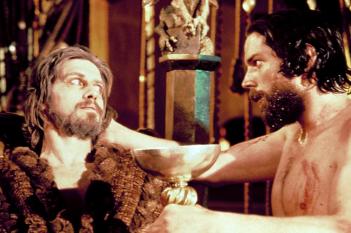 He travels far and hard, watching his fellow knights fall one by one. When he is caught by his enemies and hanged and he is about to die, he finally sees the Grail, then a voice is heard: «What is the secret of the Grail? Who does it serve?» Perceval is saved at the last minute, losing the Grail. But he must try again. On one of his travels, he finds Lancelot, gone mad, preaching the apocalypse with a cross on his neck. As Perceval tries to approach him, Lancelot pushes him into a river. Perceval is pulled down by his armor. He is going to drown. He takes off his armor piece by piece. He becomes a common man again, fragile and alone, about to die, resembling Christ himself. And then he sees the Grail again, and again the voice asks: «What is the secret of the Grail? Who does it serve?» But now Perceval knows the answer: «You and the land are one.» «Who am I?» «You are Arthur my king.» There: that’s everything! That’s what the movie has been telling us since the beginning: the land, the people and the king are one. That’s the secret of power. All connected. Perfect!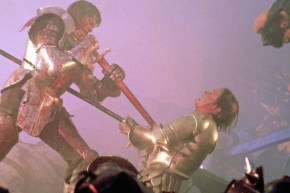
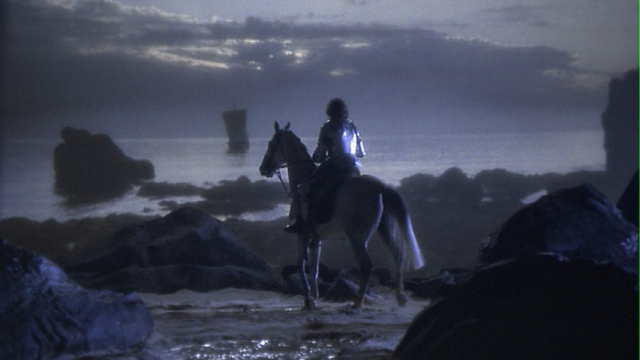
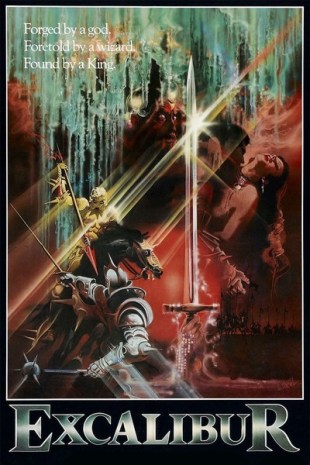
 It all starts with Uther Pendragon, a warlord of early feudal England. The land is divided and lords fight among each other to find a king that’s worthy of the throne. Uther has an ally, the wizard Merlin. Merlin draws his powers from The Dragon, which is Nature itself, it seems. Merlin would describe it as: «It is everything! It is everywhere! It is all around us!» Merlin takes Uther to a lake where the Lady of the Lake gives him Excalibur, the Sword of Power, made from the scales of the Dragon itself. Showing the sword to the other lords, Uther achieves peace and allegiance. However, he’s not a complete man and so he falls in love/lust with his rival’s wife. War breaks out again. In the mist of battle, Uther asks Merlin to use the Dragon’s power to give him a night with the woman. Merlin, seeing Uther is not the man to unite the land, accepts but demands a mystery favor in return. Uther gets his night of love with Igrayne.
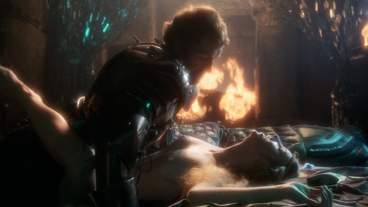 The image of a full armored man making love to an eluded naked woman was very erotic in the 80’s, and it is the perfect image to show us the Age of Chaos, an age where myths, mystical magical powers, passions, violence and war were the way of the land. Uther crushes his rival Cornwall and marries the widow Igrayne, who gives birth to Arthur. When Arthur is born, Merlin returns and demands the baby as payment for his service. See how the plot swirls around? Merlin gives his power to Uther, lends him the power of the Dragon, but as Uther is an imperfect man, a man of his age, it is exactly because he wins everything he wants that he will lose in the end. A perfect king must know that the use of power is not about him. Is not about being powerful, it’s about more than that. Still, Arthur is the union of the Pendragons with the blood of their adversaries, which makes him the embodiment of the Union. He has a half-sister, daughter of Igrayne and Cornwall: Morgana LeFey, which will be the remnant of the Age of Chaos and embodies the revenge of Uther’s rival – so Uther’s human faults, the ‘mistake’ he makes in the beginning of the movie, will be the downfall of the Pendragons in the end. A perfect circle.
 Anyway, Arthur has grown into a young man, raised by Lord Ector incognito and becoming the squire to his would-be brother Kay. Kay is to fight in a tournament to earn the right to pull Excalibur from the stone. As Kay’s sword is robbed, Arthur decides to take Excalibur from the stone and does it easily. He becomes the king, but several of the lords will not accept a mere boy as king so they rebel against him. Merlin shows up to help Arthur and is impressed by the boy’s leadership skills. As Arthur goes to help his main ally besieged by Lord Uryens, the movie gets to one of its best scenes. I’ve shown this scene at some Leadership Seminars and it always moves me. It is, for me, the portrait of true leadership. This is what happens:
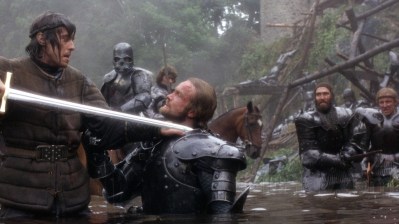 What a brilliant scene!! I still get goose-bumps from it. A king is not the one who wields the power, he’s the one who is true in his heart. The one who serves his people, not himself. Arthur understands what Uther never did. And so he becomes what his father never could. This scene not only is brilliant in the writing but completely serves the story. We not only recognize a leader in Arthur here, but we find that the reason he becomes a leader is the whole point of the whole story. This is plotting, my friends!!


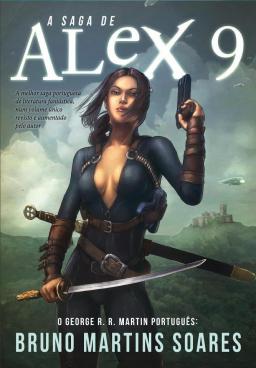 That was THE ALEX 9 SAGA – a trilogy about a Special Forces operative from the 22nd century who gets lost in Space and finds a new planet very similar to Earth, but where they are still living in the Middle Ages. She soon finds out that she’s not there by accident and the intrigue spans through several light-years and centuries of time. This saga was eventually published in Portugal in three books by the Portuguese publisher Saída de Emergência, within the series that also featured George R.R. Martin’s SONG OF ICE AND FIRE, a.k.a. THE GAME OF THRONES, and other incredible works from authors like Bernard Cornwell. Imagine my joy!






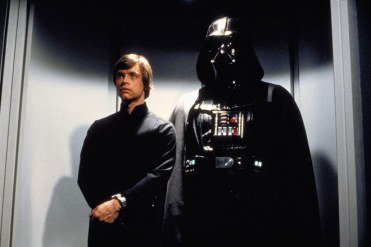
 But, really? What is this thing of ‘being turned to the Dark Side’? And how can we harmonize the pristine idea of the child Anakin with the Evil of Darth Vader? The movies’ execution is not as bad as some seem to think: if you look at the first trilogy you’ll probably find a lot of problems as well (not in the least the absurd way time is considered in THE EMPIRE STRIKES BACK – when we are supposed to believe that Luke Skywalker became an almost fully trained Jedi knight in a matter of days). The real problem with the second trilogy is that you cannot empathize with the protagonist. Anakin is either Evil incarnated or the hero we root for. He cannot be both. And there really is not another protagonist we can follow. Not even Obi-Wan Kenobi. Because he is always a supporting character. Period. And even as we see Anakin choose wrongly in many intersections, we feel, or we are led to believe, that he has a good heart, and a willingness to do the right thing. That is systematically shown to us. And even as he is deceived, it’s difficult for us to understand what is that Dark Force that is invading him and why. We see him ‘Save the Cat’ too many times to suddenly believe he will turn into someone that will cold-heartedly ‘Kill the Cat’ from then on. Something is amiss in that character and so something is amiss in that whole story.
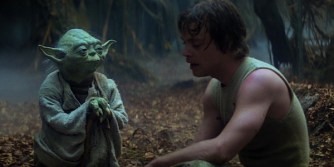 But still, I didn’t like the final confrontation between Rey and Ren. It missed something. Not only did I not understand how someone like Rey could fight and win a fully trained Sith like Ren, but also the Ren character didn’t seem sophisticated enough, devious enough, determined enough to be a Sith Lord – a strong antagonist. In THE LAST JEDI, however, that weakness is not present. Rey and Ren’s connection is in fact what moves the whole picture. And in this picture, the theme of choice comes back with a vengeance. Choices become more complicated and less clear. We can also see this in the character of Luke Skywalker – who seems to think Light will bring Darkness and maybe vice-versa. Using a lot of references to the other movies, specially THE EMPIRE STRIKES BACK, THE LAST JEDI does exactly what that second movie achieves also: to bring the forces of the antagonist to an advantageous position. Typical Second Act stuff. But it does so by blurring the lines even further and showing how difficult it is many times to do the right thing. Making the moral choice is not easy, and many of us are misguided to what will fulfill us or relieve us. THE LAST JEDI sophisticates the Star Wars Universe, but not in a strange query way as the second trilogy ended up doing. This Episode VIII shows us real Evil and real Good: when the crisis hit us, which of us will choose rightly? Even when it seems we are doomed to fail?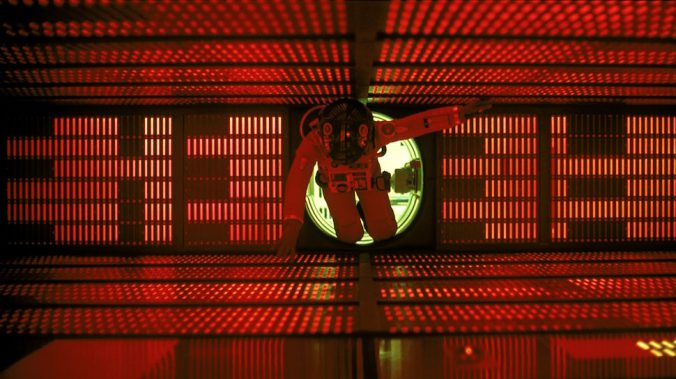
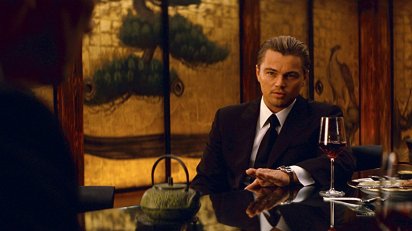 missing, but I find INCEPTION to be absolutely brilliant. The performances by DiCaprio, Cotillard, Gordon-Levitt, Ken Watanabe, Cillian Murphy, Ellen Page, Tom Hardy, are all very strong. Most of the characters are complex and human and the love story is perfect. I think the movie is very clever and brilliantly brings the Theme of Conscience to another level, forcing us to absorb several realities and timelines at the same time and always be in doubt. I love it.
 Hyperjumping