Once upon a time, television was the realm of poor acting and disenchanted directing and producing. It is said that long ago there was a Golden Age of television when wonderful shows as I LOVE LUCY, BONANZA or THE TWILIGHT ZONE actually changed the landscape, but that time had passed without much trace. All we had, then, was a bare scenery of superficiality and empty imagination. In those days we used to look at movies as the place for real dramatization and the home of talent. Very few actors with more than an ounce of self-respect and any ambition whatsoever would be caught playing for the small box and directors would get a better reputation creating video clips or commercials than working on television episodes. But then, something happened. Some would say that it was the advent of cable TV with its millionaire pay-offs or the prophecies of multiple channels and platforms in digital. However, another event comes to mind: suddenly, Writers became important. The figures of the Showrunners, Writers most of them, became warlords and noblemen. And then, as if by magic, the chains of mediocrity were destroyed and another Golden Age of television brought us a myriad of incredible and immensely talented shows. Legendary series as THE SOPRANOS or WEST WING surged from the shadows. And binge-watching was born with the likes of 24. Brilliant organizations as HBO and Netflix made history. Inevitably, as more and more shows target narrower and narrower niches, the Golden Age will slowly fade away. But let us enjoy its remnants while we can. As is my tradition, let me speak of a few shows I love, arranged in no particular order. I hope you like them as much as I do.

- GAME OF THRONES – I already talked about this incredible phenomenon here. I was already in love with this amazing story and characters well before it became a TV series. George R.R. Martin’s genius is apparent to anyone who passes their eyes through his texts. He dwarfs the likes of Tolkien or Rowling, in my view. And the series, worldbuilding in a massive unbelievable fashion, propelled him to stardom. It is a pity, of course, that Martin’s masterpiece wasn’t finished in the five years it took the series to catch up to the book’s storyline – I believe that as the screenwriters slowly replaced Martin himself, the quality of the plot diluted a bit. Maybe a lot. We still had brilliant writing, brilliant production design, and acting and directing until the end, but without the structure of Martin’s books, the producers were left to make poor plotting decisions that almost killed the series in the end. Still, it will be forever a phenomenon of the medium and the first of several HBO hits on this list.

- SHERLOCK – Steven Moffat, arguably one of the greatest TV writers of all time, signed what is perhaps the best adaptation of the novels of Sir Arthur Conan Doyle ever produced. The series design and Benedict Cumberbatch’s rendition of the sociopathic but genial detective overwhelm us with intelligence, balanced with the superb Watson of Martin Freeman and overshadowing forever the pathetic attempts of other movies and TV series to portrait these classical iconic heroes. Rarely have I seen genius so well represented and it is very difficult to keep your jaw from falling as you pursue the mysteries and conspiracies that come out of this series. And even if you feel obligated to focus on the brilliance of Cumberbatch and Freeman’s performances, and on the wonderful writing, we cannot miss the ever-talented directing that comes with it. We feel constantly one or two or ten steps behind Sherlock Holmes – as we should. And even the translation of the Victorian detectives to the modern age, with the clever adding of modern technology, does not break the link to Doyle’s novels. The different seasons, in the British tradition, are composed only by three or four movie-length episodes – but even if we spend only a few hours with this series, we will cherish every minute. Do not miss it.
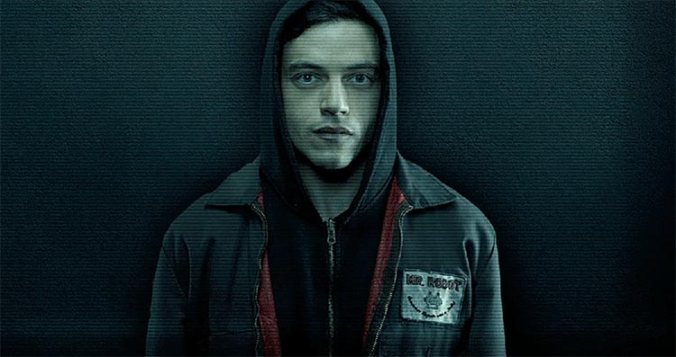
- MR.ROBOT – The American response to the brilliance of SHERLOCK, Sam Esmail’s MR.ROBOT breaks some kind of mold. Extremely clever and profound, this series about a talented hacker involved in a powerful conspiracy to end the reign of oppressive massive corporations will blow your mind. The unbelievable Rami Malek gives life to this troubled and isolated hacker vigilante who always has a surprise up his sleeve. At each turn of the screw, we are left with more questions than answers but there is something extremely perturbing and relatable about the whole absurd story of Elliot Alderson, along with the surprising performance of Christian Slater. Still, what makes this show really powerful is the inspiring, creative and talented directing by Esmail. I really believe his name will become a household name in the near future, especially if he crosses the line into the realm of movies. He has a touch of Kubrick in him and his shots and solutions always feel a bit off and yet incredibly adequate.
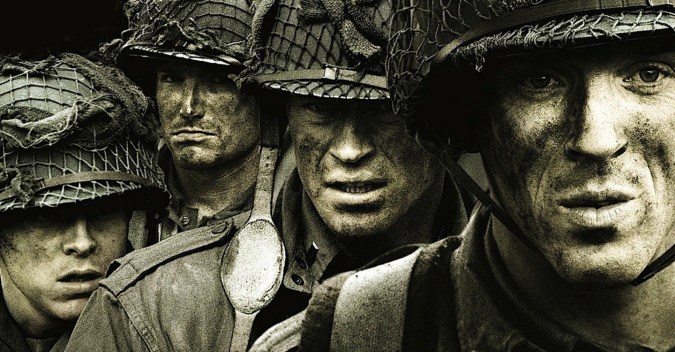
- BAND OF BROTHERS – Here’s another show for the history books. Literally. It tells the true story of WWII’s 101st Airborn Division’s Easy Company as this group of ordinary men become extraordinary by doing their job in the intense theatre of the European War, from the invasion of Normandy through to Germany itself. Sponsored by the capable and iconic hands of Steven Spielberg and Tom Hanks, these 10 movie-length episodes use filming solutions we recognize in SAVING PRIVATE RYAN. The series is amazingly powerful, featuring also testimonies from the survivors of Easy Company themselves. With very few women through the whole thing, it is, however, one of the best war stories ever produced. It’s incredibly solid in every way. The directing, the music, the acting, the design, the producing, the cinematography: everything is top-notch in this 2001 HBO series.
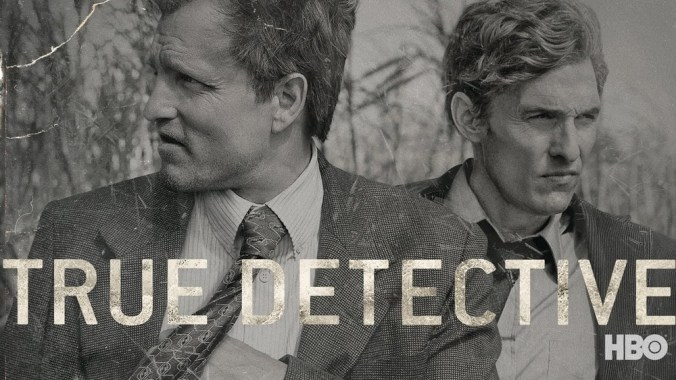
- TRUE DETECTIVE – It is widely noted that this is a series that has been decreasing in quality since the outset. Each season is an isolated detective story and I do think that the third season, with Mahershala Ali and Stephen Dorff, is the lesser of the three so far. I liked the second season with Colin Farrel, Rachel McAdams and Vince Vaughn – the ending much better than the beginning, I must say. However, the season that made this series a legend was the first one: 2014’s season with Matthew McConaughey and Woody Harrelson enacting a story by Nic Pizzolatto with the solemn and inspired directing of Cory Jojy Fukunaga. This first season was tense, heavy, challenging and finally extremely cathartic. An example of the exciting and fulfilling range of incredible TV shows of the current Golden Age.
There are a lot more shows that deserve mention, of course. It has been a privilege to witness this era of creativity in television, as we suffer the relatively bland products of the Hollywood movie business. As I said, let’s enjoy it while it lasts. There are already signs that the time of greats is passing. And this is all I have to say for tonight. See you around the next campfire, fellow travelers.

 Some narratives don’t develop on the pillars of conflict. Virginia Woolf’s KEW GARDENS, for instance, which I find an excellent short-story, does not live on conflict. But the vast majority of stories are based on a conflict between antagonists and protagonists. It could be a story of Man against Nature, as in JAWS, or Man against God, or Man against Himself, but conflict based stories are the most straight forward, the easiest and the most common kind. Even in love stories. At the center of love stories, there is always an obstacle to love. The better the obstacle the better the love story. And so, in Reiner’s WHEN HARRY MET SALLY we have a conflict between Love and Friendship. In Ephron’s SLEEPLESS IN SEATLE you have Distance as an obstacle to Love. In Austen’s PRIDE AND PREJUDICE, the main obstacles are… well… Pride and Prejudice. You have a good obstacle to Love, you have a story.
 So, in summary, a good antagonist must have one principal, important characteristic: His/her main goal is incompatible with the protagonist’s goal. That’s it. Now if you want a blunt instrument or a precise delicate scalpel is up to you and what you want to do with your story. If you want an evil chess master or a basic volcano, it’s up to you and the story. So it all comes down to the main goal of the protagonist. What does he/she want? And this goal depends on one thing… well… actually two: your Theme and your Message. What is your story about and what do you want your readers to retain in the end? What do you want your protagonist to learn or not to learn in the end? That you must not be too proud or too prejudiced to see Love just in front of you? Or that you can be so blind that you will lose your family as you try to protect it? Or do you want a protagonist so driven and stubborn, like Marv in Miller’s SIN CITY, that he will never learn until he’s dead?
 Think of a movie like JAWS: a sheriff who is scared of water and who came to a small coastal community to escape from the confusion of urban civilization is confronted with the threat of a killer shark. The Theme is Man against Nature – or Civilization against Nature. The Message is: only when you respect Nature can you deal with it (or something of the sort) – Civilization disrespects Nature at its own peril. Now, this is a deep common problem that affects all of us and which most of us can relate with. How you then develop it around the conflict between a sheriff and a shark and make it a unique story is at the core of your talent as a writer.
 Today came out an article of mine on Writing in English in the

 Now, this text was prompted by two things I read that illustrated the two sides of this spectrum. On one side was an article from an academic calling himself elitist and debunking writings from non-academics, saying non-academics are lazy and don’t study all kinds of hypotheses and thinking that was done for thousands of years. Academics, he seemed to say, have more Knowledge than others and so they know better. I don’t completely disagree with this assessment, to be honest: academics study a lot and know a lot and most of the time they are the spearheads of our Knowledge. Universities all over the world significantly and systematically and constantly improve our lives. But I have a few issues about that ‘elitist’ claim about academics. I know a few academics and believe me: many times they are simply wrong. This happens because they are not perfect and because our Knowledge is not perfect, but also because Academia is many times more concerned with politics and money than with Knowledge and Education. Academics themselves don’t agree with each other and sometimes they don’t commit to opinions themselves. On the other hand, as Kurt Lewin once said: «There’s nothing more Practical than a good Theory.» Yet, many theories out there are simply not practical: they can be right in a lab, but they don’t work in real life. When we are stuck with Academia we are often limiting our options and that is a pity.
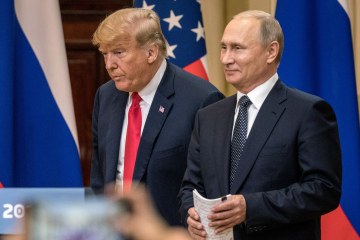 On the other side of the spectrum was a comment made to me by a Trump-supporter. He accused me of basing my opinion on fake news coverage and movie-star rants. That is not true: I read books on History, books on Politics, and books on Economics, and a lot in between. That gave me a little bit of Knowledge and helped me analyze the problems and think about the options on the table. I base my opinions on my Education and my Knowledge and the opinions of many – not on Indoctrination, Emotional Attachment or Religious Thinking. I say Trump is nepotistic not because someone said so but because he appointed his daughter and son-in-law to the White House. I say he is a racist not because someone told me but because of what I heard him say after Charlottesville. I say he is a sexual abuser because of what I heard him say about women, because his lawyer is in jail for helping him with his abuse and because I believe the accounts of dozens of women about his abuse. I say he is autocratic as I see him try to circumvent the Judicial and the Legislative branches. I equate him with Nazis because of what I see him do and say about immigrants. I say he is corrupt because of scandal after scandal, of resignation after resignation of corrupt officials from his Executive. I say he conspired with the Russians as I hear Intelligence officials testify in Congress and as I see him bow down to Putin in Copenhagen and in every international policy of the United States for the last two years. And on and on…
 The best antidote to tyranny and stupidity is Education. We need to develop our Critical Thinking and our Free Thinking to improve our lives, our society, our world, and our culture. And that’s the role of Education and educators: to improve our options. To improve other people’s options. To get us all to make better decisions. We don’t need to be dried up academics, but it is incredibly dangerous for all if we allow ourselves to be dragged down by prejudice and ignorance. Knowledge, in the broader sense – in the sense that includes Skill and Information and Critical Thinking and Wisdom – improves our options and our decisions. So let us commit to it, I challenge you. Our Freedom depends on it.
 I used to be a very annoying kid. I had a fascination for movies since a young age and I would spend hours chasing people down to be able to describe to them thoroughly the latest movie I’d watched. Every single scene. And until my 20’s I was capable of remembering every single movie I had seen. After that, the movies became too many or my memory too evasive and I started making mistakes about this or that picture, this or that actor, this or that name. I still remember very well the first PG-13 movie I saw in a theatre. It was 1977’s Mike Newell’s mediocre THE MAN IN THE IRON MASK. My parents took me one evening, while my younger brother and sister remained at home. I felt like the luckiest kid in the world. This was at Cine Santa Maria, in Funchal, Madeira, Portugal. I don’t know if it still exists. And I remember the first PG-13 movie I went with my brother: it was 1980’s THE SEA WOLVES, with Gregory Peck, Roger Moore, and David Niven, and we saw it at Cine Casino, in the same city, where we lived. And I remember the first James Bond movie I ever saw: it was THUNDERBALL and I saw it with my father and brother in Lisbon in ’82 or ’83. And the first time I saw THE SOUND OF MUSIC with my mother and siblings at a theater in Lisbon. And 2001 – A SPACE ODYSSEY in Lisbon which I saw with my mother when I was 13. I hated it then. Love it now. See how annoying I can become? Movies blow me away. I love them. I can’t stop talking about them.
 When I started writing movies I didn’t know that much about it. I wrote a few scripts over the years, in my 20’s. I wrote some short-movies and some long features. It can be very frustrating to write for cinema because you can write and write and write but unless you convince someone to produce the movie, it will never leave your desk drawer. Writers are the only professionals in filmmaking who do all the work before there is even a glimpse of some money coming in. You can write many scripts, for years, without earning a cent! Just look at Guillermo del Toro, the Award-winning writer-director: the other day he unveiled 17 scripts he completed without ever having the chance to make them. 17 scripts! This is the commitment a screenwriter must have to the Craft.

 Hyperjumping