So it’s Christmas, I saw some episodes of Netflix’s THE WITCHER and have a few things to say, so hear me out.
Here I am again. I’m sorry I was away for so long. Other duties spoke louder, as I have explained before. I’m still late with my writing, but now things are more under control, the deadlines have been extended and my vacations will allow me, I believe, to come to grips with the work that needs to be done. It’s always a risk to leave too much work for your holidays, but I have a sense I have things under control and that’s a whole different feeling than the one I had before. So thank you for your patience and your understanding.
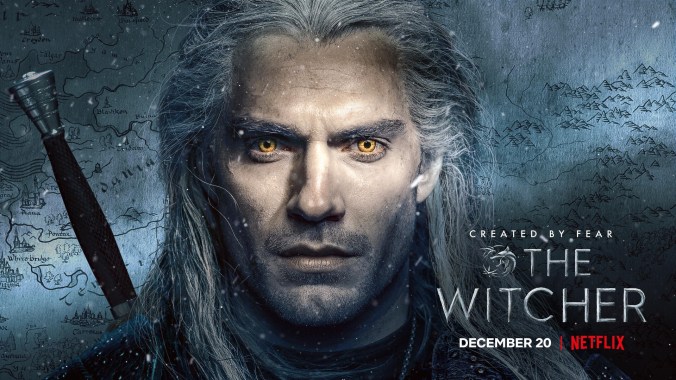
And did you catch the first season of THE WITCHER? I watched four or five episodes and am eager to see some more. Andrej Sapkowski’s writing was one of the good surprises I got this year. I found it interesting, clever, sophisticated and satisfying. I wrote a little bit about it here. And I was at first enthusiastic and then ambivalent about having it morphing into a television series. Enthusiastic because Netflix has already shown us how good it is in producing quality series. Ambivalent once I learned of Henry Cavill’s casting as Geralt de Rivia. Cavill is one of those actors that I constantly underestimated for a while because of his beauty – along with the likes of Brad Pitt, Tom Cruise, Charlize Theron and Gal Gadot, for instance. Cavill is actually pretty good. And he does a really good job as Geralt. I could see as soon as I watched the trailer that he would be a major asset to the series. Again, I was underestimating him: he is the major asset of the series and every time he is on screen it is a pleasure to watch him.
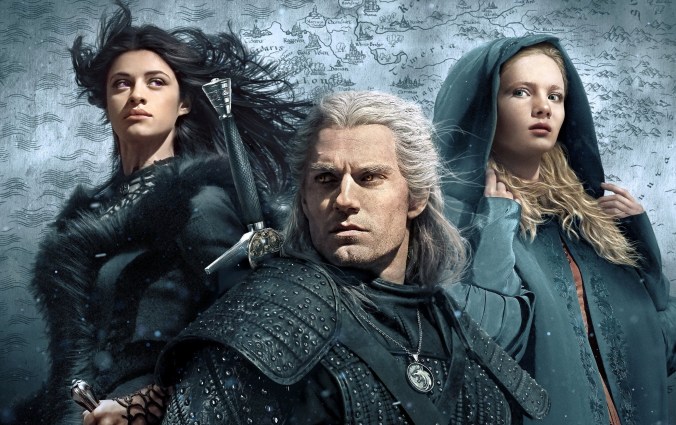
But THE WITCHER has many other good features. The runners made a difficult but successful decision, in my view, of starting the plot a few volumes into the story, beginning with the fall of Cintra. And then, without warning, they gave us backstory once and again, then using visual cues and text cues to show us the flashbacking. At first, it’s strange, and I know of some people who are still complaining about it, but as far as I’m concerned it’s a very clever and very sophisticated and interesting way to go about it and I loved it.
 Then, there’s the usual comparison with GAME OF THRONES – you can read a bit of what I thought of GOT’s last season here. Of course, there is a lot that invites the comparison: kings and queens, geopolitical intrigues, magic and monsters, etc. But THE WITCHER has a completely different feel to it. I don’t believe it does intend to be another GOT. Martin’s writings and HBO’s GOT is more dense, more realistic in some sense, with refined dialogues and character development, mixed with Martin’s definite genius for plot and storytelling (sometimes let down by the TV-people’s choices). It was also based on Britain’s War of the Roses and European Medieval History. THE WITCHER is lighter, assuming immediately its distance from Human reality and our History. It works of course with symbolism and it is not bare of real-world references and significance, but it proposes a different reality and a more linear and focused storyline. But that’s not necessarily a bad thing and I’m enjoying it immensely.
As Christmas and the old year are coming to a close, it occurs to me that they have something in common with several of the things I describe above. I grew up watching my father read mystery novels – Arthur Conan Doyle, Agatha Christie, Rex Stout, Earl Stanley Garner, etc. His generation was actually much more interested in these kinds of stories than those of Science Fiction and Fantasy, which they considered kid’s stuff. Mysteries were also focused on one type of question: «who done it?» They ended up being very formulaic in that sense: everything depended on the answer, or the knowledge of the answer, to that simple question. Who killed who and how to prove it. Things like GOT or THE WITCHER elude that kind of certainty and are definitely much more complex. They work with appearances, they play with Time and Space and History, and they are symbolic in nature. Much like Christmas. A shallow understanding of Christmas would think it’s just for children. But we all know better, don’t we? We can see that the whole world, whole peoples and civilizations are implicated in this exercise of celebration – of love, warmth and caring.
 There was a time in the past, I believe, when questions and answers were simpler all around. In those days, I think, when 99% of scientists believed in something we would expect that 99% of the population would believe it too. And when the FBI, the CIA, the NSA and all other Intelligence Agencies in the US believed in something, we expected the Americans on the whole to believe it too. But we are not in those days anymore. Now we have to deal with more complex realities where fantasies are dealt with as if they were the reality and reality accused of being fantasy. But even if we can use fiction to develop our understanding of the world, we shouldn’t confuse the two. We shouldn’t be completely deceived by this fantasy that is Christmas nor this fabricated calendar device that is the New Year. After all these illusions, the days will succeed one after the other and all the problems and challenges that were there before will plague us again and again and we will have to come back to deal with the ferocious relentlessness of reality.
But for now, it’s Christmas. Today I will be meeting my family for feasting in the season’s delicacies and exchange laughs and presents. It will be a good day, warm and caring and full of love. So be well, my good friends! Sing and dance! We will go back to the fight soon enough. Cheers to all!

 The ability and the determination to write when you work full time and have a whole rich and absorbing life beyond it is not a given fact. People have kids and hobbies and washing machines that break and road accidents and weddings and funerals and doctor appointments and tax forms to fill in. And then you have to relax and go look at the sea and walk the dog and do yoga and make love and read of course, always read, which is what got you into this mess in the first place. So, many times it is not easy at all and there are growing pains: problems and challenges that come up as you start growing and getting noticed. People ask you to write articles for magazines, or participate in short-stories anthologies, or write synopses and bios and take care of your website and post on your blog. As with any other business and organization and art, these are the moments that will make you or break you. If you can overcome the unbearable overwhelming moments of growth when you think you can’t take it anymore, if you can come out swinging after those, you will succeed. But for that, you must be organized, focused, determined and not panic.
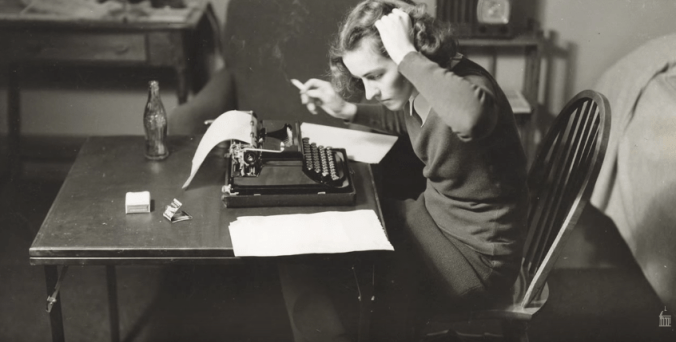
 I hope this post also helps you find your own pace without too much self-loathing. You need to keep loving to write. If you’re doing it for the long run you must create a system that allows you to keep doing it no matter what. Keep at it. Be persistent. And love doing it. Because that’s the craft. I really don’t have brilliant solutions and most of the time I’m as lost as most of you are. But I’m doing what I must. What I love. And that’s the most any one of us can aspire to, really. See you around, my fellow knights.
 How about rape? Rape is not exactly sex, in the sense that, as many criminologists would tell you, rapes are more about power and violence. I don’t know if you ever watched Gaspar Noé’s movie IRREVERSIBLE. I remember watching it at a movie theatre and witnessing the incredibly graphic scene of Monica Bellucci’s rape. Bellucci is one of my sexual icons – I think she’s basically gorgeous. But I remember watching her get raped by a criminal in that manner was the single least sexual arousing scene I ever watched. If you ever had an illusion that rape has to do with sex, I dare you to watch that movie. Rape is about power and about violence. And it’s horrific.
 These last few weeks have been pretty hectic for me, but I’m finally able to tell you about it. As a writer, I have gotten used to analyze and review my personal strategies along the way. An important factor is to take care of my physical, mental, economic and psychological health. I’m one of those people who often take on more than I can chew, and that has got me into some disagreeable situations in the past. I’ve been near a couple of mental breakdowns before (or have even been through them, diagnosed or not) and they have knocked me out in moments where it could really make a difference. I am also aware that creativity itself depends on our psychological conditions and that it is crucial that I take care of mine (it’s my livelihood, in the end) – there’s nothing so frustrating as wanting or needing to write and to issue original ideas and thoughts and being completely unable to do so. That’s why, at one time or another, I promote my own idleness, even though I do it in a way that I never completely stop. So what happened in these past few weeks and why am I talking about this? Let me tell you about it.
 So, last weekend started on Friday the 11th. I took a day off to attend this year’s Fórum Fantástico, my favorite Sci-fi/F event in Portugal. I thought that Friday would be the boring day of this three-day event, but it wasn’t! Not only did I reconnect with some friends and contacts, with ad-hoc important business meetings on the spot, but I got to meet one of my absolute favorite Portuguese illustrator/designer: the talented Tiago da Silva. He once created the cover for one of my novels, but I hadn’t yet met him in person. It was great and maybe we will have a chance to work with each other soon. Then, Saturday, the 12th, was another full day, with the likes of Ian Watson speaking, plus a handful of very talented Portuguese and international speakers. It strikes me, looking back, how incredibly developed are the new generations of designers, illustrators, comic book artists, game creators and other little geniuses in the Portuguese SF/F scene. On Sunday, though, the focus was a lot on me. It started with playing a demo of the HOT TARGETS: THE DARK SEA WAR CHRONICLES, the game by Sérgio Mascarenhas based on the universe of my books. Then after lunch, there was a speaking event with the ubiquitous Rogério Ribeiro at the Auditorium: about my writings! And then, at the end of the day they delivered the Grand Prize Adamastor for the Fantastic for SF/F novels in Portugal, and… I WON! I won the award! For the Portuguese version of THE DARK SEA WAR CHRONICLES. What do you know!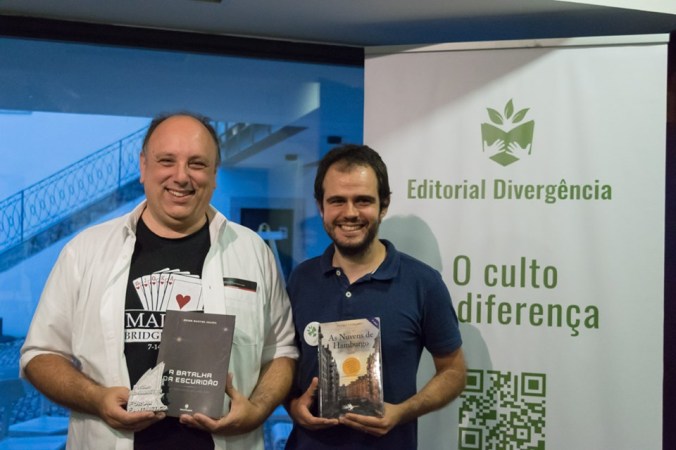


 «As we were speeding through the dirty streets in Thalof’s car, I thought I was looking at a giant lump of mold made of aluminum and zinc and dirty grey rocks and white chalk bricks that was slowly growing in an organic unorganized wild fashion inside a monstrous white ceiling cave. Huts after huts after huts.»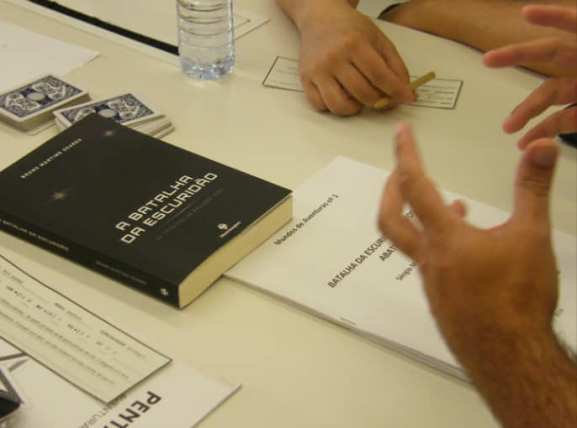


 This weekend I traveled North to the special and charming city of Oporto for the city’s Book Fair. My publisher had me come in for a book signing and there I went. The Oporto Book Fair is not a big event, we’re talking of about 130 exhibitors, but I’m certainly not one to complain, I’m happy to stage any book signing, of course – and don’t think many people came, I’m not that known of a writer. But still, I signed a couple of books and had fans come in with previous publications, happy to meet me almost as much as I was happy to meet them. I was also happy to return to this city, the one they call The Undefeated. Been there a few times and I love to go back.

 So it’s easy to equate the phenomenon of immigration with progress and prosperity. It seems they come hand in hand. Actually, I remember meeting a Swedish professor that showed me how the USA had built its success around immigration. He said something like this: «If you emigrate to Sweden or Portugal or France, you will never be a Swede or a Portuguese or a French. Maybe your children, having been born in these countries, can have the chance of being considered native – if they’re lucky and they don’t have a different tone of skin or their names don’t give them up. If you emigrate to America, though, you can legally become a citizen after five years. You just become an American like any other. That’s the biggest competitive advantage the Americans have over everybody else.» A place where you can converge a vast amount of points of views, cultures and customs is a place of great learning and adaptation, becoming strong and sophisticated. Places that remain closed and homogeneous and bare eventually fall sick and poor and die.
 If you ever read Bernard Cornwell, Simon Scarrow and/or Adrian Goldsworthy you might know that Oporto is a city where the brilliant general Arthur Wellesley, the Irish Duke of Wellington, and his red-coats faced the great armies of Napoleon and defeated them. As I crossed the Douro River on a train, heading back home to the South, I remembered those incredible battles fought by, among others, expatriated soldiers. Part of Wellington’s genius was the creation of integrated battalions, with both British and Portuguese nationals, and later Spanish, Dutch and Germans as well, if I recall. Diversity, he seemed to notice, make us all stronger. We should all notice it too. See you around the next campfire, fellow warriors.


 Hyperjumping