Merry Christmas: on Winter Solstice, Flat Earth and Ambiguity

So Merry Christmas everyone, or Hanukkah or any other way you believe in celebrating the Winter Solstice. This time of the year has been special for thousands of years, marking the shortest day of the calendar and the beginning of hope of nicer times to come. The great Stonehenge seems to have been built around this particular date and every Northern Hemisphere religion seems to attach some significance to it. Even people that believe the laws of Nature are somewhat random would agree that this date is objectively interesting.

nintchdbpict000290111808

We all strive for a purpose, to learn and understand the Meaning of Life. It’s difficult, in a Universe so large and mysterious, to deal with so much that is unknown. Is there life in other planets? Will the Universe ever end? Will it end in cold or heat? Can we travel faster than light? What kind of forces are at work all around us? Is there life after death? We know nothing or close to nothing. And for some reason, that lack of knowledge is very scary to us. We feel without control. Fearful of what we don’t know. Even if there’s reason to believe that, despite all the dangers, most of us are safer now in our daily lives than it was ever possible in the History of the World. When we watch other animals in the wild, a lion, a zebra, a kangaroo, we can see they are always watchful, always alert. They live in the fear of the dangers of the jungle or the savanna. If they are not careful, a predator, a natural disaster or a surprising snake or scorpion can put their lives in danger. Maybe it is this ancient habit of dealing with the scary unpredictabilities of life that makes us still today, when we live in our safe quiet civilized homes, to be afraid of what we don’t know.

And so we cope. I think it was Freud that said that mental health is the ‘ability to deal with ambiguity’. If most in our lives, in our Universe, is uncertain, it takes a special kind of soul to be able to relax and accept that being alive is being uncertain. Others, less sure of themselves, will create all kinds of subterfuges to deal with the unknown. Some of these subterfuges are harmless and even clever. In my view, that is the case of Christmas and other Winter Solstice celebrations. Maybe we’re not particularly sure why the Universe moves in certain ways and why a certain regular date, in the middle of Winter, is always the shortest day in the year, but we can accept that it is so and celebrate it. Whatever excuse we use for it, it’s a time in the year we can be more caring, more nurturing, more empathetic, more loving.

Others, though, will cope with uncertainty in less healthy and responsible ways. At the center of these are paranoiacs. For paranoiacs, the uncertain is so scary that they are willing to accept any desperate and absurd reason for the ways of the world. Paranoiacs, the studies say, consider themselves the only ones that are ‘in the know’, when in fact they are remarkably easy to fool. Once they believe in their theory nothing will move them, as they cling desperately and blindly to the ‘one thing’ that seems certain to them. Especially in a world that appears to be increasingly uncertain.

That’s why, in times of crisis and uncertainty, conspiracy theories and political opportunists thrive. Wrestling to believe in something, people unable to reasonably deal with the anxiety of the unknown will buy the most absurd of certainties. That the Earth is flat, that Man didn’t land on the Moon, that immigrants destroy civilization, that America is Evil, that the Western civilization is perverse, that terrorists will win in the end, that journalists are all liars.

Even if we can accept that one or several of the above premises could be correct, none of them is certain or even likely. And they present an added problem: they distract from emerging dangers that, even if they are uncertain, are far more likely, as Climate Change or the danger of another large war. There are far more evidences of Climate Change that of any of the premises I’ve mentioned, and very rarely in the History of Mankind there was ever the kind of massive arms build-up we are seeing today without resulting in a devastating war.

img_5145.jpg

This said, the likely antidote to all these problems, from ambiguity to paranoia, from Climate Change to the danger of war, is the kind of spirit and amity we cultivate during what some of us call Christmas. So enjoy, be kind, nurture, love, read books, talk to your friends and family, play in the snow and sing watching chestnuts roasting on an open fire. Rest. Hope. There’s a lot to do next year. Merry Christmas and a Happy New Year.
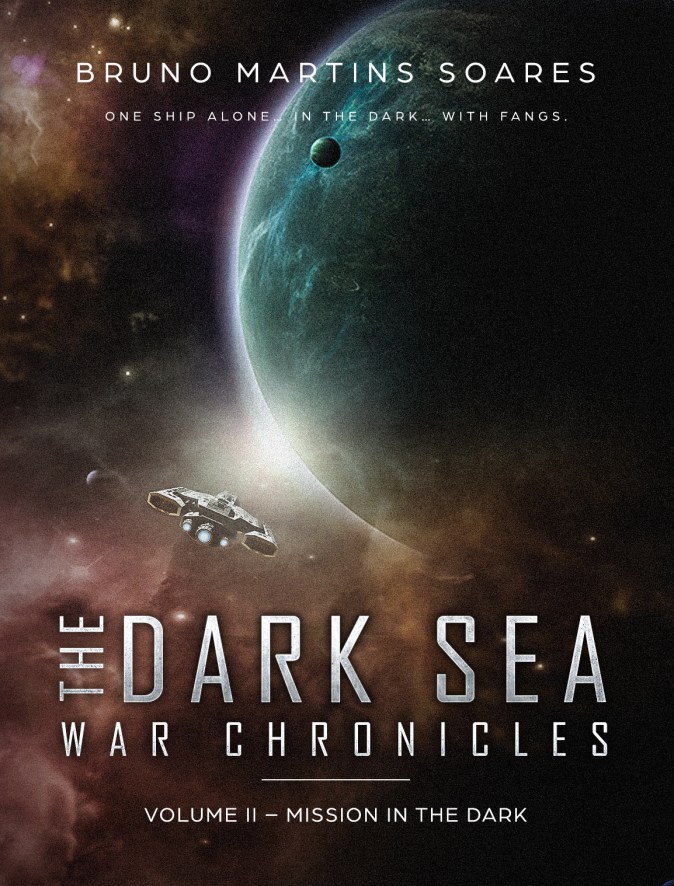
The Dark Sea War Chronicles – Book 2 – Mission in the Dark

Here it is, Book 2 of my scifi series, The Dark Sea War Chronicles – Mission in the Dark, is finally available at Amazon. I hope you like it! (click on the image to follow link)

Bruno_Martins_Soares_KVol2

In a distant solar system, a war breaks between the Webbur Union, its ally the Kingdom of Torrance, and their rival, the Axx Republic. Byllard Iddo is a young man who accidentally killed his father in a martial arts training session. He left to join the Space Navy.

As the Dark Sea War intensifies, Iddo takes command of the modified sloop-of-war Arrabat in a dangerous covert mission to cripple the operations of the illusive Silent Boats. Surviving or not, Byl and his elite crew are determined to change the face of the war.

On Rhythm: Stop Before You Jump, Mr.Hemingway

Stop.

Right now!

And now…

JUMP!

Jump into an action sequence and danger, and see the characters run and fight and bleed and scream and die and survive!

I say it over and over and over. You don’t write with words. You write with ideas. Let me prove it to you once more:

U don right we’d worse, U right we the I.D. us.

See? Even if I write the wrong words you can follow me, can’t you? And ideas are in words, of course. In a much more concrete way than in music, for instance, which is much more abstract most of the time. But not all of the wide spectrum of ideas, not all of the great strength of ideas are in fact in words. Big words don’t make great ideas. Emotions are in the music. Emotions are all about rhythm. All about punctuation.

Punctuation is overwhelmingly more important than words. Look at the beginning of this post. What did you feel? Confusion, yes, but also, probably, fluctuations in your own take of something I was trying to convey. Some dynamic. But was it the words? Some of it, yes, of course. But much of it was the punctuation. Because… (drums)… rhythm is emotion.

If you are writing action sequences this, for me, is the most important thing you have to learn. How to move attention and emotion at the same time. The masters use a pair of concepts that most screenwriters and movie professionals know about but not all book writers know how to control: buildup & payoff. I’ve talked about this last week, in my post on Netflix’s ‘Godless’.

Hitchcock used to say that an exploding bomb has no tension; it’s actually a release, a payoff. The tension comes from watching the clock numbers decrease one by one in the bomb’s timer hidden under the table while everyone in the restaurant is oblivious to it and goes about their normal lives. You build up the tension before you pay-off the emotional investment with a great bang.  And the way you slow down and speed up descriptions and actions are a way to manage tension, buildups and payoffs.

Look at this passage of Hemingway’s ‘For Whom the Bell Tolls’. He is talking about a bellbullfighter that feels crushed by the image of a bull’s stuffed head he killed and which is being offered to him at a celebration. See how Hemingway uses details,  ‘and’ and commas to build up the speed and the rhythm and the tension gradually until the bullfighter explodes. The words are almost clumsy, but the ideas and the rhythm are very powerful:
«’Towards the end of the speech, Finito began to shake his head and he got further back in the chair all the time.

‘”How are you, little one?” I said to him but when he looked at me he did not recognize me and he only shook his head and said, “No. No. No.”

‘So the president of the Club reached the end of the speech and then, with everybody cheering him, he stood on a chair and reached up and slowly pulled the cord that bound the purple shroud  over the head and slowly  pulled it clear of the head and it stuck on one of the horns and  he lifted it and pulled it off the sharp polished horns and there was that great yellow bull with black horns that swung way out and pointed forward, their white tips sharp as porcupine quills, and the head of the bull was as though he were alive; his forehead was curly as in life and his nostrils were open and his eyes were bright and he was there looking straight at Finito.

‘Everyone shouted and applauded and Finito sunk further in the chair and then everyone was quiet and looking at him and he said , “No. No.” and looked at the bull and pulled further back and then he said “No!”»

See how it works? See how the way Hemingway writes creates the tension of the bullfighter in our head? It’s not the words he uses, it’s the rhythm he imposes and controls masterfully. It’s the buildup he creates.

Now: how do you use that in an action sequence? One way is, paradoxically, to slow down the action. Even to stop. Infamous film directors like Michael Bay or John Woo use pornographic slow motion in the middle of the action, going so far as to put fire, flying pigeons and even explosions in slow motions to manipulate emotions. But others do it other ways. See Christopher Nolan in ‘Inception’. He uses slow motion in the climatic scenes at the end of the movie, but he gives a reason for the slow motion (different levels of consciousness), and jumps from action to action to maintain the tension, using also the unifying song of Edith Piaff to impress the urgency as he slows down the action. So when things slow down, we feel the tension rising.

See also, in writing, how Alexander Kent does it in his novel ‘Command a King’s Ship’. It’s the scene of a naval battle in 1784.51GCF4FFV8L._SX323_BO1,204,203,200_

«Dead and wounded lay everywhere, and as marines ran to their places for boarding Bolitho saw Shellabeer mangled beneath a gun, and Pryke, the carpenter, pinned across a hatch coaming by a broken length of gangway, his blood linking with all the rest around him. And Fowlar, could that thing really be him?»

This paragraph where Kent stops the action and gives you an image of the scenario, of the carnage going on, works as slow motion in movies. It’s a moment to stop and feel the danger, before the main character springs into action once more. This not only opens your eyes to things that are happening, but it also builds up tension that will make your final action more intense. That’s how masters do it.

There’s a lot to talk about rhythm and buildups and payoffs, so I will keep speaking about it. Let me finish with an excerpt of my own writing, not as masterful as Hemingway or Kent, of course, but I think can show you how I use differences in speed and even stopping the action with thoughts and feelings, and using short and long sentences and other devices to manipulate rhythm and tension in an action sequence. It’s from my work-in-progress, a post-apocalyptic novel called ‘Laura and the Shadow King’. I hope you like it. Maria is trying to escape her captors with her little girl .

«With the spotlight following the car, she drove passed the truck, and then the BTR and the rest of the soldiers. But then something went wrong. Something was wrong. The tail lights ahead. The SUV. It had stopped. And then white lights. It was coming back. It was reversing. And the BPM was turning around. They had seen her. They had seen her in their rearview mirrors under the spotlight and they knew she shouldn’t be there. That something was wrong. Maria had to stop the car. She had to stop and wait. The soldiers approached from behind. And someone was stepping out of the SUV. More armed soldiers. And a man with a moustache. It was Goran. It was Goran, the Serb. And he looked straight at her. He looked at her and he recognized her.

Oh, My God!! What could she do?? What could she do?? If she didn’t do something immediately, everything was lost. She would lose her daughter! She would lose her forever!

Goran started walking towards her and that’s when she noticed it. She noticed the dirt road on the right. There was a gap in the rails on the right and a dirt road. There was a soldier there, but she didn’t care. She stepped on the gas, bumped the soldier away and sped into the dirt road. And they fired! They fired! She heard the bursts and the back window crashed and the little girl screamed and Maria crouched behind the wheel and she heard the screams back there.

‘CEASE FIRE! CEASE FIRE! DON’T SHOOT!’»

Managing Investment and Satisfaction: Netflix’s ‘Godless’

When I was a kid I read a lot of westerns. There was this kind of western novellas, very small books, or booklets, which you could buy in newspaper stands in Portugal. My father used to buy me some, and I read dozens and dozens. They weren’t very good, far from it, but taught me a few lessons in writing, mostly because the plots were very a925995538145da158227466b3203889e123ccccsimilar from one another. There was the tired and retired gunslinger that wanted a peaceful life but had to stand up against the powerful oppressors. There was the sheriff everyone considered a coward for this or that reason until he finally stood up as well. There was the hard woman who fought against bandits that wanted to take her land, usually helped by a tired gunslinger looking to settle. And there were tales of revenge, of course. The plots barely changed, so I would admire the tricks the writers used to twist something or to make the story a little bit original. And then I became a fan of Louis L’Amour, a master of the genre.

And so it was with both nostalgia and excitement that I started watching Netflix’s GODLESS 7-episode series a few days ago. Most of the familiar themes were there: the tired gunslinger, the apparently coward sheriff, the hard women facing overwhelming odds, the young wannabe gunslinger, the cruel and scary band of pistoleros harassing the powerless. Well produced and directed, as you’d expect from Netflix, it has good dialogues and good writing and with the excellent acting of the likes of Jack O’Connell, Michelle Dockery and Scoot McNairy, among others, it was a treat to watch. And then there were the impeccable performances of Sam Waterston and the brilliant Jeff Daniels. It was the kind of series that would become a favorite of mine and I would herald it to the seven winds until hell and high water… If it wasn’t for a fatal flaw.

There are these two crucial concepts that professional writers and filmmakers know all about: the concepts of buildup and payoff. I will speak again of these when I talk about rhythm and Hitchcock and Hemingway, next week. Simply put, build up is the creating, managing and building of tension inside a story. Payoff, on the other hand, is the reward for that tension.

Think of it as investment, both of writers and of audiences. When writers and audiences invest time and attention span on a particular character, detail, description, plot-point, storyline, they will expect an equivalent return on that investment. If they invested a lot, they will expect to have a good and proper reward. If they don’t invest much, they’ll expect it is not a very important item to invest in. So when you make a great buildup of something, you expect a large payoff, or you’ll feel ripped off. And when you do a slight build up, and suddenly the item is crucial to the story you’ll feel something is wrong and the story was poorly arranged.

I sometimes refer to JURASSIC PARK and how Spielberg prepares us for the grand entrance of the T-Rex. He has set-up the scene already, when Grant (Sam Neill) shows how amazed he is that the Park has a T-Rex. But at the moment the giant dinosaur is about to appear, it all starts with a glass of water. A glass of water that vibrates on the dashboard of an SUV. And the frightened faces of the children, feeling what’s coming. That’s the buildup of tension. And so we feel a great payoff when the monster shows up to chase them. This is a good buildup and a good payoff, equivalent in span and power.

See also, in GAME OF THRONES, the effect of that massive 9 minute battle scene, now known as the legendary Battle of the Loot Train, when (SPOILER) Daenerys attacks the Lannisters mounted on a dragon. There has been a buildup of several years and dozens of episodes to get to that massive scene, and the scene corresponded to that investment, so the fans loved it.

eee51ecb4465246e16593c83db970d4fd9182bf6

Now let’s go back to GODLESS. (SPOILER ALERT) The whole first 6 and ½ episodes are a great buildup to one thing: the 30-plus hard men riding with the outlaw Frank Griffin will fight a battle with the almost-entirely-female citizens of the town of LaBelle. And the gunslinger Roy Goode will face Griffin himself in that battle. That’s it. That’s the whole series in a nutshell. That’s all there is to it. So if you know anything about buildup and payoff you know this: that battle has to be a major-absolutely-incredible-unforgettable-astounding battle. That’s how you justify the whole investment in the series. And the thing is: it’s not. The battle is not fantastic. It’s just a lot of uninteresting shooting, where the bad guys are mostly overrun from beginning to end, without any chance of overcoming their fate, being shot in the street like fish in a barrel. And the last gunfight between Goode and Griffin is also dull. There is nothing unexpected or surprising in the climax of the series. Or, in fact, the unexpected and surprising part was the failure of the payoff. It just fails. I felt ripped off, and I bet you felt it too. They destroyed the whole series in one bad sequence. Even the moment Frank Griffin and his men faced the Buffalo Soldiers a few minutes before was a more enticing scene than the intended climax.

So there it is. I felt disappointed by GODLESS. I enjoyed (basically binge-watched) more than 6 hours of good drama. I was excited, interested and taking pleasure in all of it. Until the last half-hour. And now I can only feel disappointment. That last battle might have worked a couple of decades ago. It’s well staged and executed. It just doesn’t have any plot-points. It’s just too easy and too bland. The same for the gunfight between protagonist and antagonist. There’s no excuse for something like this in this day and age.

Do you agree? Disagree? Do comment.


The Handmaid’s Tale of Impossible Choices

I’ve been late to the whole Margaret Atwood’s train. But I finally caught it. Fiction, I usually say, is the realm of the complicated. If we want to learn what it is to be in an impossible situation without going into it ourselves, fiction is the way to do it. We identify with the characters, we empathize. And we learn.MV5BMzEzNTIzMDk2OF5BMl5BanBnXkFtZTgwNjIzODQxMjI@._V1_UY1200_CR90,0,630,1200_AL_

The old dilemma of Liberty is one of paradox. If we have freedom to choose or not-to-choose, we have it as long as we choose. When we decide not to choose, we relinquish that freedom. Others choose for us. As Popper would put it, the same goes for tolerance. If we want to remain tolerant, we need to stay intolerant to intolerance. Not allow abuse.

Because values matter. Moral coherence  matters. That is not a left or right argument. Morality is not the monopoly of traditionalists, conservatives or marxists. Quite the opposite. Liberalism is all about values as well. It’s about freedom. Freedom of speech, freedom of religion, freedom to choose, freedom to live your sexuality, freedom to associate with whomever you want, freedom to be what you want to be. So this is a call to all of us. There are things taken for granted that are simply wrong.

I hear every day: ‘all politicians are corrupt’. No, they are not. And ‘There are worst things than corruption’. No, there aren’t many. Corruption means we all pay but only the richest and the amoral (not the same thing) get what they want. It means law can be broken with impunity. It means we can keep the illusions that politicians and other officials represent us, but they in fact represent themselves and the ones that pay them. This is not okay.

I hear every day: All States spy on their people. That is not acceptable. Security does not depend on pure obedience, political submission or abdication of a private life. But all these things are convenient to those in power, aren’t they? So spying on your fellow citizens is a practice that is corrupt and should be opposed.

I hear every day: all men are pigs; all women are bitches. Whatever this may mean, it’s wrong and it’s not something we should simply accept.

I hear every day: Democracy is the best of systems.

Yes, democracy is the best of systems. If we vote. If we stand up. If we fight for what’s important. Adolf Hitler was elected to office, and all he needed were people like Eichmann, passive, egotistic, opportunistic and unwilling to take part in the debate, to be able to do the unthinkable. If democracy is to work, we have to stand up.

hmt_01We are losing great artists like Kevin Spacey and Louis C.K. not only because of their abhorrent behavior but also because they were nurtured by a system that allowed their behavior. And all those who stood by and did nothing are part of that system. A system of tolerance towards the intolerable.

But it’s easier not to take part. It’s easier to choose not-to-choose. Choosing means leaving a place of comfort, maybe risking our own lives and those whom we love. But what’s the alternative? Watch all we believe in disappear without a trace? What we need to know is that we’re not alone and that small gestures repeated a thousand times mean more than they seem.

And that’s why it’s important to know a woman called June, who is put against her will in the position of not-to-choose. A position where she is systematically raped and tortured and has to remain polite, submissive, obedient. And then she doesn’t. And we learn.

Villeneuve’s Arrival Reality Check

At the moment I write to you I’ve just watched Villeneuve’s ARRIVAL for the second time. It’s a brilliant movie, based on an inspired novella by Ted Chiang. In my view, along with MANCHESTER BY THE SEA, it’s one of two movies that were actually worthy of the Best Picture Award this year. Now that I’ve watched it once more, not being bothered by my own eagerness and excitement for the next plot-point, I could focus on more technical/philosophical aspects. Please be careful with SPOILERS, those of you unfortunate enough not to have seen it yet.

SUiavMWW5Vo.movieposter_maxresFirst, let’s state the obvious. The way the movie ‘manages’ time is non-linear, close to the way the aliens themselves feel time. I know that this is interesting per se: it’s also very difficult to achieve when you write it and it works a lot like THE SIXTH SENSE, as in: the final revelation informs you on the whole movie and it’s impossible to understand the movie the same way once you know the secret code revealed at the end. I dare you to create this kind of effect. It’s not impossible, obviously, but it’s not easy either. And it’s certainly admirable and satisfying.

However, there’s also the message of the movie: code/language creates reality.

It’s been many years since I’ve read Lacan but his writings have fascinated me ever since. And he says, if I recall correctly: that each of us creates his/her own reality that is somewhat related to, but not identical to, a potential objective reality out there. Just think of your dreams: when you are dreaming, sometimes you think you’re awake and that dream is the reality. What if everything is a dream? Or, as in the MATRIX: how do we know that chicken tastes the same to everybody? Maybe each of us tastes it completely different. In fact, we can almost be sure of that. Some people feel something as salty, but other people feel it is not. Or smooth, or dry…  We all have different senses and different ways to perceive the reality around us, so in a matter of speaking, we are creating it. Or co-creating it. And so there are as many human realities as there are human beings.

Wow, slow down, Bruno. Say that again. Ok, just read the following: all of us perceive reality to be different and so, in truth, there is a different reality for each of us.

And if that is so, then the Symbolic reality, the product of both dreams and language, is the closest we can get to an objective reality. Why? Well, forget about dreams, just focus on language. Language is only effective if the meanings of things can be shared. A line on the ground is only effective if the drivers understand that it divides the road into the lane that’s going and the lane that’s coming. If the meaning was not there, if it wasn’t shared, then we would have innumerable traffic accidents. That meaning conveyed by language and signs, the Symbolic reality, is the part of reality that belongs to more than one person and so it belongs to more than one single reality. It’s the realm of relationships. And so, it’s closer to an objective reality of some sort. Relationships, in the end, are the most objective realities we can have.

Ok, Bruno, now you’ve done it. Say it again. Very well, let me sum it up: 1) each of us has his/her own reality; 2) Languages are meanings we can share, thus; 3) Languages are the closest thing we have to share a common reality, so; 4) Only in relationships do we come closer to a potential objective truth. Ok, so far?

This cannot be confused with some ‘post-fact reality’. As if knowledge was inexistent and the truth was never known, remaining in the minuscule corner of each person’s reality. I believe, and I feel ARRIVAL is confirming this same message, that the most effective language we have, the one that gets us closest to the truth, is the language of Science. No language we know brings us closest to an objective reality than this language that adapts itself to what can’t be refused. If you cannot refuse something because evidence systematically indicates it, then it becomes ‘scientifically accepted’, and we can call it ‘fact’. And so, it brings us closer to the truth and, of course, to each other.

Language is a fascinating thing. And Language and Science, Louise and Ian, are a beautiful couple.

From another perspective, as I also like Hannah Arendt, I would have to say that Evil is ignorant and stupid. You cannot remain violent and brute if you are profound, for when you can understand something or someone, when you can comprehend their reasons, you can develop alternatives. Violence is the failure of reason. Just as in the movie. When understanding seemed to be more dangerous than war itself, Louise and Ian had to step up to avoid catastrophe. Language and Science seem to be, in some way, the antidote to Violence. Only when Louise can touch the Chinese General do the alternatives to violence become apparent and a different reality becomes possible. One even stranger than could be imagined until then by a stupid and ignorant mankind.

Well… Food for thought. Sorry if this post was too dense. Good stories make you think. Thank you Villeneuve and thank you Ted Chiang.


How to Write Attractive Characters

I like clichés. All clichés have some truth behind them. That’s why they are clichés. And so they are useful. But they are not interesting. Because everybody has seen them at one time or another. So how to avoid clichés when you’re building the characters you want to be attractive?

Let me use a cliché: there’s nothing sexier in a woman than her brain. No, this is not a line, it’s actually what I think/feel. I’m a heterosexual man so I like tits and ass (yes, we are all vulgar). But I have seen perfectly beautiful women I didn’t find attractive in any way and didn’t move me at all; and I have known ugly ones who were extremely Resultado de imagem para eye sexyattractive and made me shiver.  Physical attraction, for me, is not only about physical attributes but other things as well: the way a woman enters a room, the way she treats other people, what she finds funny, how she smiles, the curiosity in her eyes, the expressions of her hands, and yes, if she is clever or not, a remark she made, an intelligent observation, a polite nod. It’s all about the little things.

So how does that translate into character development? You need to start with physical attributes. I’m serious. It’s a ‘need’, not a ‘want’. The readers need to start imagining the scene immediately. When you want to physically describe a character do it as soon as you can. I hate it when I’m imagining a tall brunette seducing the protagonist and 20 pages later the author decides to drop in that she is actually short and blonde. It’s irritating, and it’s sloppy. If you don’t want to physically describe a character in the first few pages she shows up, then don’t describe her at all! Leave her physical attributes to the imagination of the reader. He/she will do a good job.

If you want your character to be physically attractive in a particular way, find a particular trait to focus the attention. I remember when I was young and I was reading «The Three Musketeers» (I think it was that book, I’m not certain), I remember Dumas describing Constance (was it her?) as having ugly hands.Resultado de imagem para the three musketeers I could never find her attractive after that. I could only think of her ugly hands. Today I do exactly the opposite. If I want to make a character attractive, I give her/him a particularly remarkable positive trait: maybe shining eyes, a beautiful small nose, an elegant neck, lovely hands. And I will mention it several times.

But now that we’ve gotten the physical attributes out of the way, let’s start working on the broad attractiveness. Here, again, it’s all about the little things. I usually identify with my male characters and fall in love with my female characters. So I find I pick one trait of mine I like (often my analytical capabilities), or a trait I find attractive in others. From there, I expand the trait to build the character.

For instance: Mirany Cavo, from ‘The Dark Sea War Chronicles’. I wanted her to be relaxed and nice. These seem obvious traits, but they are not. Many people find it difficult to be relaxed and nice. What kind of person is relaxed and nice? And strong and clever? I built the whole character of Mirany around these attributes. Meaning: everything she does conveys a relaxed manner, being nice, strong and clever. I wrote several details that show this. The way she walked with her hands in the pockets of her overalls. The way people respected and loved her. The way she talked to people. The way she smiled. And I stuck with that until the character herself changed.

In Alex 9, from ‘The Alex 9 Saga’, I had another problem. Alex was a hard woman, a warrior, very physical and mostly quiet. I tried to make her attractive by what she noticed. By the things she paid attention to. And then I went further and showed her in her childhood, when she had become tough, as an orphan adopted by a corporation. Punching someone in the throat is already brutal. But when it’s a little girl that does it, intentionally, it’s even more violent. Alex punches some boy in the throat and sends him to the hospital. She needs to survive and we can see how hard she has become already at a young age (actually, that punch in the throat will become her signature strike). And when her new master, Kaoru, invites her to have private lessons, she is surprised. She asks in expectation: «Alone?» This scene shows finally how vulnerable and so alone she feels. She never thought someone could care for her enough to pay her that kind of attention. That flashback of Alex as a child makes her more human, a little bit more fragile, and that makes her more attractive. We suddenly realize that she does care what other people think and feel. And so, when she starts responding with tenderness to a family that helps her, trying to fit in, we understand where she’s coming from, and we like her for it. She’s not just an empty shell.

And after the little things come the big things.

For instance, Byllard Iddo, from ‘The Dark Sea War Chronicles’. For some time he seems to be a ‘yes-man’, dull and obedient. A Navy lieutenant who follows orders. And he is not very interesting. But then we find he can and will disobey direct orders to protect the ones around him. He thinks for himself. He innovates. He is a step ahead of the rest of the officers. And that’s when we start to like him, to find him interesting. And now that we care for the protagonist, the story can really begin.

It’s important in the first 15% of the book, or at the very least in the 1st Act, to ‘Save the Cat’ or ‘Kill the Cat’, as Blake Snyder would put it. Imagine a movie featuring a corrupt violent cop. He’s at a stake-out. He’s not very likeable. But then he notices an old woman in trouble: her cat is stuck up a tree. So, risking his cover, the cop goes out of his way to help that woman and save that cat. And then suddenly, he’s a good guy. He can be guilty of murder later on, but he saved that cat, so we helped the audience or the reader to like him enough to identify with him – and we have a protagonist. Or we could have a perfectly nice cop that when the old woman is not watching, manages to kill the cat. And from then on, we’ll hate him – and we have an antagonist. You give the reader reasons to love or hate a character. And that’s how you build attractive ones.


Why I believe in my characters

I believe we all should be happy.

I never know whether to laugh or cry when someone tells me ‘happiness is for dummies’, or ‘all of us here are happy people’, or ‘I’m a perfectly happy person’. I seldom believe them. I think these people are really desperate to scream how unhappy they are and find it impossible to do, so they twist it in their heads and try to sell it to us as exactly the opposite of what they’re feeling.

I believe happiness is possible and desirable. I believe most people are not happy. And there is no ‘perfect happiness’. I believe happiness is sleeping well and peacefully. I believe happiness is waking up eager to face the day. I believe happiness is, paraphrasing Kipling, to ‘meet Triumph and Disaster and treat those two imposters just the same.’

But happiness depends on something else. It depends on purpose. It depends on finding our meaning of life. Because if we find our particular meaning of life, and if we are able to work towards our goals, and there are people around us we can trust and we have confidence in ourselves, then we can be happy. It’s so simple it’s almost corny. It’s so simple it’s almost wrong. Because the reality is: none of these things is easy. It’s not easy to find our meaning, it’s not easy to really trust in people, it’s not easy to be confident and secure.

And that’s why I believe in my characters. My protagonists are my personal heroes. Most of them will feel at a total loss at one moment or other. Not because of the odds they are facing, not because of the enemies that want to destroy them, but because they are pitched against the void of having no meaning in their lives. Alex 9, a warrior from the future, an orphan unable to have children who’s been raised by a corporation, is looking for a mission bigger than her; Byllard Iddo, a Space Naval Officer in a distant solar system who accidentally killed his father, is trying to be accepted by a new family, the Navy; J.J.Berger, a Spec-ops operative in a devastated Earth, is trying to understand his place in a post-apocalyptic world.

On the other hand, as they pick their short-term goals, they are getting closer to their long-term goals. And they manage to overcome obstacle after obstacle, not only because they have confidence in themselves, but also because they are helped by the people they trust.

Someone said that ‘this thing of being a person is a rather complicated affair’. Yes it is. But that’s why it’s worth it to write fiction. ‘Complicated’ is the realm of fiction, not of theory. I hope my characters are real enough to you, as they are to me.  And I hope we all learn from them. This blog is an attempt to reflect on that.

I’m calling this new blog Hyperjumping. Not only because I want you to jump with my characters to other galaxies and other places in Space and Time, but because I also want to jump with you towards new ideas and perspectives. I hope you accept the challenge.