Casablanca and the Low Points of the Graph

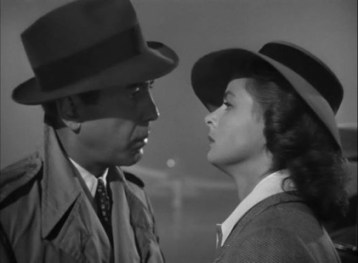
Tonight I had the pleasure to watch CASABLANCA for maybe the fifteenth or twentieth time. It is still one of my favorite movies after so many years and so many times I’ve seen it. This movie has some of my favorite scenes of all time and the ‘Marseillaise’ scene always excites me. Some of the moments of the movie seem a bit over the top, of course, but the film was made 75 years ago, so of course some things didn’t age well. However, most of it still blows my mind. Certain dialogues are incredibly good and a few of the shots are crazy beautiful.

Casablanca,_title

The movie also makes me think a lot about writing. I believe screenwriting is a powerful school for whatever kind of writing you want to do and CASABLANCA is one of those films you absolutely must study. For some time now I’ve been interested in what I call the Low Points of the Action, which are typical points in the writing where the emotional graph seems to be quieter. Typically, when the catalyst moments, or inciting incident, or the Bad Guys Close In part, at the middle of the Second Act, or the Final Battle in the Third Act, when these moments happen, the emotional graph in high or increasing. And as these plot-points are racing by, writing is exciting and we follow closely all that is happening. I find, however, that the good writers pay as much attention to moments where the emotional graph is lower. I’ve written several times about how the MATRIX’s low points are well taken care of for the most part, but now let me talk to you a little bit about CASABLANCA – some of the scenes in the low points are so well written they are some of my favorite low point scenes.

One of them is the dialogue between Rick and Renault outside Rick’s Café.  Even though Renault is always introducing and explaining Rick almost ad nausea, this dialogue is lovely: «Rick, why did you come to Casablanca?», «I came for the waters.» «What waters? We’re in the desert», «I was misinformed.» It’s not a very important scene, only there to show once more the intimacy and the friendship between both characters and to suggest Rick is a mystery. But still, even at the low point, CASABLANCA presents to us a small pearl of a scene that always makes me smile.

We_ll_remember_those_days_and_not_Casablanca

Another lovely scene is Rick and Ilsa’s encounter at the market. It is at the Midpoint of the film. The Midpoint is a difficult point to explain but I believe more and more it is an important moment of a screenplay or a novel or other large fiction text. At the Midpoint of CASABLANCA, Rick founds Ilse looking at an embroidery towel at the market. It is the moment Ilsa will tell Rick that she had been married to Laszlo even as they met in Paris, but somehow that doesn’t surprise us and the scene, as most Midpoints (some notable exceptions notwithstanding, like MANCHESTER BY THE SEA), is not very exciting. But both Bogart and Bergman are excruciatingly beautiful in this scene and the way they talk to each other, the pain they carry, the weight of the past, all of it is superb. And then, in the middle of it, there’s the salesman trying to entice Ilse to buy the towel. «Only 700 francs,» he says. But when Rick addresses Ilsa, the salesman exchanges the price card: «For friends of Rick, only 200 francs» he says. Both Rick and Ilsa ignore him, and Rick says something that suggests he had met Ilsa the day before and not in the best way. And so the salesman steps up his game: «For special friends of Rick, only 100 francs.» This small comic relief in the middle of a dense intelligent conversation is absolutely brilliant and is so well written that it works in spite of being so risky. I love it.

Another two low points in CASABLANCA I really enjoy are a credit to Paul Henreid’s acting as he plays Victor Laszlo. The first happens in the hotel when Laszlo and Ilse return after the ‘Marseillaise’ scene, and after Laszlo was blown off by Rick about the letters of transit. In this scene, Ilse is asking Laszlo what happened with Rick. Laszlo goes to the window, looks down to see the policeman who’s following them hiding behind a column, he pulls the blinds down, then he goes to a table and lights a cigarette and then he shuts the light down and then he sits next to Ilsa in the dark, waiting for the policeman to think they’ve turned in. And then there’s a small piece of lovely dialogue. Laszlo asks if Ilsa was lonely in Paris when he was at a concentration camp. We all know the answer. We know she was in a love affair with Rick in Paris. And he knows it also. And Ilsa knows he knows. And he asks «Is there something you want to tell me?» And it would be perfectly fine if she had told him everything at that moment, but she says: «No, Victor, there isn’t.» And that’s brilliant! That seems innocent and easy, but it’s so difficult to write: because we all know the truth. The fact that she doesn’t want to talk about it is so much better, it gives us so much about Ilsa. And Laszlo’s reaction gives us so much about him. He tells her he loves her and she, as usual, replies: «Yes, Victor, I know.» And still, he understands her and doesn’t press her.

00-story-image-ingrid-bergman-casablanca

This understanding mature character of Victor Laszlo comes into play in another low point in Rick’s Café, when he tells Rick he should escape with Ilsa from Casablanca.  In this scene, it always irritates me that the man is trying to bind his wounded wrist in a way that it’s so obvious it will not work. But overcoming this small detail, the conversation is so smooth and so to the point. It seems too much. It seems over the top. Would a man say that to another man? But it is also so smooth and so strong. That’s Laszlo. That’s what keeps impressing Rick. That Victor is so smooth and so strong. In the end, CASABLANCA is a bromance movie between Rick and Victor Laszlo. Rick falls in love with Laszlo and that makes him sacrifice his love for Ilsa. And that little moment in the Café just before Laszlo being arrested is another small pearl that makes us believe in that bromance.
milosc-421x310

Well, but that’s me. Maybe you think I’m exaggerating. Maybe you don’t find fascinating any of these small moments. But I love low point of action scenes and I find that some of the best writing shows up in moments we’d usually underestimate. My favorite moment in CASABLANCA is still the ‘Marseillaise’ scene, and the «Play it, Sam» scene and «All the gin joints in all the world» scene, and the airport scene, and the intro. But the low points are also wonderful. And yet so simple. That’s what I think.
Post… ponement

Dear Friends, I will be present at a special private event this weekend that will unable me to post this Saturday as usual. Please wait for me just a few more days. I promise I will post twice next week: on Tuesday and on Saturday. Thank you for reading! See you in a few days!

Spielberg’s ‘The Post’ and the Banality of Truth and Evil

I believe Steven Spielberg is one of the greatest filmmakers that ever lived and THE POST is a brilliant movie. And it’s a timely movie as well. A few years ago, serious journalism was an endangered species. More and more people were tuning into social media and paying undue attention to amateurish bloggers and maleficent news personalities. The advent of Donald Trump changed all that and in 2017 the ancient powerhouses of journalism resurged all over the globe with particular mention to our venerable and adored idols of The Washington Post and The New York Times, who not only have been incredibly strong in the Trump years but have also shown us again the meaning of true journalism.

20869570_FubnW


In the 19th century an important writer called Alexis De Tocqueville wrote about Democracy in America in a way that made him a major source of American thinking. In his masterpiece, De Tocqueville named a strong press as an important pillar in a successful democracy. Without a press able to inform the public and limit the abuses of the politicians, no democracy could survive. And true journalists, the ones that understand the seriousness of De Tocqueville’s claim and are proud to represent their high role, are many times true heroes of the modern age. It is fitting, then, that filmmakers are sometime fascinated by them.

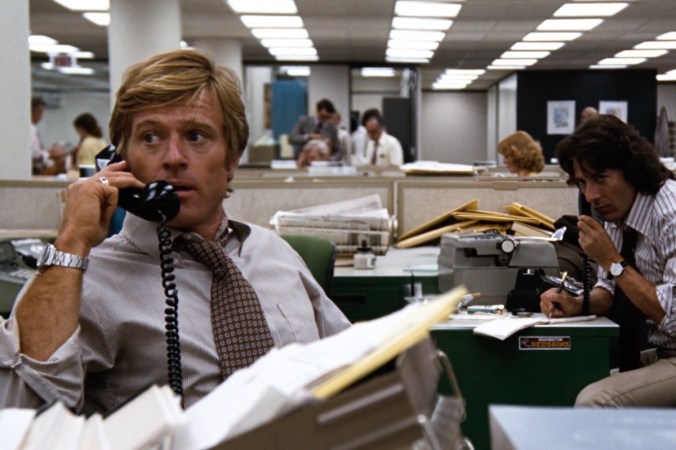
This month I watched three very good movies that honor journalists, enacting three true stories that had great impact in our History. I’ve watched the superb ALL THE PRESIDENT’S MEN, by Pakula, maybe for the tenth time; I’ve watched McCarthy’s SPOTLIGHT for the second time; and I’ve watched THE POST for the first time. SPOTLIGHT, about the Boston Globe’s revelations of the child abuse cases in the Catholic Church, and despite lovely performances by Michael Keaton and Live Schriber and a fragile Best Picture Academy Award, is by far the weakest of the three. Mark Ruffalo is not at his best and McCarthy is not in the league of Pakula or Spielberg.

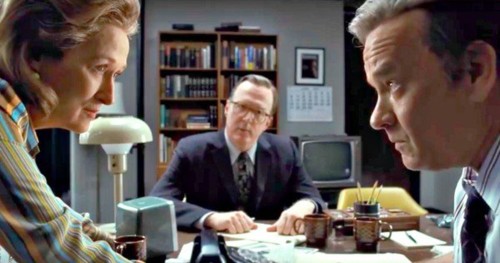
THE POST, about The Washington Post’s exposé of the Pentagon Papers is a solid movie that will be a classic, not only by the matured and intelligent direction of Spielberg but also because Tom Hanks and Meryl Streep are probably the finest actors I’ve ever seen, and what they do with Ben Bradlee and Kay Graham is remarkable. But I am still in awe with that film I love which is Alan J. Pakula’s 1976’s masterpiece, based on the work of Carl Berstein and Bob Woodward as they denounced the Watergate scandal. ALL THE PRESIDENT’S MEN not only shows great direction and screenwriting, but also iconic performances by Robert Redford, Dustin Hoffman and Jason Robards. The film’s finale is a bit abrupt, but the final sequence is so good, so beautiful, so well directed, that we forget about the writing faux pas.

allthepres.0

We need journalism. We need to believe in it and we need it to be serious, intelligent, vigilant and free. In a Democracy, it is the last guarantee against abuse, as all these pictures strongly argue. One of the most important texts of the 20th century is a journalistic piece written for The New Yorker by Hannah Arendt called EICHMANN IN JERUSALEM (which I also happen to be reading again). In it, the German philosopher narrates the Israeli trial of Adolph Eichmann, an ambitious and opportunistic German that ascended through the Nazi hierarchy by his cunning ability to deal with bureaucracy and logistical problems.  He was also Evil. Arendt shows how the Evil in Eichmann came from a simple fact: the logistical problem he was instructed to solve was how to erase Jews from Nazi held territory, be it by expelling them, concentrating them in ghettos and camps or simply kill them – and Eichmann was able to block in his mind the job he was to do from any moral considerations. His crime was embracing banality. His crime was not thinking about the unthinkable so he could be efficient and effective. And so he was a willing cog in one of the most brutal murdering machines in Human History. He was satisfied with his job, even though killing Jews was not particularly interesting for him.

And so the Banality of Evil holds hands with the Banality of Truth. The relentless pillar of banality is invisibility. What is banal is not important. And so when we decide to ignore the objective hole that is in front of our eyes, we are being complicit and negligent. The role of journalism is to destroy this banality. It’s to reveal. To show what’s being concealed in spite of its importance. Curiously enough, invisibility is the opposite of transparency. If we are transparent and true, we are not invisible. We are whole.

Spileberg

THE POST is a film that shows us the struggle of journalists in this fight for Truth and Democracy. What they are capable of, what they risk and what they achieve. Ben Bradlee was one of the greatest and a moral compass for many. And Kay Graham was a pillar of modern society. THE POST honors them in kind. Both the movie and Spielberg, who has been consistent in this plight, take a moral stand: Democracy needs Truth. Truth needs Freedom of Speech and a Free Press. And we need to stand tall protecting both of these.

Yes, we need Truth. Truth is important. Truth protects us. And that’s why we should believe in journalism. We should feed it. We should rely on it. We should worship it. Well done, Steven.

The Good Doctor & The Resident

Today I was on the phone for a couple of hours with a friend of mine who told me a horrific story of how the first month of the year was: «the worst beginning of the year of his life». Of course, as soon as he told me that I knew something had happened with his health or his family’s health. It turned out his wife almost died due to a medical error. The story was appalling: as far as I understood it, a surgery had gone wrong and she had been urinating inside her belly for about a month, can you imagine!?

d7825a9a683e910e42e1a5dbcc74b3d6

Most people’s horror stories, I think, are health issues. Wouldn’t you agree? We have nightmares about dogs, or snakes, or being on a plane that’s falling, or sharks, or ghosts. And that’s why most of horror movies are about those fantasies. But in real life, there are few things more terrifying than health issues. And in my experience, most of us don’t have a good time in hospitals or with doctors. And if it’s bad in the National Health Systems in many civilized countries, paid by the tax-payer, assured by over-worked tired civil servants, delayed by endless bureaucracies, it seems even worst in the crazy-expensive insurance-dominated system of the United States. I once had a friend of mine in California who was bitten by a poisonous spider and almost died because going to the hospital was too expensive. For a European, that’s insane! I can’t even imagine how it is in other parts of the world.

With all this, I’m not particularly fond of medical TV-shows. There are a couple I was interested in in the past, including CHICAGO HOPE, a David E. Kelley show back in the 90’s, with the solid Mandy Patinkin. It was a good show because it had strange cases and moral dilemmas and you never really knew how to decide a case. But that’s the best that can be said about it. I didn’t really like E.R., or any other medical series. Most of all, these shows were all soap-opera-like. They all seemed – and they still seem – to white-wash what really goes on in the Health System, showing doctors as heroes with their exciting sensual but still petty lives.

And then came Shore’s HOUSE M.D.. And what a show! Hugh Laurie played a medical-Sherlock Holmes that every week would be solving a highly dangerous mystery where a criminal condition would be close to murdering a patient or more. Laurie was absolutely brilliant, migrating from comedy to drama with a touch of genius. The characters were interesting and it was brilliantly written – with the added bonus that a regular person wasn’t able to decipher half the words in the dialogues and still become addicted to the drama and the emotional payoff. But since the last season of HOUSE, a few years ago, no other good medical shows caught my attention. Please don’t speak to me about items like GREY’S ANATOMY, PRIVATE CLINIC or CODE BLACK. I will not speak of the likes of them.

I took a look at Soderbergh’s THE KNICK, where Clive Owen played a drug-addicted doctor in Knickerbocker Hospital in New York at the start of the 1900’s. I watched a single episode and even though it had obvious qualities, I felt uncomfortable with its raw portrait of that awful reality and didn’t get hooked.

But now here come two new shows, both of which I’ve been following for a few weeks, now.

The-Good-Doctor-370x247

David Shore’s new drama THE GOOD DOCTOR tells the story of Shaun Murphy, an autistic surgeon that is hired by a prestigious hospital. The show is based on a Korean medical drama and is becoming hugely successful. Still, the show, at least the American version I’m following, doesn’t have a very interesting plot, is not particularly well written (not in the likes of HOUSE, at least – which is certainly a high bar) and it does perpetuate the beautifully clean face of the Health System that I was criticizing just a minute ago. Still, I can’t stop watching it for a reason: the astonishingly brilliant performance of Freddy Highmore. Highmore will only be 26 this next Wednesday, but he is already one of the most talented actors alive today. If you saw him along side Johnny Depp and Kate Winslet in FINDING WONDERLAND, or in BATES MOTEL facing Vera Farmiga, you must see him in THE GOOD DOCTOR. He’s just tremendous!

But there’s another medical TV-show out there that you should take a look. It’s called THE RESIDENT and the experience it conveys is much closer to what we ourselves feel in Health Systems. In THE RESIDENT, doctors and nurses are still the heroes, but they are not battling strange deceases or killer bugs: they’re battling each other and the system. In this show you will find Chief Surgeons that kill more patients than save them (and still are able to routinely blackmail their way out of blame and retirement), and others that are willing to let their patients die to protect their studies, etc. This series shows a dark underworld of medical tragedies that resembles the reality with far more clarity than any other I’ve seen so far. And with a 6.3 rating at IMDB it’s certainly highly underrated. But I recommend it. It will never be one of my favorite shows, but it’s different, trust me, and makes us think.

resident

As I become older, the idea of being dependant of the Health Systems that loom around us is pretty scary. Today I had another wakeup call on the subject. Stories inform us, real ones or fictional ones and we should all be thinking of the systemic problems that plague us all. I still think the Health System is a theme waiting to be properly explored in fiction. But not from me, I’d say… More than I can chew, I’m afraid.

My ‘Blade Runner’ 2049 vs 2019

I feel like the title of this post is almost in code, but I suspect and trust that the few people that understand it are the ones I’m aiming it at. I first watched the original BLADE RUNNER a long time ago. And watched and watched. The first Harrison Ford line in the movie is one of my favorite ‘voice-over’ sentences. I can quote it from memory: “They don’t advertise for killers in the newspaper. That’s me, Dekkard. Ex-cop. Ex-Blade Runner. Ex-killer.” Still today, when some sanctimonious expert shouts in my ear that ‘voice-over’ is a demeaning technique I recall this sentence in this 1982 film and ignore the… person. And then, in the Director’s Cut coming out much later, Ridley Scott took out the ‘voice-over’ and I was irritated until I found he needed to sacrifice it to give a whole other meaning to the movie. Was Dekkard a replicant? To preserve this possibility, Scott had to lose the ‘voice-over’. This way, Scott ended up making two different movies about 2019, not only one, and both of them very good.

blade-runner-1982

I’m writing this post today because I just watched Villeneuve’s BLADE RUNNER 2049 a couple of days ago. And I loved it. If you read my post on ARRIVAL you probably already know Villeneuve is one of my favorite directors at the moment. He is clever, relatively slow in the pace, but profound in meaning. It’s always delicate to tread on the path of a classic and it was dangerous for Villeneuve to make a sequel to Scott’s BLADE RUNNER. But the director came out of it with flying colors. The warm x cold lights, the way the shadows move or design the scenes, the confrontation between old characters and new, between old concepts and new, all this multitude of vectors were harmonized in a skillful, masterly manner.

In the original BLADE RUNNER, based on a text by Philip K. Dick and set in 2019, Dekkard, played by Harrison Ford, is part of a police force, called Blade Runners, that pursue illegal aliens, escaped man-made people designed to work in other planets. This is one of Ridley Scott’s best movies ever, around the time he also made ALIEN and then THELMA & LOUISE. In my view, Scott’s work suffered since then and he has been making worst and worst movies for years (see, for example, the impossible KINGDOM OF HEAVENS), often spoiling the screenplays for whims alone. In BLADE RUNNER, however, Scott is in top form, creating a dark, oppressing future society and molding a classical filme noir cop-story in a clever and sophisticated scifi plot.  In this phase of his life, just as in ALIEN, Scott’s movies had an intimacy trace of some sort. Harrison Ford and his nemesis Rutger Hauer were filmed up close and dramatic and action scenes were also filmed in a close setting, contrasting with the larger than life sceneries of a planet in decay and a society crushed by technology.

Even though Scott’s movie is all about cloning and humanoids’ dilemmas (even though the replicants are androids, they are so ‘human’ they might as well be clones), that’s not what we feel the most. At its center is the confrontation between Man and God. The replicants in BLADE RUNNER 2019 are trying to know how long they have to live and maybe even wondering if their makers can prolong their lives. At the end of the movie, as he leaves to live his love affair with a replicant, Dekkard shows how hollow that question is, stating: “We don’t know how long we have together. But then again… who does?”

BLADE RUNNER 2049, however, is a different animal. It’s a larger movie, not only in the way it is filmed but also in the conflict and plot. There are more characters and more intricate motivations. Now K, Ryan Gosling’s character, is a replicant that is also a Blade Runner, hunting other replicant criminals. He suddenly realizes there could be a replicant/human baby out there and is set to find it. It is a miracle and one that has deep implications, instigating various forces to kill it or nurture it. This movie is no longer about Man and God, about the meaning of life, but it’s about loneliness and race and persecution. K’s drama is deeper and he seems to be followed by everyone, but he is profoundly lonely and that impacts his mission – at a point he starts to suspect he is the baby himself – he is then looking for his childhood self.

blade-runner_u286

All three movies (2019, Director’s Cut and 2049) pose different questions, all of them what I call Conscience Questions. Philip K. Dick was a master of these stories: where you are not sure what reality really is and the main conflict is between the characters and the ideas of reality in their minds.

Still, maybe to your surprise, I would say Villeneuve’s BLADE RUNNER 2049 is the better movie. It’s very well made, beautifully shot and very well written. I love Jared Leto’s character Wallace and loved seeing Ford as Dekkard once more. The virtual lover played by Ana de Armas is a wonderful character and the love affair with K is very very good as the portrait of today’s loneliness setting.

But, I would have to say, I still prefer the original Ridley Scott’s BLADE RUNNER. It just has a special place in my heart. It’s more classical and yet groundbreaking in its filme noir style. It always reminds me of Raymond Chandler or Mickey Spilanne in a way this new movie is unable to achieve. And even as I really enjoyed the end of the Villeneuve’s film and Ryan Gosling in the snow, Roy’s death in the original BLADE RUNNER is still one of my favorite scenes. The way that dove gets freed from the grip of the dying clone in slow motion, as corny as it is, and Ford’s face as Roy stops talking, it still moves me and it makes me stop in front of the screen. “Moments lost in time, as tears in the rain.”

blade-runner4

But this is my Blade Runner. It’s the way I feel about these movies. I’m sure others will disagree.

Dragons, Monsters, Critical Decisions and Watercooler Moments

I’ve written somewhere else about what I call the ‘Critical Decision of the Hero’. This decision is the one that will be at the center of the whole story. Some would say that the main decision by the hero of the story happens at the climax and establishes the point where the victory is won, where the solution is achieved, where the conflict is resolved. I don’t believe so. I think the Critical Decision is another one.  It happens typically at the end of the First Act and Joseph Campbell would call it The Acceptance of the Call. I think this Critical Decision shows up in basically every story, by the hero or the protagonist: there is a conflict and a main challenge and the decision by the protagonist to accept the challenge and face the odds becomes the propeller for the whole story. Every time there are doubts and obstacles, the protagonist will return to this decision and decide whether to keep going or give up. Until the very end.

81REr7pwCVL

The Critical Decision is a very important moment in a story and I like it when the authors pay due attention to it. Who can forget, for instance, THE SONG OF ICE AND FIRE’s Daenerys’ decision in A CLASH OF KINGS of stepping into the fire with her dragon eggs? Or Frodo deciding to go to Mordor (the first book’s Critical Decision is for Frodo to leave the Shire, but the whole saga’s Critical Decision is to go to Mordor)? If the decision is properly prepared, it can become a source of inspiration to us all. Preparation, however, is far from easy. Skill is needed.

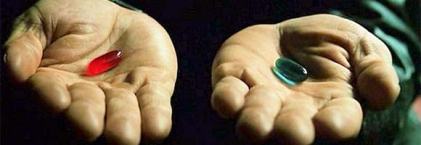
Think of THE MATRIX for a second. We all know that when the time comes, Neo will choose to learn the truth, to accept the red pill and go through the looking glass. Still, it’s important to support that decision and so the protagonist is tested several times. He has to make successive decisions before he even meets Morpheus and makes the Critical Decision. At the beginning, his computer says «Follow the White Rabbit» and a couple knocks on Neo’s door, inviting him to a club. He declines, but then he sees the tattoo of the white rabbit and changes his mind. In the club, he meets Trinity and she asks him what is the question he wants to have answered – he responds: «What is the Matrix?» The next day, he is reprimanded by his boss, who tells him that if he wants to keep his job he has to obey the rules. And then Morpheus calls him and tells him he has to decide if he wants to escape the police or go with them. That’s the only time Neo’s strength fails and his doubts overcome him. He lets himself be caught by the police. In the interrogation, Agent Smith tells him he has to choose between Anderson and Neo – Neo gives him the finger and asks for a phone call. He wakes up in his bed and Trinity picks him up. With a gun to his head he has to decide «their way or the highway», he decides to stay. Only after all these decisions, when the question is so well established in all our minds, Neo is finally faced with the Critical Decision: the blue pill or the red pill.

bd3

This decision is the basis of the whole story and the build up to this moment is crucial. Even Cypher plays with it later: «Oh why, oh why didn’t I take the blue pill?»

In THE MATRIX the buildup is so well done that the Critical Decision itself becomes a Watercooler Moment (a moment to remember – we’ll speak more about this in other posts). No-one who watched the movie ever forgets the moment Neo chose the red pill.

Another Critical Decision. In TAKEN, Bryan Mills (Liam Neeson’s character) in on the phone with his daughter who is away in Paris, and she’s frantic, telling him some men are in the apartment, kidnapping her friend. Bryan immediately decides that she must hide under a bed and tells her she would be taken. He had foreseen this event and his Critical Decision was the one to allow his daughter to go to Paris in spite of all his instincts. The Watercooler Moment comes next, when the kidnapper comes to the phone and Bryan tells him he has a «particular set of skills» he will use to find him and kill him. And the kidnapper tells him «Good luck.»

In THE SOUND OF MUSIC the Critical Decision comes when Maria sings «My Favorite Things» and we know she decided to stay with the Von Trapp. In JAWS, I believe it’s the moment Sheriff Brody decides to hire Quint, the fisherman, and take the matter into his own hands, even though this comes later in the story.

jaws-still

The whole set-up, the inciting incident, the debate, the doubts of the first 10%-20% of the story are the preparation for the Critical Decision. And even if the decision seems obvious and easy at the moment it is taken, our job as authors is to make it difficult until that very moment. In ancient secret Portuguese maps, un-sailed seas were marked with the expression: «From here on there are only Dragons.» The English version of the phrase states: «Here there be monsters». These were the borders of the known Universe. Those who crossed it must be bold and determined. Not all protagonists are overall bold and determined. Maybe some are forced to take the Critical Decisions, or don’t even realize the gravity of their choices. Still, the strength of our stories depends on these moments when the characters decide to cross the border into the unknown and we all say: «Here there be monsters.»


STARZ ‘Counterpart’: In What Dimension Should We Be?

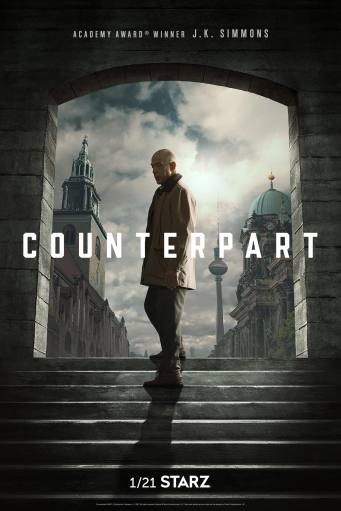
I was impressed with the first episode of Starz’ new series COUNTERPART. With a good premise and an interesting set-up, this sounds like a winner. Let’s just see what happens as the series launches on January 21st, i.e. tomorrow. The plot revolves around a UN civil servant that suddenly finds out he is involved in a secret project of guarding a portal between two dimensions. This civil servant, played by the very solid J.K. Simmons, finally meets his counterpart from the other dimension: a copy of himself in every way, except he took different decisions in life. A killer has also crossed from the other side, so the story is promising.

counterpart-jk-simmons-e1509641526580

The main question posed by Simmons’ characters is one that can make us think for a long time: do we make decisions according to what we are, or do the decisions we make actually define us? This is not a merely philosophic or idle question. China, I’ve read the other day, is preparing a system that computes every decision one makes. Every book we buy, the restaurants we eat in, the people we socialize with, all of this is to be organized in a single system that gives us points and evaluates us, punishing us or rewarding us for each decision we make. Many in the US are also limited by their credit ratings that tie their future possibilities to their record of decisions made. If we ignore our recollections of Orwell’s 1984 or SNOWDEN, and all the abuse that might come from a centralized system that tracks our decisions, we could even admit that all decisions have consequences and so it’s fair to evaluate us by what we have decided in the past, however minute those decisions might have seemed to us at the time. Isn’t the whole Justice System based on that principle?

Still, raw decisions, and even wrong decisions, sometimes happen in a context that will need to be evaluated through different perspectives. That’s why, for example, murder is a crime, but a legitimate self-defense killing is not. The context qualifies the result. And that’s why we have trials, judges and juries. A fair system must allow us to make mistakes. The whole Human Experience balances between a dimension of Security, where we are safe, and a dimension of Freedom, where we can do what we want. We could only have 100% Security if we stopped Time entirely. Pascal said: all movement leads potentially to pain. All movement has a degree of danger. So to be 100% safe, all movement, all freedom, would have to be eliminated. On the other hand, if we had 100% freedom, chaos would be the result. There’s a Goldilocks level, a balanced level, where we can basically be free and safe. A fair system strives for that balance.

In a fair and modern system, we should be able to make the freest decisions we can, preserving the most security we can. But that means the system must allow us to make mistakes and learn and recover from our errors. This is not only crucial for us as individuals and to have meaning in our lives, but also crucial for future societies, where progress is so fast. Successful societies will be more and more dependent on creativity. And creativity depends on freedom, on risk-taking and on learning from our errors.

We could almost say, because fiction is the realm of the complicated, that just as we do, all our Main Characters are always dwelling on this crucial balance: more Freedom or more Security. That goes for the MC’s in COUNTERPART. As the story evolves, we learn that one of the J.K. Simmons character seems to have made decisions prioritizing Security, and the other seems to have made decisions prioritizing Freedom.

counterpart-1That apparently determined two different personalities. The one prioritizing Security seems more humble, rigorous, timid, tamed, less successful. The one prioritizing Freedom seems more confident, strong, successful. But we can see that something is evolving in the background and that other reasons and other contexts are looming in darkness. So I’ll be waiting to find out where it is all going.

Maybe fiction is the way to experiment with difficult and Life and Death decisions without going through them ourselves. Maybe watching movies, TV and reading books is our simplistic way to choose Security. To be safe while we travel in our own minds. Or maybe it is the way to free ourselves, to free our thoughts, to help us decide. Either way, we must use our power to decide and demand a fair system. Because it is in our hands. It is each and every one of us who has to fight to have fairness and freedom and security in our lives. We can’t leave that power to others. Or we will never be truly free and secure.

‘Alita, Battle Angel’ and the End of the World as We Know It

A long time ago, here in Portugal, the French bookshop chain FNAC opened its first stores and that’s when I came in touch with manga comics for the first time. They appeared on the shelves in French, so you might say that my original manga experience was in French. And one of my first loves in this experience was the story of a little cyborg called Gally, in a series called GUNNM by Yukito Kishiro. This series is known in the anglo-saxon world as BATTLE ANGEL ALITA, and will soon be brought to the screen by producer James Cameron and director Robert Rodriguez.


uclo6dwfqipcwyap6do3

Alita is a small feminine cyborg of immense power and skill, that comes to life in a dystopian world divided in two: the slump-like world of Earth vs. the luxurious space-stations in orbit. On Earth, practically everyone is a cyborg, brains with mostly mechanic bodies. I will not tell you the surprising and satisfying ending to the saga, but (as usual) I rather talk to you about what’s behind these dystopian worlds we see more and more in our fictional universes.

Technological Singularity, that Von Neumann expression referring to the point where technology overcomes humans, is approaching rapidly.  It’s not just in movies like ALITA, the MATRIX, A.I., Westworld, and many more: it’s actually almost here. For real. Every day I see videos in my Facebook feed showing me the latest human-looking robot, or driveless cars or drones, or news articles on Big Data developments or chatbots and Artificial Intelligence. So, scary or not, here it is.

It’s not the first time that the rise of machines threatens Humans.  Centuries ago, almost all in the Human Race farmed the land or lived of the land. There were other professions, as warriors or smiths or priests or traders, but these were minorities. Agriculture reigned. Until the machines arrived and made everything both easier and more difficult. From the 18th century on, society was convulsed with technological revolutions one after the other that changed life as known until then. First, the steam-machines in farming and ships and elsewhere, then the railroads, then electricity, then the combustion engine, then other things including flying and computing. These led to many disturbances, including our worst wars, and massacres beyond imagination. But they also brought the (almost) end of slavery, the explosion of education, the development of modern medicine, the tourist and travel revolution, television and movies, the Space frontier, etc.

While these transformations were taking place, the role of Man in the Universe was changing dramatically. If we were no longer needed to farm the land, what should we do? We went into industry. In the beginning of the 18th century, most things owned by people, like tables, pens, swords, plates, hats, were made by one or a few people. Nowadays, after the revolutions, we look around and mostly all we own implies the work of thousands. Our tables, pens, knifes, hats, cars, computers, were made by designers that designed them; miners that got the materials off the Earth; professionals that made the paint, the plastic, the pieces, the assembling; maintenance workers that oiled the machines that made them; salespeople that sold each of these components; marketing people that made the adds where we saw these products for the first time; drivers that got the products to the shops; shopkeepers and managers; etc, etc, etc.

On the other hand we didn’t have to work so many hours, roles in society didn’t have to be as strict as before, and we didn’t have to be prisoners of the land, unable to make our own decisions. And so we now work 7 or 8 hours a day instead of 12 or more, for 5 days a week instead of 7. That’s why we have paid vacations, unions, unemployment benefits and health insurance, public education and public health systems.

At the same time, documents as the US Constitution, and many other constitutions, were hailing that ‘All men are created equal’, that we have the freedom to speak and to intervene in public life. And even women could be as valuable as men and even vote, God help us!

That’s why we now perceive the Industrial Revolution as a positive step in Human Evolution. For many, when it was happening, it seemed like the end of the world. So maybe the Singularity could also be an opportunity. It could mean we have to work fewer hours and could dedicate ourselves to creative jobs or others we can’t even imagine at this point.

MV5BYzI5YTMwNjUtMDcwYi00ZDllLTg0MWUtOTMyM2VmNGQ4NDIwXkEyXkFqcGdeQXVyMTkxNjUyNQ@@._V1_UX477_CR0,0,477,268_AL_

But it’s not a stretch to imagine a world like Alita’s. Desperate and unjust. We already have a world divided between the rich and powerful vs. a mass of powerless living in sometimes appalling conditions. Two worlds separated by what seems an insurmountable distance. It’s possible, I don’t know how, that the Singularity could bring us the opportunity to face these injustices once more. To challenge again the inequality that still plagues us, and to launch another call-it-what-you-may Revolution.

I will not tell you how Alita’s saga ends. I don’t even know if the movie will be faithful to the books. But I assume there’s hope, my friends, there’s hope. The movie is scheduled to come out in mid-2018. I’ll be anxiously waiting.

The Marvelous ‘Marvelous Mrs.Maisel’: Success, Failure and Resilience

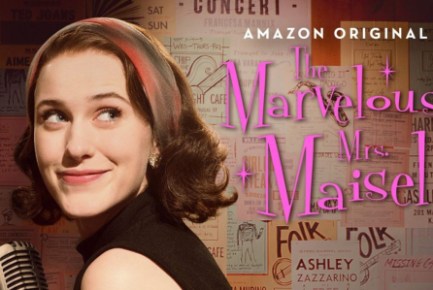
At the time I write to you I just discovered Amazon’s MARVELOUS MRS.MAISEL. It’s 5 a.m., I’ve just watched a couple of episodes and I’m hooked. This kind of writing makes me green with envy, but I can’t stop watching. This is what good writing is all about: building a wonderful life, ripping it apart and then re-constructing it in a liberating way. I’ve been writing all my life but it took a real act of Faith to accept this life as a serious option. It’s not an easy life and, at the time I write to you, not a certain life either. Still, the ones that make it have to accept it on Faith, have to put their heads down, work like crazy and believe in the impossible. Many times that requires a shock of some kind. The Universe paving the way.

maisel

Amazon’s Original THE MARVELOUS MRS.MAISEL stars Golden Globe nominee Rachel Brosnahan in a well-deserved major role as a Jewish perfect housewife in 1950’s New York who’s trying to support her husband’s failing comedic hobby until… he leaves her. And that’s all I have to say about that. Featuring that Sorkin-eske kind of dialogue to which Amy Sherman-Palladino already accustomed us, this series’ intensity is much higher and the narrative sense is sharper than it ever was in GILMORE GIRLS.

J.K.Rowling made a speech, I believe in 2011, at the Commencement ceremony at Harvard that is now quite famous. She basically made a eulogy of failure. And what a speech! You can find it online, as it became viral. She spoke about her life after graduating from Harvard and how it went from bad to worse until she found herself, in her words, ‘as poor as you can be without being homeless’. For her, failure seems a necessary step to true success. A step to really find out your potential and become closer to what you can do. Rowling’s failure made her open to her writing and propelled her to create HARRY POTTER, a series that was turned down by multiple publishers before becoming almost the very definition of success. I recommend you listen to the speech. I’ve listened to it many times and will listen to it several more. The main message is, as Alex Borstein’s character Susie, in MARVELOUS MRS. MAISEL, tells Midge: ‘Everybody bombs’. Mrs.Maisel will find out: life is not perfect and being perfect isn’t even the best thing at all.

For some time in the past I used to make a living training executives in multinational companies. Sometimes I would ask the basic question: where do you see yourselves in 3 to 5 years? Little by little I discovered one thing: most of the people I asked this question became instantly depressed. Many people had never thought about this, about the direction of their lives. And those who did simply didn’t like the answer. Individuals accommodated to the paths their lives had taken without questioning much, accepting that it was ‘what had to be’. Few people took real risks with their lives and most tried their best not to think a lot about it. They had buried their dreams and found excuses for the holes in their souls. This will be more and more difficult to manage, though, as society is developing into a completely different animal than it was before, preparing to devour all traces of the world we know today. And most people will be surprised that their plans of comfort and their perfect paths through time will not be there where they thought they would be. Predictability is an endangered species. So they will have to adapt, think differently, wake up to the demands of change.

Failure will be inevitable for many or most in the next few years, as the world and the History of Mankind will surprise us all. But that does not have to be a disaster. Maybe some failure and some risk is exactly what the “Doctor” is ordering. Maybe failure is a true requisite for success as paradoxical as it may sound.

the-marvelous-mrs-maisel

Both Ms.Rowling’s speech and Mrs.Maisel’s tale are inspirational in a time like this. They remind us that many things we think as dangerous or impossible are actually quite achievable. Psychologists in war areas will often speak about children that lost everything and witnessed traumatic events, and that even then were able to find a way to make sense and to become healthy, to be resilient. Resilience is our ability to adapt to change and still persevere. Navy Seals, in turn, have their 40% rule: they figure that when your mind is saying you reached your limit, you’re actually only 40% done – you still have 60% to give. So go, Mrs. Maisel, be all that you can be! You made my day already.

Ayer’s ‘Bright’: Difference, Discomfort and Lessons in Integration

This Christmas I was happy to watch the new Netflix’s movie: David Ayer’s BRIGHT. It stars two great actors with great chemistry: Will Smith and Joel Edgerton, as a human and an orc who are reluctant partners in a fantasy LAPD. It reminds us of other Ayer successes, from his directorial DC blockbuster SUICIDE SQUAD to his brilliant scripts for TRAINING DAY or END OF WATCH. Actually, BRIGHT takes the very risky leap of integrating both genres: Mythical Fantasy and hard-boil Street-Cop-Gangbang action thriller. Or whatever they’re called… Yes, of course mixing genres is a difficult and risky enterprise: you have to be able to be credible in the several genres you use, and integrate them in a way that does not offend the fans of any of them. On the other hand, if you succeed, it could become something special. And Ayer was certainly able to pull it off. BRIGHT is a brisk, funny, imaginative, enjoyable, well-made movie that I definitely recommend.

79t31

Different is not always good. An agent I once met told me: «When someone comes to me and tells me he wrote something that has never been done before, I usually find out there was a good reason for not having been done before.» Many writers and other artists tend to go for «different» like moths to fire. But «different» is sometimes a cop-out, a way not to do the work, not to be really creative and sophisticated and deep. On the other hand, how many vampire, werewolves, dragons, dwarfs, elves and orcs can we really handle? I am very suspicious and even nauseated buy cannibalistic writers that must use other people’s characters to enhance their own. This whole PRIDE AND PREJUDICE AND ZOMBIES trend and the likes is really tiring to me. Develop you own ideas, for crying out loud!

This said, there are remarkable writings that have become so dear to us exactly because of the netting of diverse influences they are made of. From the top of my head I recall THE MATRIX, and its mixing of hacking, kung-fu movies, post-apocalyptic environments, manga and anime, etc. Or WESTWORLD. With its mixing of western storytelling and scifi dynamics. In the end, it’s all about characters and integration. It’s all about the human history within and the way it touches our core. It’s all about the story.

The theme of BRIGHT echoes these kinds of problematic. It centers in the story of two cops, one human and one orc, which struggle in a world full of magic where humans live between the extremely capable elves and the clumsy brute orcs. This code becomes a way to talk about race and immigration problems. I particularly liked the dialogues between Smith and Edgerton, well developed and clever, many times uncomfortable. The portrait of Edgerton’s orc character as stupid, crude, maybe treacherous and bad, is a reflection of both what we think of orcs in general and how some people see certain immigrants or certain races.

At a time when many in the US are losing their jobs to new technologies and hordes of refugees knock on Europe’s door, immigration is an uncomfortable subject at best. Immigrants bring new (or old) customs, different ways of thinking, they look differently, they sound differently, they eat differently and even smell differently in some cases. Some of the ways they behave seem like disrespect to many of us. And as they struggle to understand our languages, rules and traditions, they seem stupid and crude. The mistrust and discomfort immigrants cause soon become race issues, as patterns emerge. And then there are concerns, real or imaginary. That the way we do things will be tainted by archaic customs. That our streets will become unsafe because of these people. Or that many of them are in fact terrorists, rapists or drug and human traffickers.

Bright

In reality, data shows us something different. Immigration is of course uncomfortable to immigrants and hosts alike, but it also brings many advantages, improves economies and the well being of many, and helps develop stronger societies, also balancing demographics in all countries and increasing educational inputs everywhere. Since the beginning of History successful civilizations attract immigration. When we think of a cosmopolitan center, as New York today or ancient Rome or Beijing, or other era’s Lisbon, Paris, Amesterdam or London, we think of places full of life and uniting different cultures and different peoples. Cosmopolitanism is equivalent to diversity. These cities have attracted immigration because they were successful and in turn thrived because of immigration.

I believe all life forms look for comfort. Comfort is good. We like the things that are familiar, the places we grew up in, and what feels natural to us. Immigrants bring change, and change, good or bad, is mostly uncomfortable. So we react, and many of us focus only on loss and negative feelings, not being able to see the wonderful richness of what’s different. But going back is an impossibility. Change is a constant. Trying to stop time is futile. I have no idea of what comes next, but I’m very sure it won’t be the same as it was yesterday. And that is something we must accept and prepare for, with open hearts and minds. Because, most of all, discomfort can generate creativity. And creativity generates progress.

This said, I think BRIGHT is an intelligent, creative, complex and fun movie. It makes us think in a sometimes-subtle-sometimes-not-so-subtle way. And I laughed and suffered with the characters, and believed the story. That’s the best thing, when you believe the story. As fantastic as it may be. Good show, Netflix. Happy New Year, everybody!