First Duty of the Free: Voting for a Crippled Europe is Still Voting

Today I voted for the European Parliament. I love voting. I am filled with surprising joy when I cast my vote. It’s a moment of freedom and pride. We all should do it. It’s scary to note that it is likely that one of the victorious forces to come out of this election will be the far-right parties all over the continent. So abstention must be overcome, it’s a non-starter at this point. We must all vote. After I cast that bulletin in the ballot I came home and went over an unpublished article on Europe I wrote a couple of years ago and found it very current and still encapsulating my ideas. So here are some of them.

290ab1b233e27eb899c896d011c9fc6771cc8489f47074899404243fc9539ae7

Today, it’s a cliché to state that the European Union and all its History since the foundation of the European Community of Coal and Steel in 1952 allowed for a particularly long period of peace and prosperity. Military campaigns in Europe were until recently not only frequent but extremely costly. After the disastrous World Wars and following Montesquieu’s idea that commerce leads to peace, European integration has arguably benefited the whole world.

The path, however, has not been easy, with challenges at every corner over decades. The lightning-fast fall of the Berlin Wall and the Soviet Union and the end of the Cold War, for instance, took everyone by surprise. Suddenly, countries just beyond the border of Germany wanted to take part in this great experiment of modernity and liberty. Poland, Hungary, the Czech Republic, Slovakia, Slovenia, and several other States were released from the tight fist of communism and everyone rushed to welcome them. Everyone seemed eager to take them in. Country after country. And no-one seemed happier than the US, who lobbied endlessly for countries to join the Union. Even Turkey and Ukraine were considered.

Through it all, the European leaders have always responded with steps forward: they promoted rampant enlargement and flourishing bureaucracies, brought down borders, unified currencies, created High Courts and Banks etc. Treaty after treaty, what the European Union is today was almost unimaginable at the beginning of the 1950s. I was 15 years old when my country, Portugal, joined the EU in 1986. The Union was then called EEC, European Economic Community, entertained 12 member-States and was ruled by the Treaty of Rome. Now, the EU has 28 member-States (27 once/if the UK leaves) and is ruled by the Treaty of Lisbon. And no-one ever asked me what I thought of it. Actually, no-one ever asked most of the 500 million citizens of this great behemoth what they thought of these immense changes even though most aspects of their lives are now commanded by European rules. And many of them were not ready.

30_year_war

These citizens have been increasingly showing concerns. European countries are democratic countries, with a solid tradition of legitimacy based on popular vote. However, the European institutions themselves do not follow this principle. The European Commission is nominated without elections and wields considerable power. The European Parliament is elected but in a strange and diffuse way. When I vote for the European Parliament I vote in a national election, and for national parties. But these parties are grouped differently in the European Parliament. So I may vote for Portugal’s Social-Democratic Party in a European election in my country. But this party will be integrated into the European Popular Party in the European Parliament. I know what the Social-Democratic Party stands for in Portugal but, unless I’m very educated and knowledgeable, I will have no idea what the European Popular Party stands for in the EP. And I never actually voted for the European Popular Party anyway, and never will – the system doesn’t work like that. Besides, the European Parliament doesn’t have much power anyway.

So, in the end, it’s the Union’s Council of Ministers that remains the most powerful body, deciding the most important matters behind closed doors. In the Council, the ministers and representatives of the Governments of each member-State trade in influence and big ideas. And some dark and pernicious little monsters start to unveil: the fear of Germanic hegemony, the looming Franco-German axis, secret and selected summits, etc. Maybe all of them illusions or exaggerations. Still, that’s what we see in the Council. The remains of Old Europe, a Europe of greedy Sovereign States, working in the shadows of the diplomatic elites, with arm-wrestling deals and fragile alliances.

xx11xvd390b01

If the European Union were a Federation like the United States, the Government would have to satisfy even the weaker states. A Presidential Candidate in the US wouldn’t dream of campaigning only in Texas or California, ignoring all the other states. And even though many of the candidates come from big states like New York or Illinois or Texas, some of the Presidents were born in smaller states. Bill Clinton came from Arkansas, John Kennedy from Massachusetts, Jimmy Carter from Georgia.

In Europe, however, a Spanish citizen or a Slovenian or a Greek knows that Angela Merkel has incredible power over his or her life. But she is not elected by either of them. She must only satisfy the Germans. The same for Macron, the French President, who only serves the French. And the same for any other national leader.

The European Treaties go to great lengths to prevent offending the sovereignty of each member-State. They establish the Principle of Subsidiarity, for instance, determining that what can be decided by individual States should not be decided by the Union. And they force many matters to be decided by unanimity or qualified majority, or even voted in the individual Parliaments of each State. But that’s how the quagmires begin. These principles were easier to comply when there were only 12 States at the table. They become a nightmare when there are 28 States voting. That’s why crisis like the migrations from Northern Africa, the collapse of Libya or Syria or the frailty of Greece have been so difficult to react to.

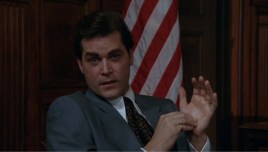
Goodfellas Ray LiottaFor many European citizens, the feeling is one of skepticism. What in reality is a problem of «not enough Europe» is felt in the streets as a problem of «too much Europe». If the Union doesn’t work, why are we investing in it? Remember that scene at the end of «Goodfellas» when Ray Liotta’s character is running around cooking pasta, getting high, trafficking drugs, managing his family and lover and trying to escape surveillance as everything crumbles all around him? That’s how I sometimes feel when I look at the Union struggling in the mud with all these geopolitical events. When will it be too much to handle?

Oh, but it gets worse…

As if on cue, enter the National-Traditionalists. These barbarians have been preparing their ambush for twenty or thirty years. They are not Conservatives. Conservatives want to preserve the status quo. Traditionalists want to radically return to the values of the past. One of the strategists of this line of thought is the American Steve Bannon, so active in today’s European elections, another is the Russian thinker Aleksander Dugin, influential within Vladimir Putin’s circle. He says that the major countries listening to him are Russia, Iran, Turkey and the United States, but we can see it as well in Saudi Arabia, Israel, Brazil or the Philippines. For them, globalism, progress and modernity are evil ideas. «There is no global flag», says Donald Trump.  They are very suspicious of international organizations as the UN or NATO, and of free-trade, international conventions, immigrants and, of course, the EU. Even more, they are suspicious of liberal western values. Says Dugin: «If we reject the laws of modernity such as progress, development, equality, justice, freedom, nationalism, and all of this legacy of the three centuries of philosophy and political history, then there is a choice.»

bethisguyThese strange people have been gathering strength all over Europe as well. They’ve been biding their time, waiting for the right moment. The moment when the weaknesses of the Union becomes apparent. Figures like Marine Le Pen and Nigel Farage even turned themselves into European Members of Parliament, vowing to destroy the system from the inside. Elections in Austria, the Netherlands, Italy, France, Germany and other countries now feature nationalistic and traditionalist parties that show increasing power. Recently, a far-right member of the Austrian government was caught on tape dealing with the Russians and had to resign… Is it the first of many?

And then… there’s Brexit. Remember «Goodfellas»? Ray Liotta turns to the camera and says: «And now… it’s all over.» That’s how Brexit felt to me. It’s a game-changer. It’s exactly what the Traditionalists wanted. The older citizens of the UK made the decision. Nostalgia won. Let’s just go back.

But what does that even mean? The old traditional values they talk about led to unimaginable catastrophes in the past. World wars, genocides, economic turmoil. When, some time back, I watched the video of Adolf Hitler asking the Germans: «Do you want Total War?», and heard them reply «Yes!», it made me shiver to my bones. Is this the kind of world the Traditionalists are working for? A divided, xenophobic, warmongering world? In the words of Gudin himself: «One of the first, simplest movements in the direction of the Fourth Political Theory [his movement] is the global rehabilitation of Tradition, the sacred, the religious, the caste-related, if you prefer, the hierarchical, and not equality, justice, or freedom. Everything that we reject, together with modernity.» Scary stuff!

19jul16Winston Churchill himself was the one who suggested a united Europe – a United States of Europe, as he put it. He warned: «The Dark Ages may still return». Liberal values are stronger values. But they are under siege because we have been too timid in defending them. We relied too much upon their intrinsic worth. So we need to get back to the ballots and the streets. Today at 4pm only about 23% of Portuguese electorate had cast their ballots. 77% was no-where to be seen. Political absenteeism, both real and emotional, is the genesis of all totalitarianism. So our first duty, our first commitment, must be to voting.

Go get them, fellow warriors. This is our fight! As Kennedy once said: «First of all, we’ll be judged by our courage.»

‘Game of Thrones’: Time and Expectations

13172611561249-t1200x480

I’m still a bit shocked, just having watched the last episode. Not shocked by anything that actually happened in this last season, but shocked it is over. I’ve known THE SONG OF ICE AND FIRE far longer than THE GAME OF THRONES series. It is a story that’s been with me for much more than a decade, before it became the pop-culture phenomenon that dazzled the world. More than anything, the amazing characters will be missed, even though I’m eagerly waiting for the upcoming WINDS OF WINTER. This last season of the series was bound to disappoint. The expectations were so high that only a genius would be able to carry through this overwhelming story. And Martin is a genius, no doubt about it, and it would have made a world of difference if he had finished writing the books before the series was over. It would more or less bind the producers and showrunners to something a little bit more solid at the end of the journey. Let me speak a bit about this anyway – careful with the SPOILERS.

daenerys-ships-game-thrones

Most people (me included) cannot imagine the size of an enterprise like the GoT series. We’re talking about many millions of dollars, thousands of people – talented, creative, brilliant people – dozens of locations, mind-blowing effects. Being up there deciding on the very lives of all of these people and ideas must be terrifying. And some mistakes were made. First of all, the lack of courage: someone up there, HBO itself, the showrunners, whoever, was not brave enough to commit to a couple of more seasons. Maybe the actors were getting tired, maybe the organization was becoming difficult to manage, maybe the company felt the money involved was too risky – we have no idea what prompted that decision… but it was a shame. The story would hold up for a couple of seasons more. Still, this season was always going to be disappointing:  the expectations were too high. I spoke here about build-up and pay-off. The build-up of this series was so incredible that the pay-off was almost impossible to achieve. Whatever happened, we were bound to be disappointed. We invested too much. It is a natural phenomenon for people to fantasize too much and expect to be enthralled by a story, an idea, a man or a woman. But then, as life teaches us again and again, disappointment is also a natural result.

3EUjuZpg.0

There were other underwhelming decisions made by the showrunners besides ending it so quickly, with a final 6-episode season. We will always criticize the strategies of the Battle of Winterfell, or the cinematography of the 3rd episode, or (SPOILER ALERT) that Daenerys got mad or that Arya did not kill Cersei in the end. These are a few moments that break our hearts. Some more sophisticated options might have been better – Drogon could have gone out of control, or the bells of King’s Landing failed to ring – I wonder if the writers were clever enough to see this would lead to the same situation in the end. I am mostly critic of the fact that at least one of the first two episodes of this season is completely useless and could have been used to improve the overall result.

However, what I find the most disturbing is the following: because of the polemic that fell on this season, and one or two mistakes, we are ignoring that some moments in these final episodes, especially on the last two episodes, are some of the most beautiful, well written and powerful moments in the whole series. The last two episodes are, in truth, close to brilliant – as long as you don’t get shocked by the plotpoints. And I enjoyed most of the others, in truth. I suffered during the Battle of Winterfell, I rejoiced with Arya’s coup, my heart almost exploded when I heard Missandei say ‘Dracarys’. In truth, in spite of the episodes being so long, feature-film long in fact, they went by like freight trains and they all seemed to last just a few minutes. And then there were moments that… will remain with me forever.

maxresdefault

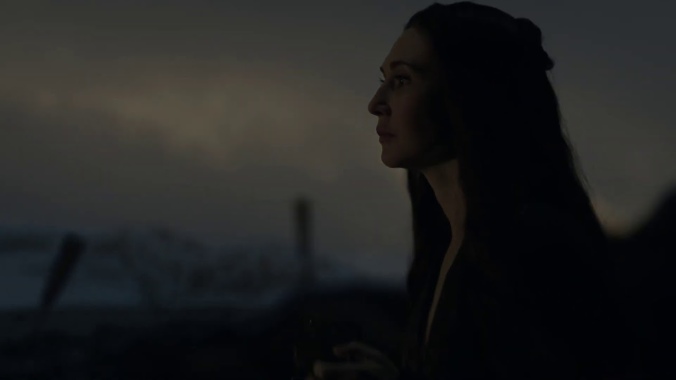
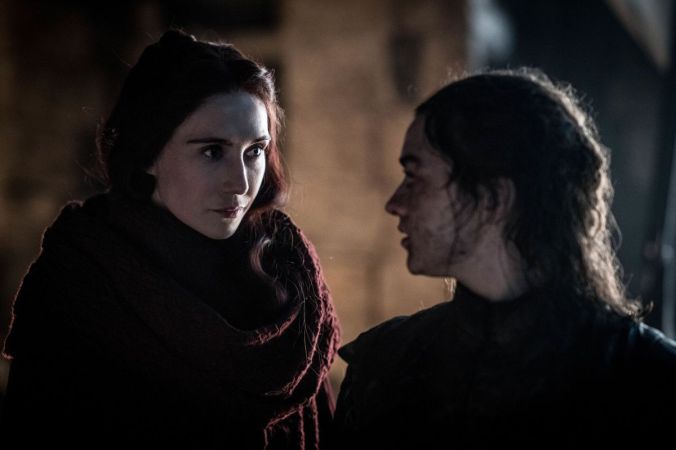
Melisandre’s death is a beautiful scene, but Carice Van Houten’s performance on the witch’s last stance at the pit is so very powerful! What an actress! The way her face changes as the dead approach is a tribute to acting.

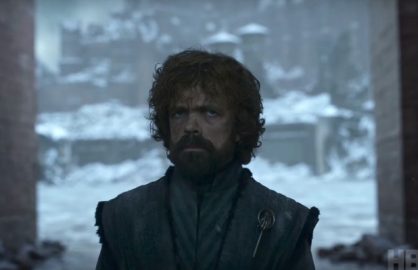
game-of-thrones-series-finale-preview-tyrion-video-418x270Peter Dinklage is an incredible actor and the goodbye scene of Tyrion with his brother Jamie is breathtaking. Extremely well written it is a pearl of Dinklage’s performance. I doubt this goodbye could ever be a better one.



Arya escaping the catastrophe of King’s Landing is perfectly well made. I was almost out of breath when I followed her through the dust and fire, as she helped people among the fallen buildings and finished up as a lonely survival – finding an equally lonely horse in the rubble. Very well done!

arya-game-of-thrones-season-8-1558127728.jpg

The fight of the Cleganes was wonderful. Very well staged and Rory McCann, playing The Hound, is an excellent actor.

Dinklage shows his skills again in both his last meeting with Jon Snow and Tyrion’s speech at the gathering of the lords. He is a monster.

Screen_Shot_2019_05_20_at_5.06.51_PM.0

The scene of Daenerys death is painfully beautiful. It couldn’t have been better, in my view. Both Drogon and Jon Snow’s pain is impressively real and powerful. It was the last breath of the Targaryen and a deserved one as well.

Jon-Snow-Kit-Harington_510.0.0

I very much liked the final montage and the final scenes of the series. It is a tribute to the talent behind this series that they were so beautiful. We will miss this fantastic journey. I hope that you, the ones that felt heartbroken and cheated by this last season, are able to go back to these episodes with fresh eyes and see the beauty that they offer.

And now for the final disappointment: GoT was an event. It’s over. It’s time for the rest of our lives. Some other genius will come… and we’ll lose our minds once more. But not today. See you around the next campfire, fellow warriors.


The Dangers of Religious Thinking

dune_hc-p_2019So, as we travel through the wrinkles of time towards the upcoming release of Villeneuve’s DUNE in November 2020, I get to wonder once more about the importance of Religion. As I’ve said here, I believe that the essence of Metaphysics, Religion, and Spirituality is basically aesthetic. There is little logical argument to assert that God exists or that God does not exist. And Science is very far from any definitive answer on the nature of the Universe. Religion and Spirituality deal with the way we ‘feel’ about Existence – it is actually in tune with how we connect with the Universe and how we find it… beautiful. How it ‘clicks’ to us. Is there a God? Some people find it impossible to think there is not, others find it naïve or fantasist to think there is. That comes from a sense of beauty, not logical reasoning. So it’s impossible to discuss and discussion, trying to convince one another of this or that kind of religious belief, seems to me, overall, not only empty but even dangerous.
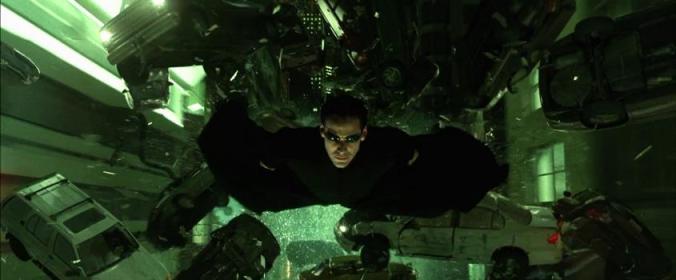
This said, Frank Herbert’s DUNE is one of my favorite SciFi books, maybe even my absolute favorite, and it has an ingenious and sophisticated way to approach Religion. Like in many other stories, from Malory’s LE MORTE D’ARTHUR (see here) to THE MATRIX TRILOGY (see here), DUNE is about a somewhat supernatural hero that becomes the focus of prophecies and bears the destiny of the species. Paul Atreides, just like King Arthur or Neo, becomes a God-like-figure, something his heirs will also incarnate. I will not speak of it here, I may in the future, in particular after November 2020.

2

Despite the fact we end up enthusiastically rooting for each of the figures I’ve mentioned above, the fact is this kind of religious worshiping and the intense, unquestioned and fanatic delegation of one’s decisions to another Human Being is incredibly dangerous and worrisome. In fact, some of the worst deeds ever done by individuals all over time and space come from this very phenomenon – from the massacres of the Aztecs to the Holocaust, to the terrorists of today and the Inquisitions of other times – many wars and atrocities were committed in the name of Religion.

Still, we need Religion. Because that basic connection with a Meaning, with the Beauty of the Universe, is not obvious nor necessarily easy. It’s all too big. The whole is too big. We seem too small. So how to comprehend it? How to manage and control our anxiety facing the whole cosmos? Thus, we need a religious sense – even if an atheist one. We need some kind of belief about this whole. There is some mystic side to life, and this is a way to own it. I don’t mean we necessarily need to belong or to integrate this or that Religion. That needs to be clear. I, for one, believe our connection with Existence to be an intimate affair. I tend not to discuss my religious belief, whatever it may be. It’s not secret or anything, but it is intimate – and my basic principle when it comes to Religion is one of freedom: there are too many people in the world trying to influence and dictate a sense of Religion to the others – I, for one, am against this dynamic. Is there a God? I refuse to discuss that subject and only a few people know what I believe about it.

This said, two other phenomena are in need of discussion: 1) the subordination of Ethics to Religion and; 2) the extreme behavior of people in crowds and in religious gatherings. I’ve spoken a little bit about 1) here.

I understand that Ethics, our idea of Right and Wrong, may easily be connected with the way we see Existence. Someone will say that we need to pray five times, or eight or ten times a day because ‘that’s the right thing to do’, ‘that’s the command’. Someone will say if we do this or that we will be rewarded by a better reincarnation. Someone will say to be good to our parents because God says so. Someone will say we need to kill the infidels. The problem with this is that Religious Thinking does not tolerate questioning, it does not tolerate resistance. If we resist, it’s because we do not have Faith, we do not believe enough. And so, if we delegate our Ethics, our sense of Right and Wrong, to Religious Thinking, we are particularly vulnerable to manipulation. A good alternative is Knowledge and Education. Education increases our options, allows for Critical Thinking, multiplies our freedom. Religious Thinking limits our options, shrinks our possibilities and does not allow questioning. Religious Thinking is not wrong per se – we just need to be careful with how we subordinate our Ethics to it.

The other phenomenon, the phenomenon of crowds, has been studied for a long time. People act in a different less-mature way when in crowds, or when belonging to large groups. The larger the crowd, the more basic will have to be the common denominator, what unites everybody. We are all different, but to become one with others, we must find what is common, and the larger the group the more primal the factor. That is why the basic IQ of a crowd is less than the one of a normal individual. It will become closer to the intelligence of a little child. And that’s how normal people can have abhorrent behaviors when in crowds, easily jumping to violence or ecstasy with little control, or being vulnerable to some leader (or ‘guide’) who is clever enough to command the moods and swings.

1984_1956-1024x585

That is why people imbued with Religious Thinking and a mystical sense of belonging in a large group are dangerous and in danger.  We must not delegate our Critical Thinking or our sense of Right and Wrong. The Universe will be here much after we will, and it is all far larger than our understanding – but our main decisions in life will define how well we’ve lived. And that is on us. Not on anybody else. And even if we are religious, we are intelligent enough not to need to impose our Religion on others, aren’t we? See you around the next campfire, fellow knights. Be free.

Coen’s ‘Hudsucker Proxy’ in Praise of Capitalism

hudsuckerproxy10

Okay, this is my last of three posts on what’s likely my favorite Coen Brother’s movie: THE HUDSUCKER PROXY, featuring Tim Robbins, Paul Newman, Jennifer Jason Leigh and Charles Durning. Even though you might feel differently after reading my other posts, I do believe this is a film made in praise of Capitalism. In fact, I also praise Capitalism. Modern Capitalism did so much to take civilization up to another level of progress – not only economic progress but also social progress. What’s most obvious at first glance is the incredible boost in material gains Capitalism brought in the last few centuries. In the last decades alone the PPP (Purchase Power Parity – what you can actually buy with your money) has increased exponentially across the globe (see OECD graph below), with particular emphasis on Asia. The ability of Capitalism to inspire progress around the world has also brought billions out from the jaws of abject poverty since the last century alone. People start believing that if they work hard and cooperate with others they can have a significant impact on the way their lives evolve.

Evolution-of-GD-P-per-capita-in-PPP-terms-across-regions-index-1960-100

Collaboration, as I have argued already here, is the key to Capitalism: we can see this in THE HUDSUCKER PROXY – as Norville Barnes comes up with the idea of a circle «You know… for kids!», the whole corporation is put into motion and many people come to make this idea into a reality: and thus the amazing ‘Hula Hoops’ is born. This storyline in the movie also shows us how Capitalism inspires innovation and makes people believe in incredible ideas that no-one else will seem to credit, allowing liberty to test them and openness for the market to accept them. With this, Capitalism also promotes the idea of Meritocracy: this thought that if you deserve it, you will succeed – if you have the merit, you have the credit; if you have the credit, you have the reward. This idea, however, seems to be far from the rule of the land. Modern Capitalism and Liberalism seemed to come hand in hand in the last few centuries, but they have been hurt and chastised in one way or the other along the way.

Income_inequality_-_share_of_income_earned_by_top_1%_1975_to_2015At the inception of Liberalism, one of the great experiments of the time was the French Revolution. Napoleon Bonaparte emerged from the chaos and two ideas emerged with him: 1) that Liberalism and Meritocracy could be used to create incredibly effective and sophisticated organizations, such as the million-strong Grande Armée; 2) that Aristocracy and aristocratic thinking were far from over. The armies of Napoleon were plagued, in the end, by the same aristocratic thinking, nepotism, and corruption that they were raised to destroy. And so was the society in general. In today’s world, wealth and power are still the ownership of an elite of public and private figures, in politics and economics, that are protected and supported by the whole system. And that is what makes for the increasing problem of inequality we see throughout the world: a small group of individuals amasses the majority of all the wealth.
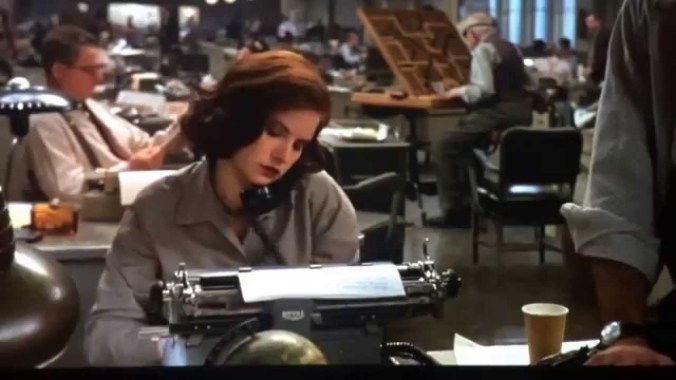
And here is, in my view, another of many of Marx’s mistakes. His focus (and shall we say Lenin’s and Mao’s as well) was on who was wielding the power and who possessed the wealth. On the other side of the Pond, the American Experiment, along with the ideas of the likes of Montesquieu, de Tocqueville, Madison and other, focused on the limits to power and on checks and balances, i.e. on freedom. And that seemed a much more effective way to go about it. In THE HUDSUCKER PROXY, Norville Barnes is raised to the top by the corrupt intent of the Board of Directors – he does not seem to merit the position of President of the Hudsucker Industries. Because of this, he came into the attention of the press, represented by Amy Archer (the talented Jennifer Jason Leigh), who aimed to unravel the whole plot. The press, the Free Press, is one of the most effective checks on the abuse of power – as de Tocqueville argued so many years ago.

maxresdefault

Truly limiting power is, in my view, a crucial foundation of a Liberal Society and Liberal Capitalism. For the focus should be on Decision Making and not on Power itself. See the example of Brazilian entrepreneur Ricardo Semmler. In trying to create a Democratic Company, where employees recruit their superiors, decide their wages and work hours, create their timetables and rules, he kept the ownership and power of leadership – but he viewed it as a one-shot pistol, for the first time he’d use his veto power he would destroy all the democratic organization he had built, all the good he had worked for. In the end, everyone is better off if the best decisions are made, and the best decision-making process we know to date is the democratic one (we’ll talk about it more some other time).

The Aristocratic Capitalism of today that we know and hate is tainted. It is elitist, unjust, corrupt, focuses on material gains of the few, promotes psychopathic and sociopathic organizations, created a narcissistic epidemic, and a rampant phenomenon of inequality, tending towards monopolistic and oligarchic economies.  A true Democratic Capitalism could be more competitive, more productive, more just, more worried with the problems and solutions of the many, would focus on the well being of individuals and organizations as well as communities, would promote empathetic, cooperative and democratic organizations. And I truly believe it is coming… because it is necessary.

One story that Ivanka Trump has told several times is the one where her father pointed towards a homeless vagrant and said to her: «That man is 7 billion richer than I am.» Donald Trump, in fact, went bankrupt several times, living off his father’s amassed wealth, destroying many lives in the process. In his view, he was poorer than a man who had nothing and owed nothing. Still, Trump was riding in limousines and helicopters, dining in the best restaurants and staying at the best hotels all around the world – and was handed one chance after the other until he became the President of the USA. I bet that the man who was richer than him couldn’t do anything of the sort. That is the face of Aristocratic Capitalism.

hudsucker-7201

THE HUDSUCKER PROXY is the story of Norville Barnes. He dared to dream of becoming a great businessman – and he did become the President of a large corporation. He climbed the ladder by the whim of an aristocrat like Sidney Mussberger – not by his own merit. But then he was driven to despair as he tried to own the part and was almost destroyed. The movie seems to speak about the importance of second chances and how we should not sink under our own failures. However, what the story really tells us about is that in a corrupt and nepotistic society, ruled by Aristocratic Capitalists, only miracles can save us in the end. And that is why we need to change it.


Coen’s ‘Hudsucker Proxy’, Protestant Ethic and Creative Destruction

0_5g8G3n5JFwKEYo-f

One interesting aspect of THE HUDSUCKER PROXY is its approach to time and the idea of second chances. As I said in the last post, this is (probably) my favorite Coen movie and it means a lot to me. The movie starts with the camera arriving at New York in the last few moments of 1958. We hear the voice of Moses (played beautifully by Bill Cobbs) narrating as if he was a Shakespearean or a Greek chorus – he is speaking of the way people are oblivious in this last few moments of the year, ‘having a good time’, maybe misunderstanding the nature of Time itself. As the camera travels through the snowy skylight of the Big Apple, we approach the Hudsucker Tower, topped by a splendid immense clock with a lighted hand counting the fatidical seconds as time runs out. Below the clock is the Hudsucker Industries motto: The Future is Now. In a moment, old ’58 will be gone and the new ’59 will begin. But before that happens, young Norville Barnes climbs out of the window of the office of the President of Hudsucker Industries. It’s his office. He has climbed the ladder to the position after the previous President, Waring Hudsucker himself, committed suicide by jumping from the top of this same building: 44 floors not counting the mezzanine. It seems the top position of this amazing corporation is not as exciting as it can be, no?

I spoke a little bit about the Nature of Time when I wrote about THE MATRIX here. I believe that, in the end, we must embrace both our limitations and our ability to choose – what matters is what we choose, our attitude, facing our finitude and our limitations. What matters is our ability to ‘make things happen’ in our lives. To ‘take in’ our time as best as we can (which is much more complex than simply ‘live every moment to the fullest’ as if there is no tomorrow – there is tomorrow and we must want it too).

hudsucker_patman_650x366Now, in THE HUDSUCKER PROXY the Coen brothers are focusing on the way Capitalism acts on the old and the new – we have the idealistic Norville Barnes against the Board of Directors headed by the ‘straight-for-the-jugular’ Sidney Mussberger. In a way, they represent the cut-throat kind of capitalism Max Weber talks about in his groundbreaking work THE PROTESTANT ETHIC AND THE SPIRIT OF CAPITALISM. He quotes Benjamin Franklin: ‘Remember, time is money.’ Weber explains how the devout protestant of the 19th and 20th century believed that it was their duty towards their lives and especially towards God that they apply themselves to their material gains. Idleness was seen as a sin. As Franklin would say: ‘He that spends a groat a day idly, spends idly above six pounds a year, which is the price for the use of one hundred pounds’. Meaning: every idle moment has a monetary cost. In this spirit, we can also follow the works of Frederick Taylor, of which Peter Drucker would write: ‘some of the most influential writings in Western Society since the Federalist Papers.’ Taylor’s Scientific Management would lead to punch-clocks, hourly wages, timetables, measured tasks, prolific production operation management, time management and other narrow productivity measures. And if we feel that is a way of thinking exclusive to Protestants, I would be curious to learn what Weber would say to nowadays work ethic of some Indians and Chinese – surely not Protestant in their majority.
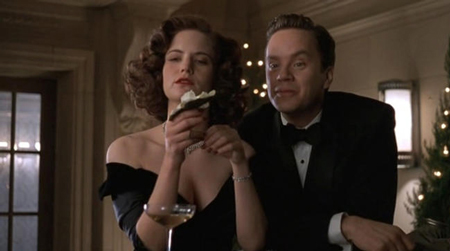
This kind of narrow-minded Capitalism, though, misses a few points. First of all, Meritocracy is not what it’s lined up to be nor is it the way of the land. Corruption and nepotism are much closer to the real way things actually happen. We can see that in THE HUDSUCKER PROXY: Norville Barnes ascends to the office of President of Hudsucker Industries not because of his merit but because of his demerit and sheer luck. Luck, as it turns out, (or the Gods, as THE HUDSUCKER PROXY seems to point out) has a lot more to do with success, studies show, than what Capitalists and Capitalistic Aristocrats want you to believe. On the other hand, a short-sighted understanding of Meritocracy does not recognize the role of so many important individuals in society. Teams and other strange groups are often much more effective in completing all kinds of tasks and the role of each member in these is not always fairly recognized. A soccer striker, for instance, may be idolized for the goals he scores, but the goalkeeper has an equally difficult and crucial task and not only earns less but also has less amount of glory.

hudsucker-proxy-lg

And then there’s Schumpeter’s Creative Destruction: it is the market itself that will choose the failure of some to give way to the success of others. ‘Out with the old, on with the new’ says someone in the movie. What THE HUDSUCKER PROXY points out, though, with impressive fairness, is the significance of second chances. A society without a safety net is a society where Fear of making mistakes reigns. And that will certainly increase the drive towards corruption and slow down innovation. In the movie, the safety net comes from the Gods themselves: as Norville Barnes falls relentlessly from the Hudsucker Tower (SPOILER ALERT) it’s Moses himself, the unsuspecting chorus, who stops the clock and gives him a second chance. The ability to fall (or fail) and rise again is inherent to a just society, and the inequality that we complain about in today’s economy may result from this feeling that only the rich and powerful have second chances, no-one else.

4123cIn the end, it’s important to understand that work cannot and should not be the sole and major focus of our lives. That is also what Norville seems to learn at the end. Being the President of the Hudsucker Industries is only of value if the rest of his life, in particular his personal life, is also satisfying. Idleness, feelings, empathy, being able to enjoy the Universe, are also important factors in a healthy society.
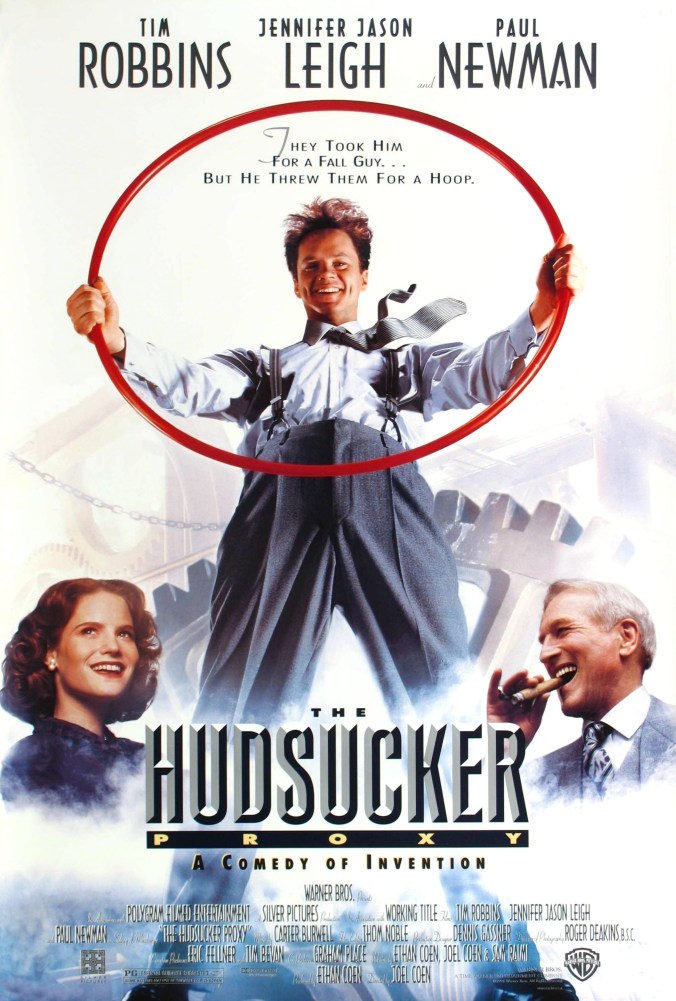
Let’s speak more of this in the future. The future is not necessarily now. Sometimes now should be simply now. Take it in. And paraphrasing Kipling: take victories and failures as the impostors they are.

Coen’s ‘Hudsucker Proxy’ and Capitalistic Aristocracy

Sorry for skipping last week’s post. As I told you, I was in bed with the flu. That’s the bad news. The good news is that GOT is back! But I won’t be talking about that today either: that’s the bad news. But my brother came visiting from England and that’s the good news. My younger brother and I are very close in age (10 months apart) and we were flat-mates in another life so we are close and think alike about many things. But as we live so far away from each other we only meet about once a year. So it was very interesting to learn in an exciting conversation that he shares my views about some of the most controversial subjects, as the flawed usual way people speak about Capitalism and what is wrong with it. I spoke a bit about it here. At the same time, I recalled what is probably my favorite Coen Brothers’ movie: THE HUDSUCKER PROXY. It may be considered one of their minor works, but it’s one that says a lot to me. I’ll be using it to structure a few thoughts on Capitalism and this is the first part of that post.

MV5BMzNkYzI4ZTYtZjJlZC00ZTVjLTk2MDYtYWMwODA0NmFiYTIwXkEyXkFqcGdeQXVyNDk3NzU2MTQ@._V1_

So here’s the story, for those who haven’t watched it. Straight out of IMDB: When Waring Hudsucker, head of hugely successful Hudsucker Industries, commits suicide, his board of directors, led by Sidney Mussberger, comes up with a brilliant plan to make a lot of money: appoint a moron to run the company. When the stock falls low enough, Sidney and friends can buy it up for pennies on the dollar, take over the company, and restore its fortunes. They choose idealistic Norville Barnes, who just started in the mail room. Norville is whacky enough to drive any company to ruin, but soon, tough reporter Amy Archer smells a rat and begins an undercover investigation of Hudsucker Industries.

Let’s start with this: Norville Barnes, played by the brilliant Tim Robbins, is a young and naïve business-school graduate who comes to New York to make his fortune. We can see him looking for work and getting increasingly disenchanted: it seems for every interesting job opening announced there is an overwhelming sentence: ‘Experience Necessary’ or ‘Experienced’. Finally, he finds an advert in a paper (or the paper finds him – destiny and luck play a curious role in this movie) announcing a mailroom job, ‘No Experience Necessary’. It’s low pay and long hours.

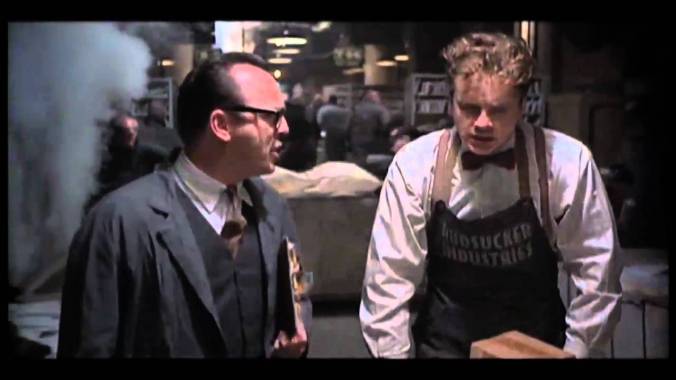
The next time we see Norville, it’s his first day at Hudsucker Industries. It’s the mailroom. The Coen/Sam Raimi script describes it perfectly: «The hellish mailroom is criss-crossed by pipes that emit HISSING jets of STEAM. As he wheels a piled-high mail cart down the aisle, Norville is accompanied by an orientation AGENT who bellows at him over the clamor and roar of many men laboring in the bowels of a great corporation.»

maxresdefault

The Orientation Agent screams at Norville as he gets flooded by other characters’ shouts, information, and responsibilities. The Agent shouts things like: «You punch in at 8:30 every morning except you punch in at 7:30 following a business holiday unless it’s a Monday and then you punch in at eight o’clock! You punch in at 7:45 whenever we work extended day and you punch out at the regular time unless you’ve worked through lunch. Punch in late and they dock ya!»

It is obviously impossible to follow everything Norville is supposed to do and all that he can do wrong. But he seems too enthusiastic to care. He is ambitious. He has plans. He has a design hidden in his shoe, a perfect circle he shows to his colleague proudly, explaining: «You know… For kids!» Norville’s colleague, sorting the mail, has been there for a long time: 48 years. «… Next year they move me up to parcels… If I’m lucky.» He says, not stopping his work. When Norville doesn’t know how to sort an envelope too big for its slot, the old sorter has the solution: «Well… if ya fold ’em, they fire ya… … I usually throw ’em out.»

MV5BOTA2MjhkOTUtZjVhZi00MjczLWJmMmQtNjRiNzU4MzdkODUyXkEyXkFqcGdeQXVyMjUyNDk2ODc@._V1_

But suddenly, an alarm sounds and the whole mailroom stops. Someone comes carrying a special delivery. It’s a Blue Letter. «It’s a blue letter… top, top level… confidential communication between the brass… usually bad news… they hate blue letters upstairs… Hate ’em!» Everybody is terrified of the Blue Letter. Of course, it’s Norville who’s chosen to carry it. He goes up to Vice-President Sidney Mussberger’s corner office. Mussberger is played by the wonderful Paul Newman. Norville’s delivery of the Blue Letter is a terrible disaster – but luckily for him, Mussberger is looking for the perfect clown, a patsy, a proxy, to assume the reigns as the CEO of Hudsucker Industries – and that is how Norville gets the job, he simply seems the worst person for it and that’s what Mussberger wants.

Now let me stop right here and think a little bit about all this.

As I said someplace else, I believe that we are slowly arriving at a political setting where we can assume satisfaction for macroeconomic and macropolitical decisions and solutions. In certain parts of the world, arguably the most center-leaning political countries as the Nordic in Europe, or New-Zealand, we are well off to an overall attitude that actually achieves social, political and economic progress in a satisfactory way. What we seem to miss is that this overall macroeconomic and macropolitical setting is systematically undermined almost everywhere by the remnants of an old foe: the aristocratic thinking that is still pervasive and corrosive within public and private organizations alike, the corruption dominating the microeconomic tissue everywhere.

lead_720_405

This first few minutes of THE HUDSUCKER PROXY show us a bit of this thinking.

  • Only aristocrats get easy opportunities: Even though Norville has a higher education, he’s nobody. He didn’t go to the right schools, didn’t know the right people, he is little people. And as such, his only possibility is to be fed to the machine through the bottom, the mailroom. Show me a country where this does not happen. Corruption and nepotism are widespread.
  • Lower employees are mistreated: lower employees are not treated as people. This happens all over the world in all kinds of organizations. People are humiliated and abused in their workplaces in a way that you don’t see almost anywhere else in present society. People fear being fired almost as much as they fear divorce or death and disease. There are actually fairly widespread phenomena of work-related suicides and work-related murders. It’s insane! And yet, we accept this status quo as if there was something wrong with the people and not with the system or the organizations.
  • The systems are so blind they are systematically boycotted: Not knowing what to do with an oversized envelope, the experienced employee will… lose it. He knows he can get fired for such a little thing, so he creates a rule to survive the absurdity of the system. And so, following the aristocratic arrogance of the Ancien Régime, the organizational aristocratic systems of today are flawed because they are blind.
  • They are cultures of fear: lower employees fear their superiors, who in turn fear their superiors, who in turn fear the response of the masses. It’s almost like we are in the tyrannies of the past! Rules are enforced with carrots and whips as if we were rats in mazes. In the 18th century’s aristocratic environment, this didn’t end particularly well, and it won’t end well today.
  • They are whimsical systems: if a high capitalistic aristocrat as Sidney Mossberger wants to install a patsy on the top of the corporation, he can. Why? Because he can do almost all he wants. He will be able to break the law, to destroy lives, to crush the environment, to be unethical and psychopathic – the system will protect him. We’ve seen this recently, with the 2008 crisis, with Donald Trump, with Exxon and BP, with all kinds of high aristocrats all over the world. They can do whatever they want – they will not be destroyed. The companies can be destroyed, employees be fired, people will lose their homes and their savings, small companies will be crushed. But aristocrats survive. And strive. Meritocracy, my friends, is a dream.

This doesn’t have to be this way. There are companies that don’t work in this manner – that incorporate democracy in their fabric and are extremely successful. But they are a minority. We have been blaming Capitalism for all the wrongdoing in the world, for all the inequality and all the misery. And it’s difficult to fight Capitalism because at the same time it brought so much good, it pulled so many from poverty and gave us so much over the years. What we are missing is that it’s not Capitalism itself that’s corrupt or corruptive. It’s Capitalistic Aristocracy. It’s the way organizations function and the way they incorporate the flaws of other centuries to favor certain individuals. We should not, we cannot, accept this. Let’s keep talking about it.

7 ‘World of Hans Zimmer’ Moments

Well… What a show! So, this past Wednesday I was picked up by a couple of friends and taken in awe to one of the finest showrooms in Lisbon, Portugal, the Altice Arena, to watch this amazing concert of Hans Zimmer music. It was in-cre-di-ble! As you might know already, I’m a sucker for movie soundtracks and scores. I wrote something about it here. And Hans Zimmer is one of my favorite composers, of course – he’s a superstar of movie music, the Spielberg of soundtracks.

7_The-World-of-Hans-Zimmer_Berlin_Symphonieorchester-des-Bolchoi-Staatstheaters-Belarus_Foto_Frank-Embacher

So on April 3, after a rush dinner, I entered this hall at the shore of the Tagus River where about 10,000 people (or more) were waiting for the music of the master to pour into their souls. Portugal is a small provincial country stuck at the end of Europe – I had no idea there were so many nerds like me, fanatical about Zimmer, eager to drool over his music played by a talented orchestra and a few superb soloists. But there they were. Thousands of them. And here I am, a few days later, ready to describe 7 moments of that night that made me shiver.

  1. The Opening: DARK KNIGHT + KING ARTHUR: I made a bet with a friend before the show that the DARK KNIGHT score would be the first music to be played and GLADIATOR the last. I actually won the first part of the bet. The thumping DARK KNIGHT drums put us at the edge of our seats right at the onset as I scrambled to my phone to WhatsApp what was going on to any heathen out there that didn’t know where I was. To some, DARK KNIGHT is the best of Nolan’s movies – not to me. But the score is something else indeed. the-dark-knight-rises-movie-2012-wallpaper-1920x1080-945x532And after a few minutes, we started hearing an exotic flute: what was this? GLADIATOR? THE LAST SAMURAI? No, it was KING ARTHUR – that mediocre Fuqua movie with Clive Owen but with a great score. Great combo!
  2. Some introductions followed and then a video with Zimmer sitting comfortably in his home in America and talking to us. He was talking to Ron Howard as well. Howard is a good director – one I respect – he made many good movies and a few great ones as APOLLO XIII or A BRILLIANT MIND. Zimmer composed the music for a few of them and soon the score for RUSH was coming up. I didn’t particularly liked RUSH but grown fond of the music. It has one of those combinations of emotion, sadness and thundering power that Zimmer is so good at.
  3. Probably the best moment of the night came a few moments later: the DAVINCI CODE suite. What a mystic, profound moment! Joining the Symphony Orchestra of the Bolshoi Theatre, the Belarus Radio and Television Choir made a stunning performance. But it was the violin solo by Rusanda Panfili that grabbed us all by the heart.  Foto: @[100890010083913:Frank Embacher Photographie]And then, of course, it finished with the Chevaliers de Sangreal theme, the one at the end of the movie – one of the best Zimmer themes ever.
  4. There were several other themes played and several other videos. I was disappointed not to hear some of my personal favorites, as THE LAST SAMURAI or THE CROWN or the main theme to MADAGASCAR, but it’s always special to hear THE LION KING played with such passion.
  5. The GLADIATOR was not the last piece, though, but it was, of course, one of the centerpieces of the night, with the great Lisa Gerrard singing on the stage. She wasn’t particularly happy with her performance, we could tell – and granted, it wasn’t her best performance for sure – but it’s Lisa Gerrard! I didn’t give a damn! I was happy to see her there! I’m a Dead Can Dance fan and a GLADIATOR score fan. It was a great moment!  Gladiator-Movie-Field-Wheat
  6. And then, when we thought the best had come and gone, we heard an amazing performance of Time, the INCEPTION theme. As you may know, INCEPTION is my favorite Nolan movie and this theme is also one of my favorites, it just prints a spinning toy in my mind. This theme was brilliantly played and it hid a special surprise – I will not spoil it for you. When it was over the whole room was screaming and shouting and clapping and going nuts!  833065-inception-top
  7. And finally, the encore. And for that, they gave us another surprisingly impressive rendition: the PIRATES OF THE CARIBBEAN suite. POTC is not a series that I enjoy that much nor have I watched all of the movies. It’s just too comedic and absurd to me. And the score is also not one of my favorites. But the performance I saw the other night was amazing. What an orchestra! What a group of incredible musicians! Very well done indeed!

014614523_1071p3cmaelstron_907pfinal

And that was it. I couldn’t resist speaking about this experience. Maybe I’m just an old pathetic nerd who hasn’t been at a concert for too long. But what the hell… THE WORLD OF HANS ZIMMER is on tour around Europe for a few months and I definitely recommend it to all you knights out there. Go watch it. Then tell me what you think. Cheers.

Another Launch: A Batalha da Escuridão

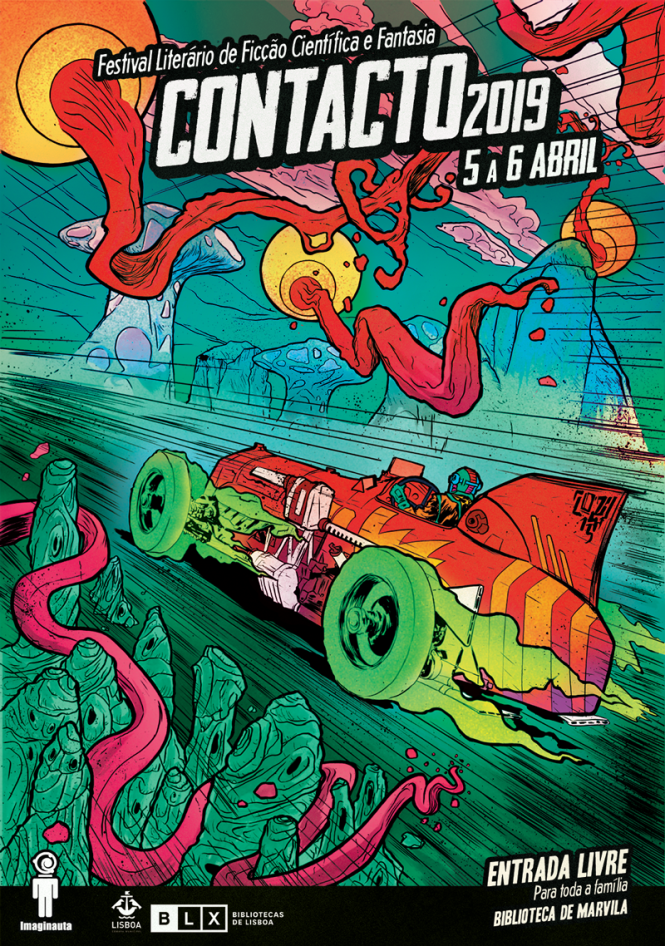
Next Friday at the Contacto Festival going on on the 5th and 6th of April in Marvila’s Library in Lisbon, I’ll be launching the Portuguese version of the DARK SEA WAR CHRONICLES, called A BATALHA DA ESCURIDÃO, by the hand of publisher Editorial Divergência. It’s an omnibus, comprising the three volumes of the saga in a 442-page volume. It has a few differences from the English version, courtesy of hard work with editor Rui Bastos – making it a better book. If you’re into Portuguese, you can pick up your pre-sale copy here.

batalha_escuridao

The Festival will be an interesting SF/F literature event, with all kinds of stuff going on. Take a look here.  I’ll talk to you about it next week.

04_projecto_lettering_ricardoreisillustration.png

Come and meet me, even if you don’t know me personally. I promise I won’t bite! I’ll be there for the launch on Friday from 7 pm to 8 pm, and for a round table on Saturday from 2 pm to 4 pm, more or less. See you there!

‘Hereditary’, Tropes, Clichés, Complications and A Creative Process

Recently I watched Ari Aster’s HEREDITARY horror movie. It’s a movie full of tropes: everything in there is something you’d expect and things you’ve seen in different horror movies all your life. Still, the film feels quite new and really different.

Screen-Shot-2018-03-13-at-10.11.03-PMThe other day somebody asked on Facebook the difference between clichés and tropes. It seemed obvious to me, but I had to think hard about it. A ‘trope’ is something familiar: like elves in a fantasy story, or the seductive vampire, or the quick-draw in westerns, etc. A trope is something people look for. In contrast, a cliché is something well… old. Something we’ve seen over and over and we probably are tired of. Like the perfect elf, or the ‘good-looking-good-boy’ vampire, or the ‘fastest gun in the West’, etc. A trope is something you can use and still have something fresh. A cliché is something stale that will not be interesting unless it is twisted and perverted – maybe we can use it here or there but at our own risk. If HEREDITARY uses clichés I didn’t notice them because the movie felt fresh: it surprised me, really. I really recommend it.

It also made me think about something else. We shouldn’t be complacent with our writing. Really. I see it all the time: people trying to write something in this or that genre and use a few tropes and in fact just ending up with a bunch of clichés. They make it too simple. And so it becomes uninteresting. People are drawn to what’s familiar, but also to what’s different. They want to learn something new, to be surprised. And so the unexpected is a writer’s friend. If it does not crush the hopes and expectations of the reader it is our friend, as contradictory as this may seem.

The unexpected happens all the time in life: we forget the keys, we run into a long lost friend, we drop the coffee cup on our lap, we trip on a dog. And so this could also happen in fiction. I would argue it should happen in fiction. It is our right and perhaps our duty to make things more difficult for our characters: because life is not simple. Here’s an example I sometimes use when I’m teaching: a man runs into a burning building to save the woman he will love. But if it is that simple, it’s boring. How many times have we seen the romance between a damsel in distress and the white knight that comes to save her? So make it more complicated: he comes to a door and it’s closed, he tries to smash it in and cannot do it; he goes back and sees a staircase, as he climbs it, the steps start to crumble, so he grabs the floor above and pulls himself up, but now the flames and the smoke push him into an empty room. He can’t see anything, maybe there’s no way out, but then he sees a cat slipping through a crack in the wall, and he goes into another room but then… Through the window he sees the woman he was going to save jumping down, killing herself: he was too late. Only later, when he meets the woman’s sister and she thanks him for his courage, will he fall in love. My point is: make it complicated. Complicated is the realm of fiction.

But complicated is not enough: it should also be creative. Our solutions must be different. We must not be complacent: if the situations and the characters are not different enough, we must change them, upgrade them. And this is, in my opinion where we must invest much of our energy. And, in many cases, this is what leads to Writer’s Block – being unable to be different enough. If you want to know more about the nature of Writer’s Block, I spoke about it here.

transferir

Now, when sometimes I need to spawn better and more interesting solutions I often do it through a particular creative process I picked up from 1940’s advertising agencies. First, though, let me speak to you about two kinds of thinking we have. Divergent thinking looks for many different solutions to a problem, as many as it can; Convergent thinking, however, looks for the right solution, the best solution. So if I ask you how many routes can I take from Lisbon to Madrid, you will use your divergent thinking and look for several routes. If, however, I ask you what’s the best route from Lisbon to Madrid, you’d look for the best route using convergent thinking. A Creative solution comes from a combination of both kinds of thinking. But if you look for the right solution, the best solution, when you should be looking for the most diverse solutions, you will most likely get blocked.

So this creative process I use goes through 5 different steps in order:

  1. RESEARCH – Go fetch. You need as much data and information you can about the Theme, Scenario, Era, Characters, etc. You need to feed your mind.
  2. FIND DIFFERENT SOLUTIONS – Let your mind go free. Go run, go to the beach, sleep, play, swim and… most of all, list the different solutions that come to mind about the situation you’re writing.
  3. FIND THE RIGHT SOLUTION – Pick the most interesting solution of all to the particular problem. Choose an idea.
  4. WRITE – Write the scene, go through the motions, put your character through the pain.
  5. REVIEW – Review, re-write, get an Alpha-reader to look at it if you find it necessary. If it’s not good enough, if you’re not satisfied, go back to step 1.

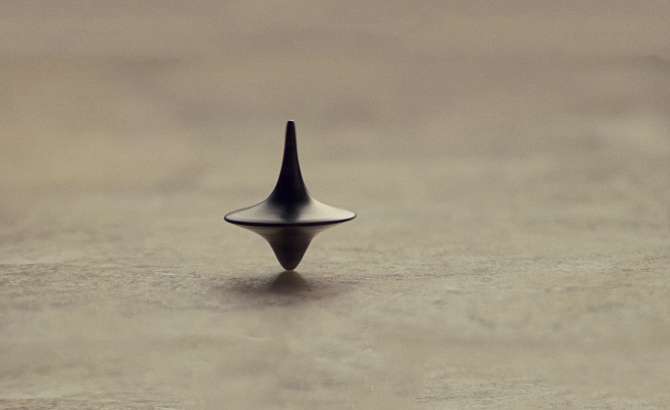
833065-inception-topI was watching my favorite Nolan movie the other day, INCEPTION, and I have to say I love the Final Image of the movie – the spinner on the table we never know if it’s going to stop or not. I just think it’s so clever! We can interpret it to death! At the same time, it’s really simple. It’s simple and complicated at the same time. And the image is cut at the absolute right moment. Sometimes, a single solution can change our take on the whole story altogether. But for that, we must not be complacent. We must not stop until we are fully satisfied with the solutions we use.

And that’s all I had for you this week. Hope it’s useful. See you around the next campfire, fellow knights.