Some people still do believe that all you have to do to write proper fiction is to sit in front of your computer and start typing. You know that old Hemingway quote: ‘All you have to do is sit in front of your typewriter and bleed’? Well, I love that quote, but it makes it well easier than it is. Much of my writing is done away from any writing device. It’s done in bed, sometimes when I wake up in the middle of the night, or in the shower, or as I drive, or as I walk on the beach or take a cup of coffee. Because even after you outlined the shit out of your narrative, even though you know your characters by heart and you are absolutely certain what needs to come next, you still need to lay down the scene. You still need to figure out what’s happening in a scene, the details, the breathing of the scene. Most of the time I won’t be able to start writing before I know exactly how the scene will play out. This is what I’ll be speaking about today.
 Brian De Palma is not one of my favorite directors. He directed a few good movies but there is always a thing or two that will bother me in them. In particular, I think he tries hard to do the same things that Hitchcock did and the old master was way better than he ever will be. Still, THE UNTOUCHABLES is a movie I already watched many times and it does not turn me away. Kevin Costner is good in it, and both Sean Connery and Robert DeNiro are superb. And it has a good script. Tonight I saw it again and it made me want to write about a particular scene. They say a good movie always has a Watercooler Moment, that moment you will be talking about the next day with your co-workers by the watercooler on the coffee break. In THE UNTOUCHABLES it is definitely the 9-minute-long Train Station Shootout Scene. You can watch it here.
First of all, the basics. A good scene should have the same structure as the story itself, meaning: Act One – the beginning; Act Two – the development; Act Three – the conclusion. And if it is really a good scene, it will have a build up and a pay off, where the tension is increased until it releases. I spoke of these concepts here.
So let’s look at the scene. Eliot Ness (Kevin Costner) and his man George Stone (Andy Garcia), are going to capture Al Capone’s bookkeeper as he boards a train at 12:05. Both men are well armed as they enter the train station. Ness will be guarding the main entrance while Stone goes across the hall to guard the South entrance. The writer knows this will be the most important confrontation in the movie – if the lawmen can capture the bookkeeper and make him testify, Capone will go to jail. The outline will say something like: ‘Ness and Stone go to the Train Station and capture the bookkeeper.’ But now the writer must make the scene memorable. It must be a shootout that will put the people on the edge of their seats. So he decides Eliot Ness’s position – the hero will be at the top of the staircase, overlooking as much of the train station as he can. As soon as Ness is in that position, the scene will play out from his POV: the camera gives you that effect, but it could be done with words.

Now, should the enemy gunmen just come in and everybody shoot? Not good enough. Let’s do Act One, let’s build up the tension. Ness sees Stone crossing the train station – he will be too far away to be of sudden help, we gather. There are two janitors cleaning the floor, minding their businesses. What are they talking about? What kind of foul stain are they cleaning on their knees? The clock shows the time: 11:56. A baby cries downstairs. Ness looks down. A lady comes pushing a baby cart with a crying baby towards the steps. She also carries two heavy suitcases. She puts the suitcases down so she can calm the baby down. Through this, we are waiting, just like Eliot Ness is. We are feeling the tension rising as he is.
The loudspeaker warns passengers to board the train. The baby is still crying as the woman is having trouble calming him down. The main doors open. Who is coming? A couple with their suitcases. They go downstairs and around the baby cart, moving away. Nothing here is important, seemingly. There are no plot-points, nothing major going on. But every detail is important notwithstanding. The way the doors open and we don’t know who will enter. The way the loudspeaker urges people towards the train – we know the time is running out. The fact that the mother and the baby are in a dangerous place without knowing, without having a chance to escape… All of this is well thought and plays a part in the building up.
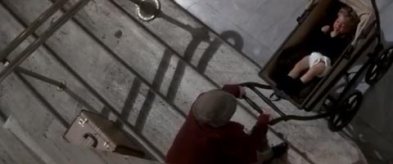 Then Ness takes notice of a well-dressed man stopping by a pillar. By Ness’s reaction, he must be a gangster. Is he? Slowly, the lady turns the cart around and starts pulling it up the stairs. She puts one suitcase on a step behind her, and then the other, and then she pulls the cart one step. Then she begins again: one case, then another, then pulling the cart one more step. Ness is becoming more and more nervous. More people come in, the clock keeps moving, the main doors open, the speaker warns. A woman comes downstairs and kisses the man by the pillar and they go away. He wasn’t a gangster after all. Finally, a plot-point: Ness decides he must do something about the woman and the child and he abandons his position to help them. As he starts pulling the cart up, the first gangsters arrive. And the Second Act begins. The whole First Act served the essential purpose: it raised the tension.
The Second Act begins as one after the other, several gangsters come into the station and go down the stairs. Ness just wants to drag the baby cart to safety but he knows everything is about to happen. He starts pulling it more urgently. But as he is on the final steps another gangster comes in and recognizes him. And the shootout begins. As he shoots the first gunman, he inadvertently pushes the baby cart and it slides down the steps.
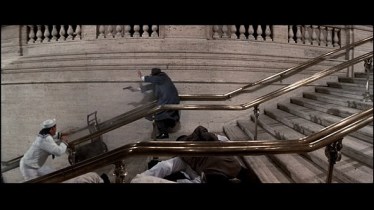 And suddenly Ness has two conflicting purposes: he must shoot the bad guys to survive and he must get hold of the baby cart before it crashes on the bottom of the stairs. De Palma shoots all this in slow-motion or the whole thing wouldn’t work, there are too many moving parts. But it works: bad guys and bystanders die, and at the last moment Stone comes running from the other end of the station and is able to catch the baby cart before it crashes. Break into the Third Act.
In the Third Act of the scene, there’s a hostage situation. The last gangster holds the bookkeeper at gunpoint and threatens to kill him. The bookkeeper, on the other hand, promises to spill all the beans as long as the lawmen save him. Maintaining his coolness, Ness orders Stone to take the shot and it’s perfect.
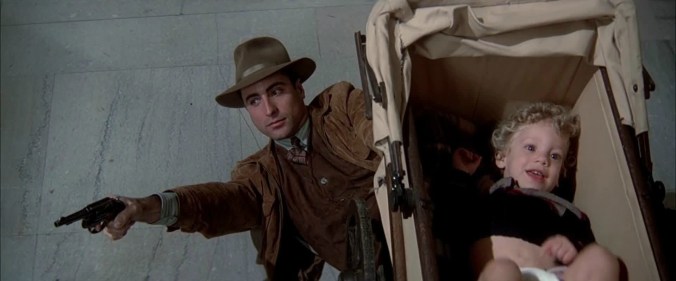
The Second and Third Acts of this scene might be evident and you would not be surprised to find something similar in a normal action movie. But what makes this such a great action scene is the First Act. The set-up. De Palma confessed he took inspiration for the baby cart from this scene of Eisenstein’s BATTLESHIP POTEMKIN. Was it necessary? Was the baby cart important for the overall story? No. But it was important for the story of this scene. It raised the stakes. It made it different. It created tension.
Can you manage the tension and the energy of your scenes like this? Can you make complex but structured scenes? I try to do it all the time and I’m always excited when it works. Until next time, fellow knights.
 So, in the beginning, we are taught conformity. Even though as babies and children we feel we are the center of the world, we are taught since the get-go that we need to conform to norms and other people. And it’s important that we learn the lesson, otherwise we will be unable to relate with other people and even ourselves, as we face the frustration of reality. Conformity to norms enables us to live with others and thrive. Remember, it seems the Neanderthals had a bigger brain and were stronger than Homo Sapiens, but our species knew how to work together and face the challenges of the elements by socializing. However, if conformity goes unchecked, we become submissive slaves, unable to make our own minds about what surrounds us, maybe hiding our more honest opinions deep inside ourselves so not to offend the Other or from fear of retaliation. Still, submissive slaves are de pillars of what Arendt calls: ‘the banality of Evil’. People who will do anything the System will ask of them without much question allow the most catastrophic wrong-doing to happen. They even support this wrong-doing, as we have seen in Nazi Germany.
 To overcome the entrapment of conformity, we can rebel and break the rules, even becoming radicals. Well, I do believe that this rebellion is very much necessary and enables us to innovate and become better as individuals and as a society. But breaking the rules and rebelling is nothing more than allowing the ‘wild’ to return within ourselves. It’s releasing our inner Neanderthal. But a sustainable System, needing balance, is usually able to counter this rebellion: madhouses and prisons and medications are made for that. I also do not believe that our most wild ‘self’ is our ‘real’ self, as some would argue. Breaking the rules for the sake of breaking the rules brings us nothing but violence and extreme behavior. It’s just another way of conformity, another way of being a slave. Just think of some of the things we are ‘supposed’ to do: in Universities, we are supposed to ‘experiment’, we are supposed to ‘try drugs’, we are supposed to ‘get drunk in parties’ ‘get wild at Spring Break’, etc. Are really all those things ‘breaking the rules’ or just another form of conformity? And how about cops and lawyers that aren’t supposed to ‘snitch’ on each other? Or CEO’s that should be allowed ‘to bend the laws’ to save the bottom line? Or flat-earthers? Or ‘jihadists’? Aren’t all these people another kind of ‘slaves’ to the System, in some kind of illusion of liberty for being ‘radicals’ and ‘rebels’?
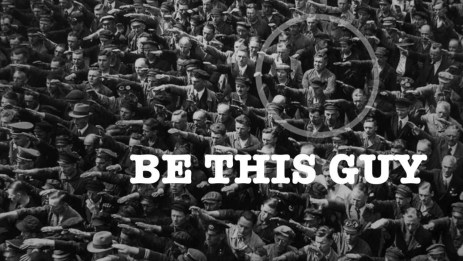 How can we counter this? We can counter this by becoming Thinking People. People who can make complex and intelligent choices. And then, we must become engaged people. We must count in a political world. We must be heard. And it will become uncomfortable for us, and it will become unpleasant. But if we are engaged we can change things, and we can prevent something horrible or disastrous to happen – just by being engaged along with many others we engage and inspire. Our opinions matter.
 I remember when I was 15 or 16 I went to watch ROCKY IV with my brother at a theater and that moment in the end when Rocky finally was able to punch the seemingly invincible Drago and draw blood the whole theater went wild and jumped in their seats. Also, every time I watch Zwick’s GLORY I cry at the end when the whole Regiment is slaughtered. This is Catharsis – this emotional jolt you get from stories. And that’s the treasure we promised our audience. To get it we have to invest and carefully build-up our characters so people care about the final situation. But it’s the final Act that will deliver the blow.

 There are a few things about writing that are a mystery to pretty much everyone who never tried it. There are a few phenomena, in my experience, that happen to many or even most fiction writers that seem wild and almost crazy for someone on the outside. Something like Writer’s Block is commonly known and widely discussed. But there are other things that happen that not even writers understand, many figuring it is something that only happens to each of them. Over the years I have been meeting more and more writers and talked with many about their writing and confirmed that these kinds of phenomena are not a figment of the imagination. So today I’d like to talk about three of these things – see if they make sense to you.
 You know that Disney short movie in FANTASIA where Mickey Mouse plays the Sorcerer’s Apprentice who tries to wield his insipient magic to complete his domestic tasks by enchanting brooms and scrubs, making them wash dishes and clean the kitchen, and then they get out of hand and the apprentice loses control and soon the whole place is flooding and plates are breaking and everything becoming chaos? Well, sometimes that happens with our writing. I’m speaking in particular about the characters and how they sometimes refuse to do what we ask them to do. Maybe the Sorcerer’s Apprentice is not the right metaphor, as in the movie this happens because of the incompetence of Mickey Mouse, and in writing it happens, I believe, in spite of or because of a high level of competence of the writer.
 Say your story is developing very well. All the plot points were at the right places and happened just as you planned, and your characters have become bigger and fuller and richer and stronger. But then you have to kill one of them. It’s imperative. Your story demands it. But as you start to write the scene where the painful departure is going to happen, you feel anguish and sorrow. As you write it, your eyes swell and you start to cry. You are still writing and it’s incredible that you can even do it as tears flow down your face. You have to stop for a few minutes to dry them until you are able to resume your writing. As you finally finish and your beloved character is dead, you feel an overwhelming sense of loss. It’s as if that character was a real person. A person that really died in your life. But how silly is that? It came from your imagination, right? It was your puppet. Why is it affecting you so much? Is this normal?
 Here’s a strange one. So you’ve been writing for a while, maybe years, on that book you really wanted to write. You are coming to its end and you have been satisfied with all that’s been done until then. But suddenly, as the end approaches, the doubts start to appear. Is it good enough? Have I made the right choices? Will anyone like the story or the characters? And the act of writing itself becomes more and more difficult. Maybe you get blocked and can’t sit down to write any word at all. Maybe you procrastinate and find any excuse not to write. Because every time you sit in front of the computer it seems the weight of the world is on your shoulders. And as you get closer and closer to the end, it all becomes harder and harder.
 Hyperjumping